
Vandaag of morgen in huis

Kwaliteit gegarandeerd

Welkomstaanbiedingen ontgrendelen: GRATIS bezorging | Tot 80% korting | Gratis 30 dagen JoyPlus-proefperiode
Download de app
A walking pad for home seems simple: unfold it, switch it on and walk. Yet after a few weeks, many buyers run into the same problems. The belt turns out to be too narrow, the machine is noisier than expected or it won’t fit under the desk. Maximum speeds and motor power are often highlighted too, even though they tell you little about day-to-day use.
This buying guide will help you compare a treadmill for home, a compact treadmill or an under-desk treadmill using specifications you can check. That way, you can choose a model to suit your space, body weight, activity goals and how often you plan to use it.
A rating such as 2.5 HP sounds impressive, but also look at the speed range, motor type and maximum user weight. An under-desk treadmill with a top speed of 6 km/h is mainly designed for walking and light exercise. If you also want to jog, you’ll need a model with a higher top speed.
Also check the difference between peak power and continuous power. Manufacturers don’t always measure or report motor power in the same way.
A stated noise level, such as 45, 50 or 60 dB, is useful for comparison, but in practice it also depends on the floor, the user’s weight, the speed and maintenance. A quiet treadmill on a hard floor may sound different from one placed on a fitness mat.
According to the relevant brands’ product information, the stated noise levels were measured under specific conditions. Treat them as a guide, rather than a guarantee of completely silent operation.
A folding treadmill or walking pad needs to fit not only when folded away. Check how much space it takes up during use too, including leaving enough clearance around the machine. Also measure the height of your sofa, bed or desk. A model that’s 10 to 12 cm high won’t necessarily fit under every piece of furniture.
For working or walking at a leisurely pace, 1 to 6 km/h is usually enough. For jogging, a top speed of 10 to 12 km/h is more practical. Also check the dimensions of the walking surface. A belt measuring around 100 × 38 or 40 cm is compact, but offers less room to move than a traditional treadmill.
Bear the following points in mind:
A model with a stated capacity of 120 kg, 130 kg or 150 kg shouldn’t be used above that limit. When comparing models, allow for clothing, shoes and any additional load. A higher weight capacity may also indicate a design intended for more intensive use, but it doesn’t replace checking the frame, belt and floor surface.
Always place a walking pad on a flat, stable floor. Before use, check that the belt is properly aligned and follow the care instructions for cleaning, lubricating and tensioning it.
A treadmill with incline can add variety without you having to walk faster. Check whether the incline is adjusted manually or electrically. Compact models often have a manual incline with stepped settings, for example from 0 to 9%.
A treadmill with an app can track speed, distance and workout data. According to the product description, some apps also offer training plans, virtual routes or interactive workouts. Check in advance that the app is compatible with your phone and whether any features require an account or are subject to additional conditions.
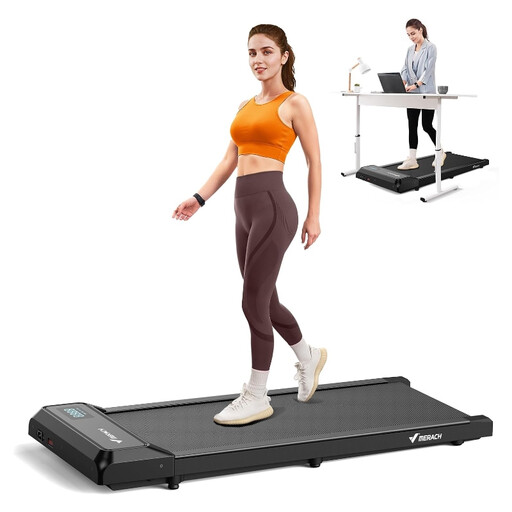
Why it suits this profile: This compact model is designed for walking and light jogging in a small home office. The remote control and no-assembly design make it easy to get started.
The product information gives dimensions of 54 × 115 × 12 cm, a top speed of 6 km/h and a weight capacity of 120 kg. This makes the key limits clear before you buy.
120 kg weight capacity, 50 dB according to the product information, MERACH app and a weight of 13 kg.
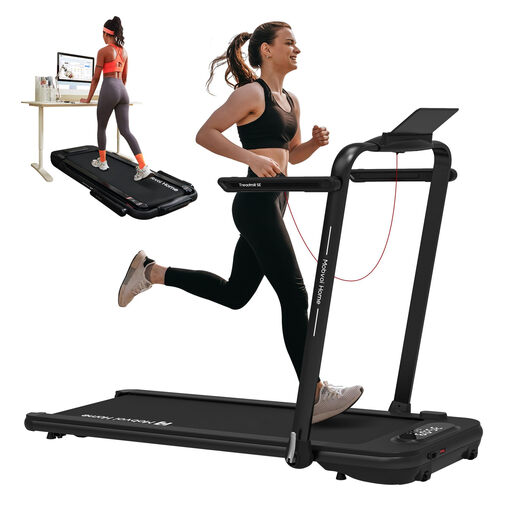
Why it suits this profile: The 3-in-1 design suits anyone looking to combine an under-desk treadmill with walking, jogging and running at home.
The different modes and speed limits are specified: 1–12 km/h for running and 1–6 km/h for walking or working. When folded, the machine is around 5 inches high.
Top speed of 12 km/h, 120 kg weight capacity, foldable design and the TicSports app, according to the product description.
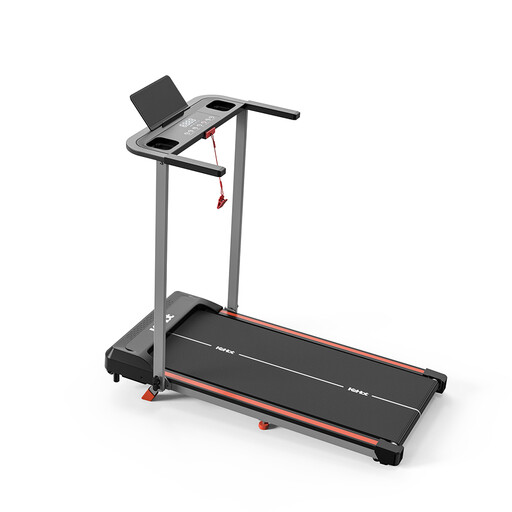
Why it suits this profile: This model is a good fit for users who want to jog as well as walk, and value incline, app connectivity and a higher weight capacity.
The specifications list the 9% manual incline, speed of 1–12 km/h and maximum load of 150 kg separately. This makes it easier to match the intended use to the machine’s construction.
150 kg weight capacity, 9% incline, top speed of 12 km/h and compatibility with EQI SPORTS, Zwift and Kinomap according to the product information.
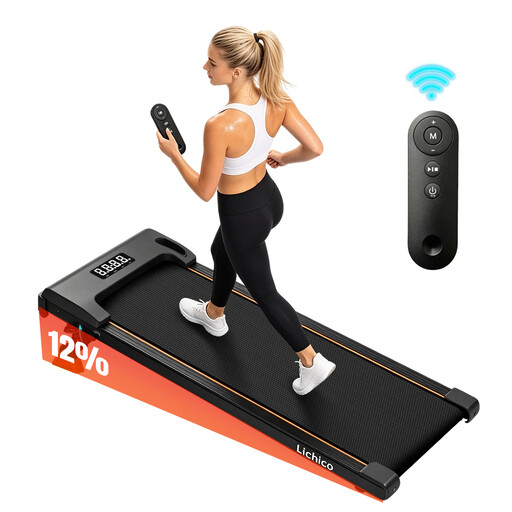
Why it suits this profile: Its low speed, compact design and stated noise level make this model a good option for walking under a desk or using in a shared living space.
The product description gives a speed range of 0.5–6 km/h, a walking surface of approximately 100 × 40 cm and a weight of around 17 kg. This gives you a clear idea of the practical limitations in advance.
130 kg weight capacity, manual incline from 0–9%, remote control and a stated noise level below 45 dB.
We’ve put together a full, up-to-date list of products that meet these strict selection criteria and current European safety regulations.
Use this quick checklist before ordering a model:
Yes, if the model has a low speed, a remote control and a suitable height. Also check that your desk is high enough to let you work in a natural position. A treadmill with a top speed of 6 km/h is usually designed for walking, not running.
Its lifespan depends on how often you use it, the user’s weight, the surface it’s on and how well it’s maintained. Clean the belt regularly, check its alignment and lubricate it as directed in the manual. Daily intensive use calls for more maintenance than a few walks each week.
Energy use depends on motor power, speed, load and how long you use it. You can work out an estimate using: power in kilowatts × hours of use × your electricity tariff. A 2.5 HP rating doesn’t automatically mean continuous electricity consumption of 2.5 HP; for a more accurate estimate, check the electrical power on the rating plate or in the manual.
