
Vandaag of morgen in huis

Kwaliteit gegarandeerd

Welkomstaanbiedingen ontgrendelen: GRATIS bezorging | Tot 80% korting | Gratis 30 dagen JoyPlus-proefperiode
Download de app
A burnt-out sidelight, a dashboard error message, or that yellowish, old-fashioned glow in your interior? Replacing your car's bulbs is a small effort with a big impact. Switching from traditional halogen bulbs to modern W5W LED lighting provides brighter visibility, a sleeker look, and lower energy consumption.
But the sheer number of options can be overwhelming. Which fitting do you need? And how do you avoid those annoying error messages? As a Joybuy Product Recommendation Officer, I'm here to guide you to the right choice. This guide will help you find the perfect W5W LED bulbs, without the technical headaches.
Before making a purchase, there are a few key points to consider. This ensures you choose the right bulbs for your specific vehicle.
Modern cars are equipped with a Canbus (Controller Area Network) system. Among other things, this system monitors whether all lights are functioning correctly. Because LED bulbs consume significantly less power than halogen bulbs, the system might think a bulb is burnt out. The result: an error message on your dashboard.
To prevent this, opt for Canbus LEDs. These bulbs have a built-in resistor that mimics the power consumption of a traditional bulb, preventing the Canbus system from detecting a fault. This ensures a 'plug-and-play' experience without any glitches.
You'll encounter various codes online: W5W LED, T10 LED, 501 LED, or 194 LED. This can be confusing, but in most cases, these codes all refer to the same type of bulb with a 10mm wide wedge base (T10). W5W was originally the designation for the 5-watt halogen version.
To be certain, always check your car's owner's manual or remove the old bulb to compare the fitting. This way, you can be sure you're ordering the correct replacement.
W5W bulbs are true all-rounders. You'll find them used as:
Pay close attention to the colour. Legal regulations apply to the exterior of the car. License plate lighting must always be white. Sidelights at the front must be white or yellow. For car interior lighting, you have complete freedom in your choice of colour.
Based on specifications and applications, we've highlighted some popular options for you.
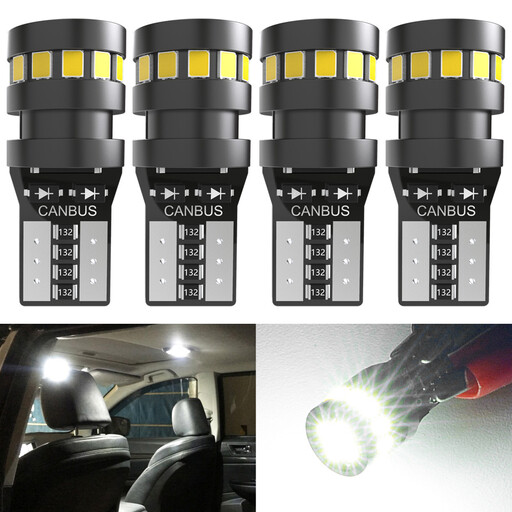
Why It Stands Out According to the manufacturer OUSHI, these bulbs are up to 300% brighter than standard halogen bulbs. The 6500K colour temperature produces a bright, xenon-white light that gives the car a fresh and modern appearance. The full aluminium body design is focused on rapid heat dissipation, which enhances longevity.
Benefits
Who Is This For? For drivers who want to upgrade their sidelight LEDs or license plate LEDs to a bright, modern white light and desire a simple, error-free installation.
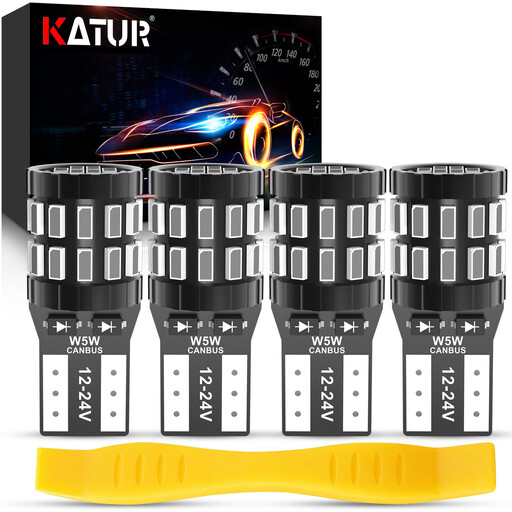
Why It Stands Out These bulbs from KATUR deliver an intense, brilliant red colour. They are equipped with 30 individual 3014 SMD LED chipsets per bulb, ensuring high light output. Another practical feature is the wide voltage range of 12-24V, making them suitable for both cars and lorries.
Benefits
Who Is This For? Perfect for those looking for red T10 LED bulbs for applications like tail lights (where legally permitted) or as striking car interior lighting to create a unique atmosphere.
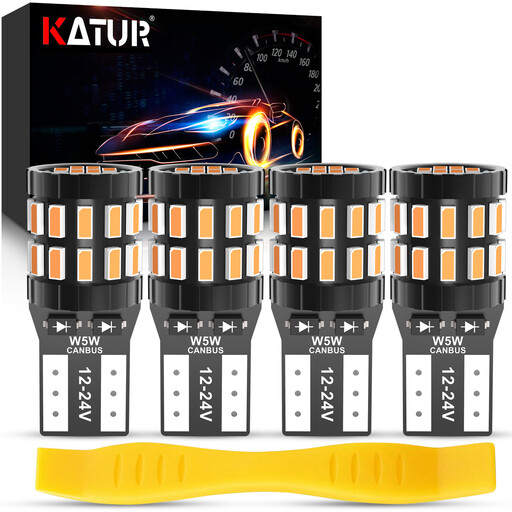
Why It Stands Out Like the red version from KATUR, this amber yellow bulb offers high light output thanks to its 30 SMD LED chipsets. The amber yellow colour is the standard for turn signals and side markers. This bulb is also designed as an error-free automotive LED bulb due to its Canbus compatibility.
Benefits
Who Is This For? An excellent choice for replacing traditional halogen turn signals or side markers with a brighter, more durable LED alternative that works right out of the box.
The world of automotive lighting is vast. Are you looking for a different colour, brightness level, or a specific application not mentioned here? Explore our full range for more options.
Discover more car lighting in the dome lights category.
In practice, these terms are often used interchangeably. Technically, T10 refers to the dimensions of the fitting (a 10mm wide glass wedge base). W5W refers to the wattage (5 watts) of the original halogen bulb with that same T10 fitting. When searching for an LED replacement, you can use either term.
This is caused by LED bulbs consuming much less power than halogen bulbs. Your car's Canbus system interprets this low consumption as a faulty bulb and issues a warning. The solution is to use Canbus LED bulbs, which have a built-in resistor to prevent this problem.
The rules are clear and focus on safety. For your car's exterior, typical regulations are:
