Who is this choice relevant to?

Presenter looking to reduce echo

You’re recording a spoken introduction and want the questions and announcements to be easy to understand. Microphone distance and the option to position a microphone closer to you are therefore important considerations. Shure explains why microphone placement matters, while Zoom and Tascam document options for built-in and external microphones.

Creator recording a quick solo introduction

You want to record a short introduction and listen back without setting up lots of equipment. Compare built-in microphones, controls and the option to connect an external microphone later. Zoom and Tascam describe options for compact recording and external microphones.

Creator recording multiple voices or wanting audible room ambience

You want to record speakers separately or retain some of the room’s atmosphere. Compare the number of inputs and recording tracks with a simple stereo recorder, and use a test recording to judge how much reverb works with the voices. Tascam, Zoom and Shure describe relevant connection and placement options.

What to consider when choosing

Compact recorder with built-in microphones

Suitable when: you’re the only speaker, can position the recorder close to you and want to keep the setup simple.

Trade-off: reflected speech may still be audible if the recorder is too far away. Also check that any external microphone you might use is compatible with the model’s input and power supply.

Recorder with separate microphone inputs

Suitable when: you want to position microphones close to several speakers or record speech separately from room sound. The Tascam DR-40XP and Zoom H4essential each have two XLR/TRS inputs as well as built-in stereo microphones.

Trade-off: this setup requires compatible microphones and cables, and you’ll need to check the power requirements. It won’t change the room’s acoustics.

Keeping the room sound deliberately

Suitable when: you want the introduction to have some reverb and the speech remains clear in a test recording. Try different distances and listen back.

Trade-off: more audible room ambience can mean less clear speech. A stereo recorder cannot guarantee intelligibility in your room.

Consideration What should you check? Who is this important for?
Speech clarity in a reverberant room Can you position the built-in microphone nearby, or is an external microphone compatible with the input and power supply? Record a test sentence in the room. When I record an introduction in a reverberant room, I want the words to be easy to understand. Around 40% of consumers are most concerned about speech clarity when there’s unwanted reverb.
Quick solo recording Check the controls, how to listen back and whether you can position the microphone where you want it. For a short solo introduction, I want to record and listen back quickly without setting up lots of equipment. Around 30% of consumers prioritise simple solo recording.
Recording multiple voices separately Count how many microphones you need to use at the same time, then check the number of inputs and tracks and the microphone power requirements. When several people are speaking, I want to be able to position or record their microphones separately. Around 20% of consumers prioritise separate microphones for multiple voices.
Retaining the room sound Make test recordings at different distances and listen to see how much reverb you can have without affecting clarity. When I want the room to be audible in the introduction, I’m looking for a balance between voice and reverb. Around 10% of consumers prioritise retaining the room sound.

Common buying mistakes

  • Buying a more expensive recorder while the microphone remains far from the speaker

    A microphone cannot effectively separate direct speech from reflected sound after recording. So switching to a different recording format won’t automatically fix the room’s reverb.

    First, try positioning the microphone close to the presenter. Then decide which recorder and connection will work with that setup.

  • Choosing an external microphone without checking the input

    Recorders can have different connections, such as a stereo mini-jack or XLR/TRS. The power requirements can also vary from one microphone setup to another.

    Before buying, compare the microphone’s plug, input and power requirements with the specifications for the exact recorder model.

  • Recording all the voices and room sound on one stereo track when you want to adjust them separately later

    A simple stereo recording offers a different setup from using separate microphone inputs and tracks.

    Decide in advance how many speakers need their own microphone at the same time, then check that the model has the inputs and recording channels you need.

Brands to compare

These brands offer different recorder setups. None of the recording features listed will remove room reverb on its own.

Zoom

The H1essential has built-in X/Y microphones and a MIC/LINE IN connection; the H4essential also has two XLR/TRS inputs.

  • Zoom lists 32-bit float recording for these models.
  • 32-bit float won’t solve room reverb, and the H1essential doesn’t have the H4essential’s two XLR/TRS inputs.

Tascam

The DR-05XP combines built-in stereo microphones with a stereo mini-jack input. The DR-40XP also has two XLR/TRS inputs.

  • Tascam lists 32-bit float for both models mentioned; of the two, the DR-40XP is suitable for use with external XLR microphones.
  • The built-in microphones on these recorders won’t solve a reverberant room on their own.

OM SYSTEM

The LS-P5 is a compact, standalone PCM recorder with built-in microphones.

  • OM SYSTEM lists three built-in microphones, 16 GB of internal memory and smartphone control. The manufacturer also specifies 24-bit/96-kHz recording.
  • These specifications don’t tell you how clear a recording will sound from a distance in your room. Check with a test recording.

Sony

The ICD-UX570 series is a voice recorder with a built-in microphone and PCM and MP3 recording.

  • Sony lists 4 GB of internal memory and USB charging.
  • These product details don’t indicate how much room reverb you’ll hear in the room you plan to use.

Philips VoiceTracer

The documented DVT4110 series has built-in omnidirectional and directional microphones, an external microphone connection, and WAV and MP3 recording.

  • The built-in microphones and external microphone connection offer different recording setup options.
  • The manual specifies 96-kHz/24-bit PCM for the DVT6110–8110, not the DVT4110.

Joybuy products

These portable voice recorders are options for capturing a spoken quiz introduction. Check separately whether you can position the microphone close enough to the speaker, and listen back to a test recording: a recorder’s features alone won’t remove room reverb.
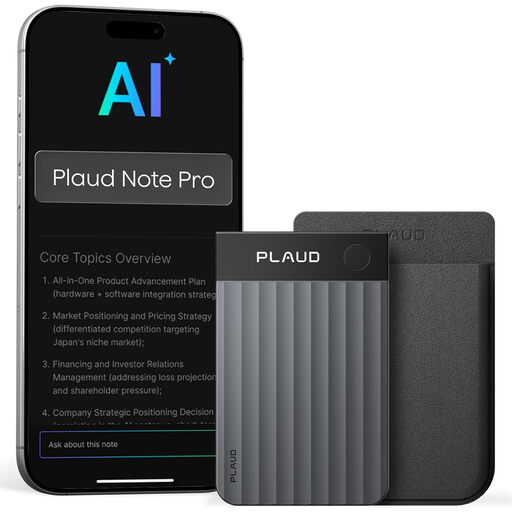
Plaud Note Pro AI voice recorder, black

Plaud Note Pro AI voice recorder (Black)

An option for recording a spoken quiz introduction. Make a test recording and listen back to check whether the voice remains clear in your room.

Joybuy

Mini AI voice recorder with 64 GB

Mini AI voice recorder 64 GB

A portable recorder option for a spoken introduction. Check that the microphone position works for the distance from the presenter.

The product title specifies 64 GB of storage.

Joybuy

Rexsun L357 digital voice recorder with 128 GB

Rexsun L357 digital voice recorder, 128GB

An option for recording a spoken introduction. Make a short test recording and check that it’s clear where you plan to record.

The product title specifies 128GB of storage.

Joybuy

Rexsun L810 digital voice recorder with 64 GB

Rexsun L810 digital voice recorder, 64GB

An option for recording a spoken introduction. Listen back to a test recording to assess the reverb and clarity in your room.

The product title specifies 64GB of storage.

Joybuy

notta AI voice recorder with 32GB and protective case

notta AI voice recorder 32GB with protective case (Black)

An option for recording a spoken quiz introduction. Use a test recording to check that the voice remains clear at your chosen microphone distance.

The product title specifies 32GB of storage and a protective case.

Joybuy

Frequently asked questions

Will 32-bit float remove the reverb from my quiz introduction?

No, 32-bit float won’t remove room reverb from a recording. Manufacturers list it as a recording feature; the balance between direct voice and reflected sound also depends on the room and microphone placement. If reverb is unwanted, move the microphone closer to the presenter and make a test recording.

What should I get ready before recording, and what should I check afterwards?

Check the power source, storage medium and microphone connection for the exact model. Make a short test recording, listen back to check that the words are clear, and save a copy of the final recording somewhere other than the recorder.

Do I need extra cover for a faulty recorder?

No, you don’t need to take out a commercial warranty to claim your statutory rights in the Netherlands. If a product is faulty despite being used normally, the seller is responsible for providing an appropriate remedy free of charge; a commercial warranty is separate from this.

Can I record quiz participants’ voices and publish the introduction?

That depends on who can be identified, the purpose and how you share the recording. According to the Dutch Data Protection Authority, identifiable audio recordings may count as personal data. An exemption for personal or household use may apply if you’re using the recording solely for personal purposes; it doesn’t apply if you share it more widely or for business. If the GDPR applies, you’ll need an appropriate legal basis. Consent is one possible legal basis, but it isn’t automatically the only one.
