
Speaker in a reverberant room
You want to record a clear news bulletin and can mainly adjust the microphone’s distance and position. Shure explains why microphone placement affects how direct speech and room reflections are captured.


To record a clear bulletin in an untreated room, the distance between the speaker and microphone matters more than the recording format: a recorder cannot remove room reverberation afterwards. A handheld recorder with built-in microphones is a good fit if you can place it securely nearby. If you want to position the microphone separately, choose a recorder with a suitable input and factor in the extra microphone and cable.
You want to record a clear news bulletin and can mainly adjust the microphone’s distance and position. Shure explains why microphone placement affects how direct speech and room reflections are captured.
You want to record, play back and transfer files straight away, without a separate microphone, and can place the handheld recorder nearby. Zoom and Tascam describe models with built-in microphones.
You want to connect a separate speech microphone or record away from your usual recording spot, and are happy to factor in extra connections and equipment. Zoom describes the inputs on the H1 XLR, while Shure provides information about the SM58.
A good fit if: you speak solo and can place the recorder securely nearby. The Zoom H1essential has built-in X/Y microphones, while the Tascam DR-05XP has built-in omnidirectional microphones.
Bear in mind: at a greater distance, the room may be more audible. These models do not have a direct XLR connection for a microphone.
A good fit if: you want to position the microphone close to your mouth, independently of where the recorder is placed. The Zoom H1 XLR has two locking XLR/TRS inputs.
Bear in mind: you’ll need a compatible microphone and connection; careful placement is no substitute for a test recording.
A good fit if: you switch between bulletins and location recordings, and built-in storage matters to you. OM SYSTEM specifies 16 GB of internal memory and adjustable microphone direction for the LS-P5.
Bear in mind: according to the manufacturer, adjusting the directionality does not remove room reverberation. The stated maximum recording quality is 24-bit/96 kHz.
| What to consider | What should you check? | Who is this most important for? |
|---|---|---|
| Clarity in a reverberant room | Can you position the built-in microphones nearby, or connect a separate microphone using a suitable input? | If I prioritise clarity over convenience, I want to be able to position the microphone close to where I speak. Around 36% of consumers put clarity first. |
| Quick solo recording | Check the controls, storage, playback options and file transfer to your editing device. | If I regularly record short bulletins on my own, I want to check my recording without a lengthy set-up. Around 29% of consumers prioritise speed. |
| Connection for a separate microphone | Check whether the input is XLR/TRS or 3.5 mm, and whether the microphone, cable and any power supply are compatible. | If I want to position the speech microphone separately or change it later, the connections are key. Around 21% of consumers make microphone expandability their top priority. |
| Recording on the move and managing files | Check the storage medium, power supply and how you can play back and find your recordings. | If I also work away from my usual recording spot, I want to manage my recordings while I’m out and about. Around 14% of consumers prioritise portability and file management. |
A recording format such as 32-bit float does not remove room reflections. Shure explains that a microphone cannot separate direct speech from unwanted reflections after recording.
Make short test recordings with the microphone in different positions before basing your choice on the recording format.
Allow time for test recordings and possibly trying a different microphone position.
The Zoom H1 XLR has XLR/TRS inputs; the external microphone inputs described for the H1essential and DR-05XP are 3.5 mm. These require different connections.
Before you buy, check that the connections and power requirements of the complete recorder, microphone and cable set-up are compatible.
Depending on your set-up, you may need a different microphone, a compatible cable or another recorder.
Storage varies by model. OM SYSTEM lists internal memory for the LS-P5, while the H1essential manual explains how to prepare a microSD card.
Before an important recording, check which storage medium you need and play back a test file.
With the H1essential, preparing a memory card may be part of your set-up.
The H1essential is a handheld recorder with built-in X/Y microphones, while the H1 XLR is designed for use with external microphones.
The DR-05XP is a portable recorder with built-in omnidirectional microphones and a 3.5 mm input for a compatible external source.
The LS-P5 combines a compact recorder with built-in memory and adjustable microphone direction.
This selection includes digital voice recorders, including models with transcription features and portable recorders for voice recordings.
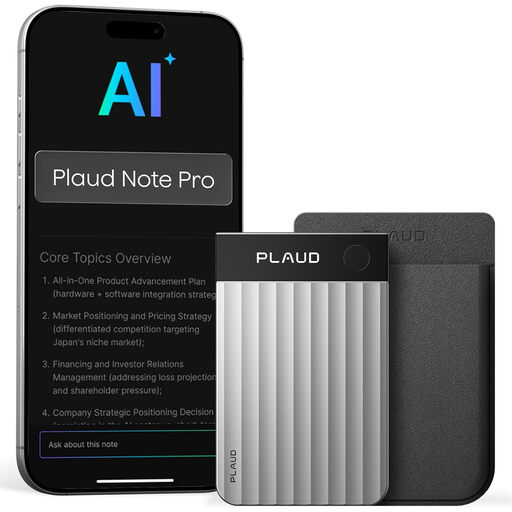 No image available
This may suit a workflow where you also want to turn a bulletin recording into text and summarise it. Check that the transcription feature supports your language and suits the way you work.
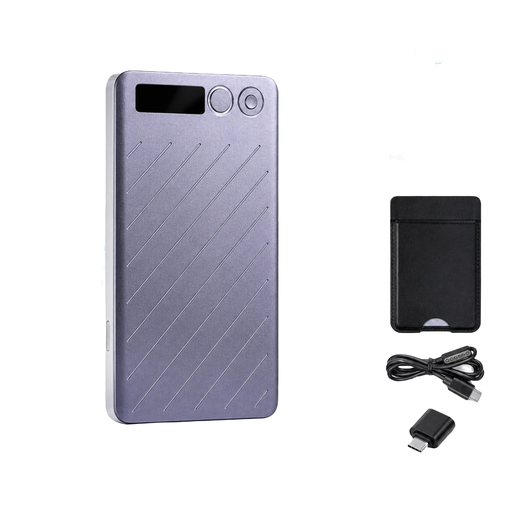 No image available
This may suit you if you also want your voice recordings transcribed. The product name specifies 64 GB and a transcription feature; check that the required software and language are right for the way you work.
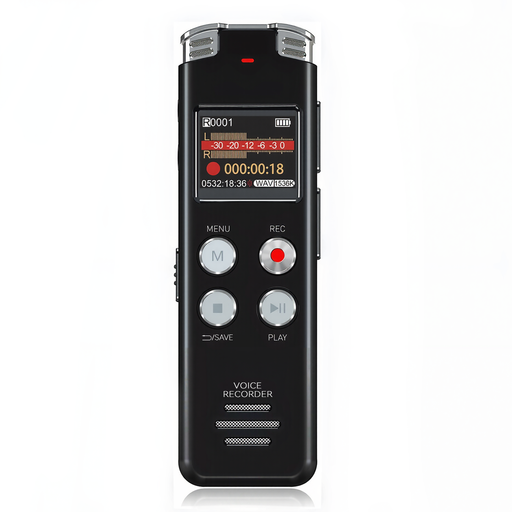 No image available
This may suit anyone looking for a portable recorder for repeatable voice recordings and playback. The product name specifies 128 GB; before recording a bulletin, check how to play back and transfer a recording.
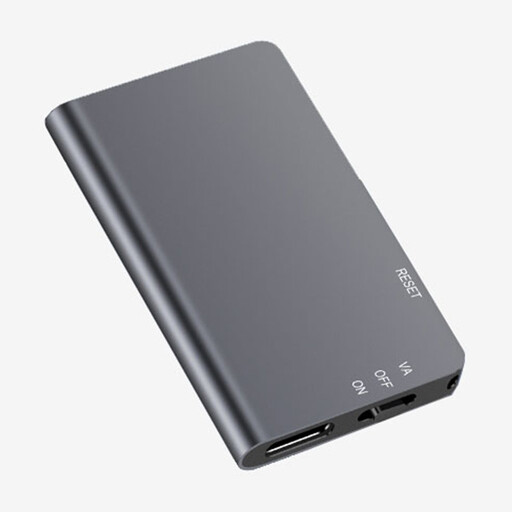 No image available
This may suit you if you want to start recording your voice easily. The product name specifies 64 GB and one-touch recording; check how to play back files and transfer them to your editing device.
No, 32-bit float does not fix room acoustics. Shure explains that a microphone cannot separate direct speech from room reflections after recording, so start with a test recording and move the microphone closer.
Place the microphone securely, record a short clip from your usual speaking position and play it back to check that the speech is clear and background noise is not distracting. Also check that the required storage medium is ready.
For a consumer purchase, the seller is responsible for providing a solution, according to the Dutch government. The legal guarantee is separate from the manufacturer’s guarantee. Many online consumer purchases come with a 14-day cooling-off period. Check whether it applies to your particular purchase.
It depends on the specific recording and publication. The Dutch Data Protection Authority describes a journalistic exemption which, where it genuinely applies, may mean that permission to use personal data is not required. The fact that something is news does not, by itself, determine whether the exemption applies.