What should you look for when buying?
First, make a test recording in the space you plan to use and assess how the room sounds. Then choose a microphone type and connection to suit your recording space and equipment.
| Priority |
What to look for when buying |
Who should give this more weight |
| Room sound and background noise |
Check the polar pattern and mounting options. Record a test script and listen to the pauses between sentences too. |
If I’m recording in an echoey room, I want to keep the microphone close and in a fixed position, and listen for reflections between sentences too. Around 36% of consumers prioritise controlling room sound. |
| Easy connection |
Check whether it’s the USB or XLR version, whether it works with your computer, and whether the set includes a cable, headphone output and stand. |
I want to record directly to a computer and monitor my voice as I speak, without having to choose a separate interface first. Around 29% of consumers prioritise an easy connection. |
| Vocal detail in a quiet space |
Listen to a recording of normal speech and pauses. For XLR, check what power is required; for USB, check which recording modes are available. |
If I can create a quiet recording space, I want to consider vocal nuance without mistaking a microphone’s self-noise for the quietness of the room. Around 21% of consumers prioritise vocal detail. |
| Recording multiple voices separately |
Count how many people will speak at once and check that your interface or mixer has enough suitable microphone inputs. |
If someone is talking alongside the narrator, I want to be able to adjust each voice separately and tailor the recording accordingly. Around 14% of consumers prioritise recording multiple voices separately. |
Joybuy products
The Joybuy products below are wireless microphone kits. Consider them as clip-on or mobile options; they’re not automatically a replacement for a fixed microphone setup for solo voice-over. Check that the receiver connects to your recording device for each version.
 No image available
DJI Mic Mini 2S (2 TX + 1 RX + charging case)
With two transmitters and one receiver, this is a set to consider if you’re recording a second voice alongside the narrator. Check that the receiver connects to your recording device.
View at Joybuy
 No image available
Hollyland Lark M2 Wireless Lavalier Microphone System
This lavalier version is an option if you’re looking for a clip-on setup. The product name states 48 kHz/24-bit, a 9 g transmitter and a quoted transmission range of 300 m. Check the connection and the conditions that apply to the stated range.
View at Joybuy
 No image available
Hollyland Lark M2 Wireless USB-C Microphone
The USB-C version is worth considering if you want to record directly with a compatible device. The product name states noise cancellation, a 300 m transmission range and 30 hours of use. Check compatibility and the conditions that apply to these figures.
View at Joybuy
 No image available
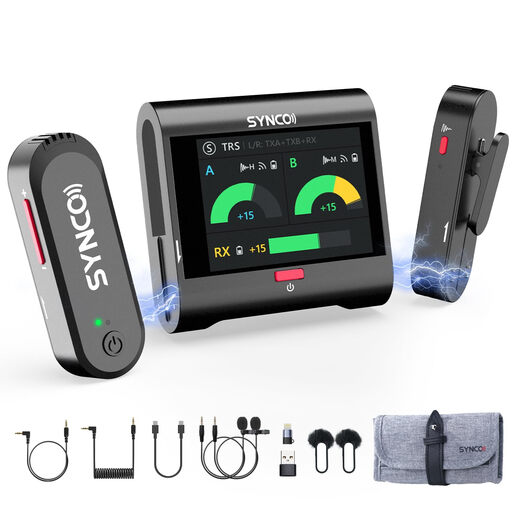
SYNCO G3PRO Wireless Lavalier Microphone System, 2.4GHz Dual Lapel Mics
The product name states that it includes two lavalier microphones. Consider this version if you want to record two speakers with a wireless set. Check how the receiver connects to your recording device and how you can monitor the recording.
View at Joybuy
 No image available
DJI Mic 3 (1 TX + 1 RX) Wireless Microphone
This set with one transmitter and one receiver is an option for recording a single narrator wirelessly. Check the connection to your recording device and whether the transmitter’s position suits your speaking style.
View at Joybuy
Frequently asked questions
Can voice isolation or noise reduction fix echo in a rehearsal room?
Not as a general solution. Shure says that the pickup pattern on models such as the MV7+ doesn’t digitally remove background noise. According to Shure, the denoiser is designed for continuous noise, not voices or sudden sounds. Record close to the microphone, position it carefully and listen to a test recording.
How should I position a dynamic microphone for voice-over?
Keep a consistent speaking distance and point the front of the microphone towards your mouth. For the PodMic USB specifically, RØDE recommends around 5–10 cm; this distance doesn’t automatically apply to other models. After recording, listen for plosive sounds and room ambience too.
Do I always need extra equipment to record with an XLR microphone on a computer?
An analogue XLR microphone needs a suitable way to convert its signal to digital computer audio, usually through an audio interface or a mixer with an interface. Check the gain too: Shure specifies an interface with at least 60 dB of gain for the SM7B. A microphone with its own USB output can connect directly via USB.
What do the legal guarantee and CE marking mean when buying in the Netherlands?
ACM ConsuWijzer explains that the legal guarantee doesn’t automatically end after two years: the product’s reasonably expected lifespan and normal use are taken into account, and the seller is your point of contact. According to the Dutch government, electronic products covered by the relevant EU rules must carry a CE marking. Check the product information for the exact version and the seller; this alone doesn’t say anything about a separate product listing.


