
Making flashcards in a quiet office
You type up card text near colleagues, so how much noise the keys make is your first consideration. Also check the keyboard layout and connection.


Start by considering how much noise the keys make and how much room you need beside the keyboard for your mouse and flashcard materials. Then check the layout, connection and any shortcut software. If colleagues work nearby, a low-profile model described by the manufacturer as having quiet keys is a sensible option. A compact or ergonomically shaped model may be a better fit if desk space or posture is your priority. Manufacturer claims aren’t comparative sound measurements, and they can’t tell you which model will feel most comfortable to type on.
You type up card text near colleagues, so how much noise the keys make is your first consideration. Also check the keyboard layout and connection.
You want to keep room beside your computer for a mouse and flashcard materials. A keyboard without a separate number pad could be an option if you don’t use one often.
You prioritise posture and hand support, and consider the keyboard shape as part of your overall workstation.
Best for: typing while colleagues are nearby.
Trade-off: a manufacturer’s claim that the keys are quiet isn’t a sound measurement you can compare directly with other models.
Best for: a desk where you want to keep room for a mouse and flashcard materials.
Trade-off: check whether you can manage without a separate number pad and the navigation and function keys you need.
Best for: those who value the shape and hand support during longer typing sessions.
Trade-off: a contoured shape or wrist rest takes up space and doesn’t guarantee health benefits.
First decide which need matters most to you: a quieter environment for colleagues, desk space, posture, repeated tasks, or a layout and connection that work straight away.
| Consideration | What to look for when buying | Who is this important to? |
|---|---|---|
| Key noise | Check the key mechanism, exact model variant and layout. Don’t treat claims about quiet keys as comparable sound measurements. | When colleagues work nearby, I want to take their peace and quiet into account while I type up card text. Around 31% of consumers put key noise first when making this choice. |
| Room for a mouse and cards | Check the dimensions and whether you need a separate number pad. | I want to keep room beside my keyboard for a mouse and flashcard materials, and I rarely use a number pad. Around 25% of consumers prioritise desk space. |
| Posture | Consider the shape and wrist rest alongside the position of your screen, chair and desk. | During longer typing sessions, I want the keyboard shape to suit my workstation setup. Around 19% of consumers put posture first. |
| Repeated tasks | Check whether the required software is allowed on your work computer and whether your design programme has tasks you repeat often. | If I use the same design commands repeatedly, I want to know whether shortcuts can help. Around 13% of consumers choose with repeated tasks in mind. |
| Layout and connection | Check the physical keyboard layout, system language and connection to your computer. | I want to type the right characters straight away and use a connection that works with my work computer. Around 12% of consumers put a suitable layout and connection first. |
Manufacturers describe some models as quiet or noise-reducing, but these descriptions aren’t measurements taken under the same conditions.
Use a quietness claim to find models you’d like to look into further, rather than assuming an absolute ranking of noise levels without comparable measurements.
The physical keys and selected input language together determine which characters appear. A mismatch can make typing up card text awkward.
Before buying, check the layout of the exact model variant and compare it with your computer’s input language, including punctuation.
According to Logitech, the customisable commands on the Logitech MX Keys S are linked to the Logi Options+ app. The feature is only useful if the software and your recurring tasks fit the way you work.
Check whether you’re allowed to install the required software on your work computer and whether your design tasks involve suitable repeated commands.
This helps you avoid paying for features you can’t set up or won’t use.
The Ody II is worth considering if you’re looking for a wireless keyboard with low-profile keys. The manufacturer’s described version has a US QWERTY layout.
The MX Keys S and Wave Keys offer different model-specific features: programmable keys on one, and an ergonomically shaped design on the other.
The KC 6000 SLIM is a flat keyboard to consider if you want to compare scissor-switch models.
The Q3 ISO is a mechanical option without a separate number pad, for those who value layout and customisation.
These models are options to compare if you’re weighing up key noise, layout and available desk space while designing vocabulary flashcards in a shared office.
 No image available
The 75% layout may suit you if you want to save desk space and are looking for a US QWERTY layout.
The product name lists tri-mode connectivity, Flying Fish switches, a volume knob, RGB lighting and an 8000 mAh battery. The product description mentions sound-absorbing layers; this isn’t a comparative sound measurement.
 No image available
The compact tenkeyless layout may suit you if you want to save desk space and don’t need a separate number pad.
The product description lists flat, quiet scissor keys, RF wireless and Bluetooth connectivity, three adjustable keyboard heights and connections to up to three devices. Check whether US QWERTY suits your input language.
 No image available
The 75% layout may be an option if you want to keep space beside your keyboard and are looking for a wired US QWERTY version.
The product name lists 83 keys, linear hot-swappable switches, a volume knob and white backlighting. The product description mentions five layers of sound-dampening material; this doesn’t give a measured noise level.
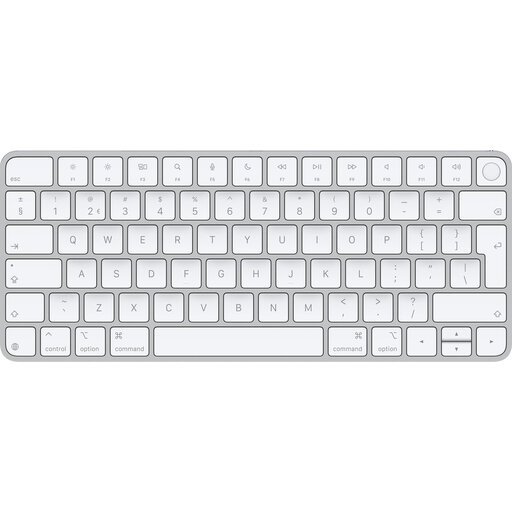 No image available
The compact tenkeyless layout may suit you if you want to save desk space and are looking for a Dutch QWERTY layout.
The product description lists Bluetooth, a rechargeable battery and a scissor mechanism. This model is designed for Mac models with Apple silicon.
 No image available
The 60% layout with 61 keys may suit you if you’re looking for a compact keyboard with US QWERTY and don’t need a separate number pad.
The product name lists a wired connection and RGB lighting. The product description calls the membrane keys mechanical-feeling.
According to Arboportaal, if an employee works at a screen for more than two hours a day, the screen and keyboard must not be attached to each other. When using a laptop in this situation, the employee must be able to use a separate screen or keyboard. This requirement doesn’t determine which brand or key mechanism you should choose.
Check that your computer’s input language matches the physical keyboard layout. Trust lists an incorrectly set input language as a possible cause of unexpected characters. Before buying, also check the layout of the exact model variant.
Yes. Assess the keyboard alongside the position of your screen, desk and chair. Arboportaal treats the screen-based workstation as a whole; a manufacturer’s claim about a wrist rest doesn’t replace that assessment.
For a consumer purchase in the Netherlands, the seller is responsible for the statutory guarantee. ACM ConsuWijzer explains that a remedy for a faulty product could be repair, replacement or a refund. There is no fixed statutory guarantee period that applies equally to every keyboard.