
Host catering for fussy eaters
You want to give guests the choice between a white roll and one clearly labelled as wholemeal. That way, you don’t have to settle on a single type of bread for everyone in advance.


Expecting guests with different bread preferences for Vlaggetjesdag? Offer white rolls alongside rolls clearly labelled ‘wholemeal’, rather than choosing just one type for everyone. Decide how many of each you need based on your guests, and check the preparation time for bake-at-home rolls and the ingredients and allergen information for every option you choose.
You want to give guests the choice between a white roll and one clearly labelled as wholemeal. That way, you don’t have to settle on a single type of bread for everyone in advance.
You want to be able to tell whether a roll really is wholemeal. The Netherlands Nutrition Centre advises looking for the ‘wholemeal’ label; ‘multigrain’ alone doesn’t confirm this.
You want to prepare bake-at-home rolls in time for a set mealtime. In that case, the oven time, available oven space and any storage or defrosting instructions on the chosen pack are important.
First decide which types of bread you want to offer and how many of each you’ll need. Then check how to store and prepare each product.
| What to consider | What to check when buying | Who it matters to |
|---|---|---|
| Choice for guests | Choose a white roll and one explicitly labelled wholemeal. Count how many of each you need before arranging them on the platter. | If guests have different preferences, I don’t want everyone to have to choose from the same type of bread. Around 36% of consumers put this freedom of choice first. |
| Wholemeal label | Look for the word ‘wholemeal’ on the pack or product page; don’t rely on ‘multigrain’ or the colour alone. | If I specifically want to offer wholemeal, I need to be able to identify it on the roll I choose. For around 29% of consumers, this confirmation is their top priority. |
| Serving time | Check the preparation time and oven temperature for your chosen option, along with any storage and defrosting instructions. | If I want to bake the rolls just before serving, they need to fit my oven space and schedule. Serving time is the most important factor for around 21% of consumers. |
| Number of rolls | Compare the number of rolls in each pack with the number of guests and the balance of white and wholemeal you want. | When catering for a larger group, I want to have enough of both types without guessing the quantities. Around 14% of consumers prioritise getting the amount they need. |
A multigrain name or dark colour doesn’t confirm that a roll is wholemeal. According to the Netherlands Nutrition Centre, look for the ‘wholemeal’ label if you specifically want wholemeal bread.
Check for this label on the pack or product page for the option you’re buying.
The fact that baker’s salt can be iodised doesn’t tell you which salt is used in an individual roll. The Netherlands Nutrition Centre lists bread made with iodised baker’s salt as a source of iodine in the Netherlands, but ingredients vary from product to product.
Read the ingredients list on the pack you choose, or ask about the ingredients used if you’re buying unwrapped rolls.
PLUS gives different oven times for its white and multigrain options. Frozen products may also have specific defrosting instructions.
Plan your oven space using the instructions on the exact pack, and check the storage instructions before preparing the rolls too.
The words ‘white’, ‘multigrain’ or ‘wholemeal’ don’t replace the ingredients and allergen information. The Netherlands Food and Consumer Product Safety Authority highlights that allergens must be listed on labels.
Check the information for the specific roll, even if you’ve previously bought a product with the same name.
These brands give you an idea of the types of bread rolls you can compare. Check the label, preparation instructions and ingredients for the option you choose; a brand name won’t tell you this for its entire range.
A good starting point for a mixed platter: Albert Heijn lists options including AH White Roll and AH Wholemeal Roll.
A brand to compare for wholemeal rolls, as well as individual white or frozen options.
An option for comparing white and multigrain bake-at-home rolls when you’re planning to serve them at a set time.
A place to shop if you’re looking for an individual white roll.
A place to compare an individual white roll with a pack of white bake-at-home rolls.
A place to shop for a white roll.
The white rolls below can provide the white option on a mixed platter. If you also want to offer wholemeal, choose a separate roll explicitly labelled ‘wholemeal’.
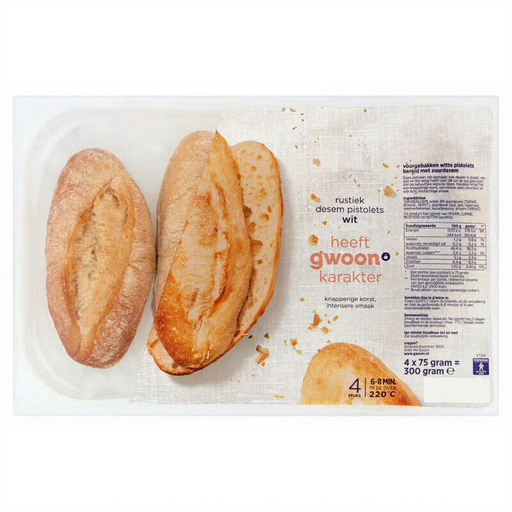 Image unavailable
A white option for guests who prefer white rolls; the pack contains 4.
If preparation is required, follow the instructions on the pack and check it for the latest ingredients and allergen information.
Choose at least one white option and one roll explicitly labelled ‘wholemeal’. Decide how many of each you need based on your guests’ preferences and the number of rolls in each pack.
Not based on the word ‘multigrain’ alone. The Netherlands Nutrition Centre advises looking for the ‘wholemeal’ label on wholemeal bread, so check the product you choose for this wording.
Check the ingredients and allergen information on the specific pack. The Netherlands Food and Consumer Product Safety Authority highlights that allergens must be listed on labels; the type of bread alone doesn’t give you all the information you need.
No. Don’t assume all rolls have the same ingredients. The Netherlands Nutrition Centre lists bread made with iodised baker’s salt as a source of iodine in the Netherlands. Check the ingredients list for your chosen product, or ask about the ingredients used if you’re buying an unwrapped roll.
Follow the instructions for the option you buy. PLUS gives a baking time of 6–8 minutes at 220 °C for its white rolls and 8–10 minutes at 220 °C for its multigrain rolls; these times don’t automatically apply to other products. For frozen rolls, check the defrosting instructions too.