
Maker filming close-ups of stitches
You film needles, thread and moving hands up close. The light needs to be easy to position and help reduce distracting shadows on your work surface.


Choose an adjustable, dimmable continuous light that you can position so your hands don’t cast shadows over your stitches. Check fabric colours with a test recording and a suitable white balance. A compact desk panel can save space on a small work surface, while a COB light with a suitable modifier offers more options for a larger work area or separate background lighting. However, it also needs more room to set up and may require additional components.
You film needles, thread and moving hands up close. The light needs to be easy to position and help reduce distracting shadows on your work surface.
You want to make colour differences between fabric and thread easy to see. Check the lighting setup and camera white balance together in a test recording.
You want both the textile and the white background to show up clearly on camera. Use a test recording to decide whether your existing lighting setup is enough or whether you need separate background lighting.
| What to consider | What should you check? | Who should prioritise this? |
|---|---|---|
| Visible stitches without distracting hand shadows | Make a test recording while moving your hands to check the light direction and diffuser or suitable modifier. | If I’m filming stitches close up, I don’t want my hands constantly blocking the work; around 36% of consumers prioritise visible stitches and minimal hand shadows. |
| Fabric and thread colours that look true to life | Check a recording under your intended lighting setup and set the camera white balance deliberately. | When teaching about fabric and thread, I want to be able to judge colour differences clearly; around 29% of consumers give accurate textile colours top priority. |
| A white background you can control | Check both the background and the textile in the same test recording, then decide whether you need extra background lighting. | If I’m using a white background, I want to be able to control it without losing sight of the repair; around 21% of consumers prioritise background control. |
| Space, power and what’s included | Check the available space, mounting options, power supply and contents of the exact version you’re choosing. | When space is limited where I film, I want to know where the light can go and what else I’ll need; around 14% of consumers prioritise setup and included items. |
A light reading taken with a particular reflector at a particular distance doesn’t tell you directly how much light will reach your textile with a different setup or a softbox.
Only compare light readings taken at the same distance and with the same setup. Also check which modifier and stand are suitable for the soft lighting you want.
You may need to buy a suitable modifier and stand separately for your chosen setup.
What’s included and the power requirements vary between versions. Check the product variant and contents before choosing a light.
Depending on the version, you may need to buy a stand, battery, battery plate or suitable power supply separately.
Choose any additional components to suit your filming location and how you want to power the light.
A background that looks evenly lit doesn’t automatically mean the stitches and textile are easy to assess.
Check the background and repair together in a test recording. Add lighting or light control only if the recording shows a specific problem.
The Key Light Air MK.2 is designed for a compact desk setup, with a clamp and USB-C power.
The NL660 is an adjustable LED panel, available with or without a stand.
The European RC 120B is a COB light designed for use with a separate modifier and enough space for positioning.
The SL60IIBi is a bi-colour COB light with a Bowens mount, designed for use with a modifier.
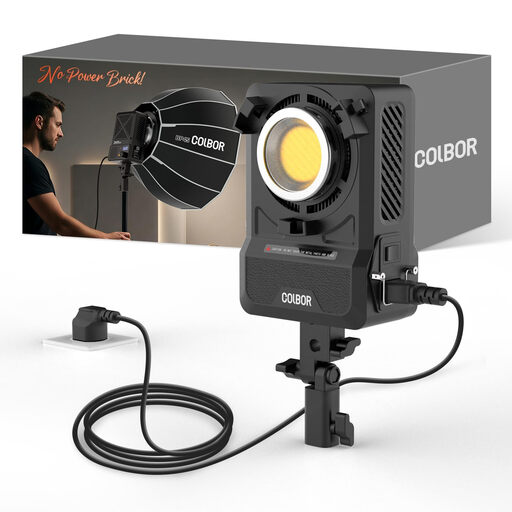
This selection features a COB video light with a Bowens mount, for a setup where you want to use a suitable modifier.
 No image available
This COB light with a Bowens mount is suitable for a setup where you want to use a compatible modifier.
The product title lists 200 W, bi-colour, 2700 K–7000 K, a Bowens mount and a built-in power adapter design. Check that the modifier is compatible and that the product information specifies the applicable EU conformity and CE marking for the light and power supply.
Make a short recording of fabric and thread under your final lighting setup, then check the camera white balance. A light’s CRI rating or colour temperature alone isn’t enough to judge how colours will look in your recording.
No. First, check in a test recording whether both the background and the repair are clearly visible. Separate background lighting is an option if you can’t get both looking right with your existing lights.
Check where the clamp or stand can go, keep enough room for your hands to move, and check the contents and power supply for the exact version. The maximum stated brightness of the Elgato Key Light Air MK.2 depends on the power supply; a stand and battery aren’t included with every version of the NEEWER NL660.
For the light and any power components, check which EU product rules apply and whether the required CE marking and product information are provided. The European Commission and the Dutch government explain that the manufacturer is responsible for applicable conformity. A CE marking is the manufacturer’s declaration, not an independent quality mark.
For a consumer purchase in the Netherlands, the product must meet what you can reasonably expect from it; if there’s a fault, contact the seller. The Dutch government states that the Netherlands has no fixed statutory guarantee period. Any additional manufacturer’s guarantee does not replace your statutory rights.