
Teacher with limited table space
You film your hands from above or at an angle and want to position the light without getting in the way of your pottery. A table clamp can free up workspace, provided it fits the edge of your table.


For a fixed, small table, an adjustable panel is a practical choice if you have room to position it beside or above your workspace. A spotlight with a softbox may work if you have space for the light modifier and want softer shadows. Choose a compact battery-powered light if you often move your setup. For any option, check the mounting, power supply and colour settings. This is a decision based on intended use and specifications, not a comparative hands-on test.
You film your hands from above or at an angle and want to position the light without getting in the way of your pottery. A table clamp can free up workspace, provided it fits the edge of your table.
You want to be able to set the colour temperature for successive lessons and control shadows on your work. Elgato and Ulanzi list adjustable colour temperatures for specific models; check the exact version against your camera and filming location.
You set up the table each time, so compact mounting and power are important. A built-in battery can be useful when you’re on the move, but also check which mount is compatible with your chosen light.
A good fit if: you film at a fixed table and can position an adjustable main light beside or above your workspace.
Bear in mind: the panel and mount take up space, and a table clamp needs to fit the edge of your table.
A good fit if: space is limited, or you want to pack away and move your setup after each lesson.
Bear in mind: a small light source can cast sharper shadows if you point it directly at your hands and clay. Also check that it covers the work surface and that you have the right mount.
A good fit if: you have room to position a light modifier out of shot and want a softer transition between light and shadow.
Bear in mind: the light, mount and softbox need to be compatible, and together they take up space.
| What to consider | What should you check? | Who should pay particular attention? |
|---|---|---|
| Shadows on the clay and your hands | Look at the size and position of the light source, and whether you can angle it. Check whether diffusion or a reflector will work with your setup. | If my hands cast shadows on the clay, I want to see both the shape of the clay and what I’m doing. Around 36% of consumers give resolving hand shadows top priority. |
| Clear workspace and mounting | Check the edge of the table and whether the clamp fits. Also check that the arm and any required mounting part are compatible with the set you’ve chosen. | At a small table, I want to position the light securely without taking up space for my hands or the clay. Around 29% of consumers focus mainly on clear workspace and mounting. |
| Clay colour and consistent footage | Check whether the exact version is dimmable and has an adjustable colour temperature. Record a test clip with your own camera and lighting setup. | When I film clay across successive lessons, I want to be able to adjust the colour temperature and keep the footage as consistent as possible. Around 21% of consumers prioritise recognisable clay colours and consistent footage. |
| Power and setup | Check which battery, adapter or cable is included and what power supply the light needs. Also check which mount you’ll need for your chosen location. | When I film in different places, I want to know how to power and remount the light. Around 14% of consumers consider power and quick setup the most important factors. |
A bright but small, direct light can cast sharp shadows on your hands and the clay. The stated light output alone won’t tell you how your workspace will look on camera.
Record a test clip while working with both hands. Check that your actions and the texture of the clay remain visible, and adjust the light’s angle if needed.
A connection on the light doesn’t guarantee that you can mount it where you want above the table. A suitable table clamp, arm or mini tripod may be sold separately.
Check what’s included in the exact package and whether the mount fits both the edge of your table and the light’s connection.
For the Elgato Key Light Air MK.2, the maximum light output stated by Elgato depends on the power source.
Check what power supply the version on offer requires and what’s actually included in the set.
Your chosen light may need a suitable adapter or another power source. Also plan where the cable will run along the table.
Desk-focused LED panels, including the Key Light Air MK.2, for a fixed filming space where a compatible table clamp will work.
LED panels for anyone with space for a larger adjustable light. Godox also describes the LEDP260C as suitable for product and video shoots.
Compact video lights such as the VL81 for a portable table setup.
Light modifiers for anyone who wants softer, more focused light above or beside the clay, using a compatible spotlight.
Compact lighting and accessory setups, including the Ace 25x, for makers who move their kit around.
The selection below includes compact video lights and one camera bundle. Check whether you’re looking for a standalone light or the complete set, and make sure the mounting and power options suit your table setup.
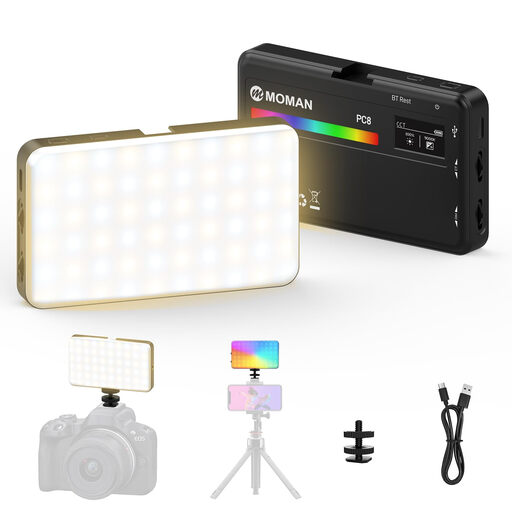 Image unavailable
A portable LED video light for cameras, worth considering if you’re looking for a mobile lighting setup. Check the power and mounting options for the version on offer.
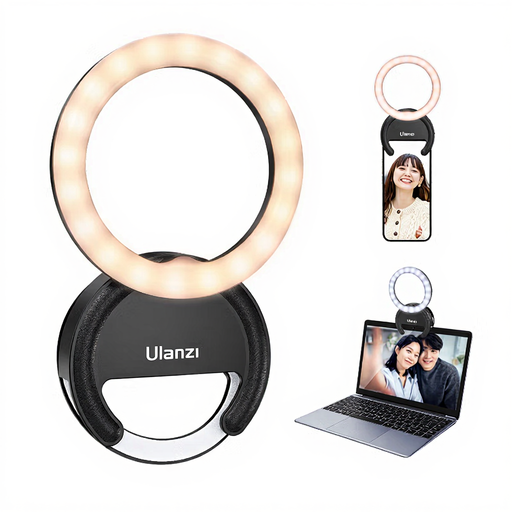 Image unavailable
A 4-inch ring light to consider if you want to add lighting to a smartphone setup.
The product name lists 3 colour temperatures from 3000–7000 K and 5 brightness levels.
 Image unavailable
A compact, portable mini light to consider if you’re short on space and want a magnetic mount.
The product name lists a 500 mAh battery, water resistance and a 1/4-inch thread. Check that the mount is compatible with yours.
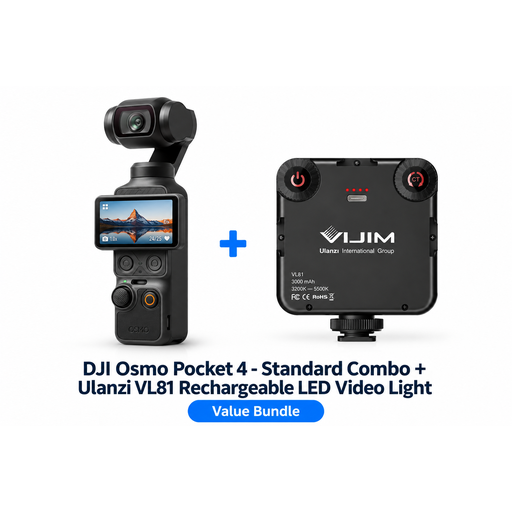 Image unavailable
This is a bundle with a DJI Osmo Pocket camera and a Ulanzi VL81 LED video light, not a standalone video light. Check that you’re looking for the complete bundle.
Ulanzi lists a colour temperature range of 3200–5500 K for the VL81. The manufacturer says the light has a built-in battery; check which mount you need for your table setup.
Place the main light at an angle beside the camera and record a test clip while using both hands. Adjust or move the light until your actions remain visible. Diffusion or a reflector can soften an overly dark shadow without removing all the shadows that show the shape of the clay.
Not necessarily. Start with one main light that you can position, then assess the footage. A reflector can brighten the darker side; add a second light only if your workspace or footage calls for it.
Where possible, use the same lighting setup and colour temperature, and limit changes in mixed ambient light. Compare test clips using your own camera; a manufacturer’s colour-rendering specification doesn’t guarantee how the final footage will look.
That depends on the product rules that apply to the light. The European Union’s Your Europe website and the Dutch Government’s Ondernemersplein explain that products covered by rules requiring CE marking must comply with those rules and carry the required marking. This alone is not proof that a specific product listing meets the requirements.