
Detail demonstrators
You want to show settings, engravings or clasps close up, with room for your hands and lighting. Magnification and working distance both matter here; Sony, Canon and Nikon highlight these points for macro photography.


For full-frame shots of engravings, settings or clasps, the camera and lens combination matters more than the 4K label alone. Look at both magnification and working distance, so there’s room for your hands and lighting. If you switch between your face and a piece of jewellery while talking, check how well the camera focuses on products too, and test the combination under your own artificial lighting. Manufacturer specifications are no substitute for a test recording with your own jewellery and lights.
You want to show settings, engravings or clasps close up, with room for your hands and lighting. Magnification and working distance both matter here; Sony, Canon and Nikon highlight these points for macro photography.
You switch between showing your face and holding jewellery in front of the lens as you explain. Sony describes a Product Showcase Set mode for the ZV-E10 II, while Nikon has a Product Review Mode for the Z50II. Also check that your chosen lens can focus at the distance you’ll be filming from.
You film under lamps and want to adjust colours and check for flicker in your own set-up. Panasonic documents adjustable white balance on the DC-G100D, while Sony Support describes flicker reduction under fluorescent lighting for applicable models.
Start with the smallest details you want to show, then check the working distance and focusing performance. Finally, assess colour, flicker and the practical size of the complete set-up.
| What to consider | What to look for | Who should pay particular attention? |
|---|---|---|
| Small details | Compare maximum magnification, working distance and the crop in the video mode you’ve chosen. Canon lists 1:2 magnification for the RF 35mm F1.8 MACRO IS STM; Sony and Nikon list 1:1 for the separate macro lenses mentioned. | If you want engravings or small settings to fill the frame, you’ll need to know whether the lens can focus up close without your hands and lights getting in the way. Around 33% of consumers make detail magnification their top priority. |
| Colour and flicker | Check the white balance settings for the exact model and record a test video under the lights you use. Sony Support recommends flicker reduction for fluorescent lighting on applicable models, but this doesn’t guarantee results with every light. | If you regularly film under the same lights, you’ll want to assess colours and spot distracting flicker before you start recording. Around 27% of consumers prioritise control over lighting and colour. |
| Focus transitions | Look at product-focused modes as well as the focusing range of the lens actually supplied with the camera. Autofocus features are no substitute for a suitable close-up lens. | When you hold jewellery up to the camera and then look back at your face, the combination needs to focus at both distances. Around 20% of consumers prioritise transitions between the presenter, hands and product. |
| Complete set-up | Check that the kit includes a suitable lens, and consider the mount, space for lights and video format you want. A fixed zoom avoids changing lenses, but won’t automatically show small details at a larger size. | If you mainly want a manageable set-up, it’s important to know which lens and accessories you’ll need, and how much space the set-up will take. Around 20% of consumers prioritise keeping their complete set-up simple. |
Magnification and working distance vary from one lens to another. The minimum focusing distance also isn’t the same as the space between the front of the lens and the jewellery.
Ask which exact lens is included in the kit, then assess its magnification, working distance and how much of the frame the subject fills at your intended filming distance.
White balance and potential flicker need separate settings or checks under the lights you use.
Record a test under your intended lighting and check the manual for the exact model for advice on flicker reduction.
Optical zoom alone doesn’t tell you whether the camera can focus at your working distance or show your smallest piece of jewellery large enough in the frame.
Check how your smallest subject looks in a close-up before letting ease of use make the decision for you.
The EOS R50 with an RF mount can be paired with a separate RF macro lens for both wider shots and close-ups.
The ZV-E10 II has a product showcase mode and can be paired with a separate E-mount macro lens.
The Z50II can be paired with a separate NIKKOR Z MC 50mm f/2.8 for product demonstrations and macro photography.
The LUMIX G100D is a Micro Four Thirds system camera, while the HC-VX3 is a video camera with a fixed zoom lens.
This selection includes pocket and vlog cameras. For each camera, check that its focusing performance and filming distance suit the smallest piece of jewellery you want to record.
 No image available
The product name identifies this as a vlog combo; check that its close-up distance suits the smallest piece of jewellery you want to film.
 No image available
The product name identifies this as a standard combo; check which close-ups you can get with the included camera at your filming distance.
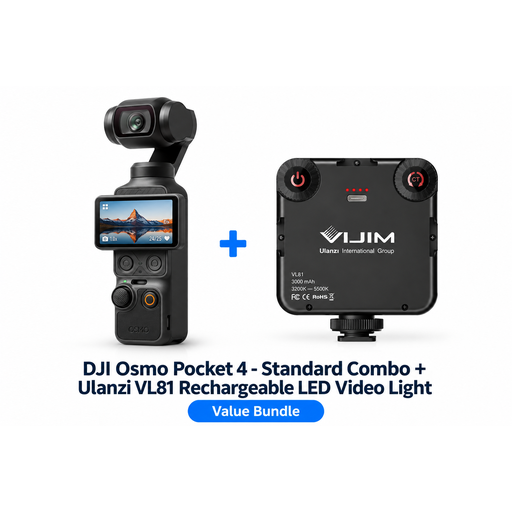 No image available
This bundle name includes an LED video light alongside the camera; assess colour and any flicker with your own jewellery and lighting.
 No image available
The bundle name includes a camera and an RGB LED video light; check the close-up view and colour under your filming conditions.
 No image available
The product name describes a pocket vlog camera with 2× lossless zoom, 107GB of built-in storage and a 2-inch rotating screen.
The title lists 4K/240fps; according to the product information, this combination is only available in slow-motion mode. Check whether the close-up view works for your jewellery.
No. 4K alone doesn’t tell you how large the engraving will appear in the frame. Check the magnification, working distance and video framing of the camera and lens combination.
Place the jewellery under the lights you plan to use, then check the framing and focus with your hands in shot. Set the white balance under the same lighting; Panasonic documents adjustable white balance for the DC-G100D. Record a test video to check for potential flicker too, and follow the manual for other models.
Check whether you’re buying a body, a zoom kit or a set with a suitable macro lens, and which accessories you’ll need for your set-up. The Dutch government says that, in many cases, distance purchases come with a 14-day cooling-off period; check whether this applies to your situation. Your rights if a product is faulty are separate from any voluntary manufacturer’s warranty.
This depends, among other things, on the purpose and how you make and share the footage. The Dutch Data Protection Authority states that the GDPR applies when someone makes and publishes footage on behalf of a business or organisation for professional or commercial purposes; a lawful basis, such as consent, is required. The personal-use exemption doesn’t automatically apply to public sharing. This specific issue doesn’t arise with footage showing only jewellery and no identifiable people.