
Writer looking for a comfortable grip
If you spend a long time working on a review, check that the mouse suits your hand size and the hand you use. A vertical shape alone does not guarantee a comfortable fit.


Start with the hand you use to operate a mouse and how it fits; then choose a connection and controls that suit your computer and the way you switch between text and reference material. Studies of vertical mice measure changes in posture and pointing performance, but they do not prove that a particular model prevents or relieves symptoms for an individual. It can also take time to get used to pointing accurately.
If you spend a long time working on a review, check that the mouse suits your hand size and the hand you use. A vertical shape alone does not guarantee a comfortable fit.
If you often switch between a draft, notes and reference material while writing, compare how easy the buttons are to reach, the scrolling and the adjustable cursor speed.
In a shared workspace, click noise, cables and how the mouse connects to your computer may all influence your choice. Also check that the hand orientation and grip suit you.
Start with your hand preference and the fit. Then choose between a fixed or adjustable angle, and between a wired or wireless connection, based on your workspace and how you navigate.
| What to consider | What should you check? | Who is this important for? |
|---|---|---|
| Hand size and grip | Check whether the model is designed for left- or right-handed use and whether the manufacturer provides size guidance. According to Evoluent, the standard Evoluent VerticalMouse 4 is designed for a hand length of around 178 mm or more; this is not a universal size threshold. | If you write for long periods, you’ll want a mouse that suits your hand and preferences. Around 29% of consumers prioritise fit. |
| Navigation and editing | Check whether the buttons are easy to reach and whether the cursor speed can be adjusted. Trust lists 1000 or 1600 DPI for the wired Verto; that figure alone does not determine how accurately you work. | When switching between text, notes and reference material, easy-to-reach buttons and a suitable pointing speed can help. Around 23% of consumers prioritise navigation while editing. |
| Connection | Check your computer’s connections, which USB port you need and whether the button software you want to use works with your operating system. According to Evoluent, Evoluent Mouse Manager for the VM4L does not work with macOS. | If you write at a laptop or a fixed workstation, you’ll want a connection that works straight away. Around 18% of consumers prioritise connectivity and computer compatibility. |
| Quiet operation | For the exact model, look for an explicit mention of quiet buttons. Trust lists two quiet buttons for the Bayo II; this is a manufacturer specification, not an independent noise measurement. | If you work next to someone who is reading, working or on a call, click noise may affect your choice. Around 18% of consumers consider a quiet shared workspace their top priority. |
| Power and everyday use | Compare a fixed cable with a wireless connection, and check how the model you choose is powered. According to Trust, the Trust Verto has a 1.5-metre USB cable; the Bayo II has a rechargeable battery. | If you’d rather not manage a battery, receiver or disposable batteries, a wired mouse may suit your routine. Around 12% of consumers prioritise ease of use and maintenance. |
Studies of mouse use have measured posture, muscle activity and pointing performance under research conditions, among other things. These findings do not prove that an individual model prevents or relieves symptoms.
Choose a mouse that suits your hand, allow yourself time to get used to the grip, and vary your posture and screen-based work. Arboportaal also recommends changing posture and taking micro-breaks.
Models within the same product range can differ in hand orientation, size and connection type. So a suitable product name alone does not always tell you whether a particular version will work for your workspace.
Check the full model name, the manufacturer’s size guidance and the connection your computer requires.
Software limitations can vary by model. For example, Evoluent states that Mouse Manager for the VM4L is not compatible with macOS; the mouse’s basic functions and custom button functions are not the same thing.
Before buying, check that the software for the button settings you want works with your operating system and exact model.
Lift and MX Vertical are different product ranges. With Lift, the fit of the specific model matters more than the name of the range.
Verto is a wired option, while Bayo II is wireless. This difference may matter if you have a fixed desk setup or would rather work without a cable.
UniMouse is designed for people who want to adjust the tilt angle and thumb rest themselves.
VerticalMouse 4 is available in separate hand and size versions, including the wired VM4L for left-handed use.
HE Break is an option if you’re considering a software-controlled break indicator as well as different hand and size versions.
These Joybuy picks are vertical mice for writing, editing and navigating at a home workstation. Check the hand orientation, connection and product specifications for each model.
 No image available
Suitable for shoppers who want to work wirelessly and switch between text and reference pages while writing.
Bluetooth and 2.4 GHz connection; USB-C charging; three DPI levels: 800, 1200 and 1600.
 No image available
May suit shoppers who want to move quickly between text and reference material while editing.
Rechargeable battery via USB-C; 2.4 GHz connection with USB receiver; 800–1600 DPI.
 No image available
Worth considering if you switch between computer-based reference materials while writing. Check the product page to see which connections and accessories are included with this version.
 No image available
Suitable for shoppers who want to work wirelessly and consider scrolling and cursor speed when selecting text.
Bluetooth and 2.4 GHz connection via Unifying USB receiver; 4000 DPI sensor; rechargeable battery; 4 buttons.
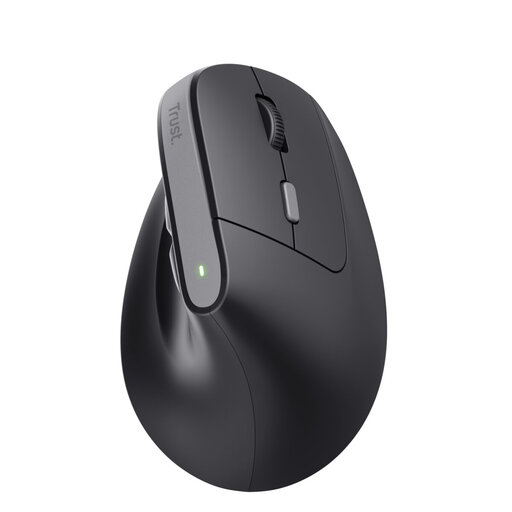 No image available
May suit shoppers who want to use thumb buttons to navigate when switching between text and reference material.
Wireless RF connection; optical mouse; 2400 DPI.
The product name identifies this version as right-handed. Check that a USB receiver will work with your computer.
A vertical mouse is not a proven individual solution for symptoms. A study in Ergonomics involving 16 participants measured muscle activity, movements and pointing performance, among other things. A study in Work found less forearm rotation with the vertical mouse tested, but also the lowest pointing performance. These research findings do not predict how a particular model will work for you. Arboportaal advises contacting the occupational physician if symptoms start to develop, and arranging a workplace assessment if needed.
Adjust the cursor speed for selecting and navigating, give yourself time to get used to the grip, and vary your screen-based work. Arboportaal recommends changing posture and taking micro-breaks; a different mouse is no substitute for these measures.
Check whether your computer has Bluetooth or the USB connection you need, and whether the model uses a receiver. Also check how the mouse is powered: the Logitech Lift used in testing takes one AA battery, while Trust lists a rechargeable battery for the Bayo II. For button settings, also check that the required software works with your operating system.
According to ACM ConsuWijzer, ordinary online consumer purchases usually come with a statutory 14-day cooling-off period from delivery, subject to legal exceptions. In the Netherlands, statutory guarantees also apply for as long as the product should last under normal use; there is no automatic fixed two-year period.
The Dutch government information mentioned does not prescribe a vertical mouse model. However, employees are covered by rules and duties of care relating to a safe, ergonomically responsible home workstation and screen-based work, including alternating with other work or taking a break. These employment rules do not necessarily apply when you write a review in your personal time.