
Thesis writer
You’d like to try a different hand and forearm position during long sessions, without assuming that one mouse will prevent discomfort.


Start with your hand size and whether you’re left- or right-handed. Then consider the grip, controls and connection that suit your home workspace. A vertical mouse can change your forearm position, but there’s no proof that it prevents discomfort: research by Quemelo and Vieira (2013) and Odell and Johnson (2015) also describes an adjustment period and differences in pointing performance.
You’d like to try a different hand and forearm position during long sessions, without assuming that one mouse will prevent discomfort.
You’re looking for a model that suits your hand size and whether you’re left- or right-handed. A comfortable fit matters more than extra buttons.
You often switch between documents and webpages and want the controls and connection to suit the way you work.
First, assess whether the grip and fit suit your hand. Then consider the controls for research and how the mouse connects to your home workspace.
| What to consider | What should you look for? | Who is this important for? |
|---|---|---|
| Hand and forearm position | Try holding and using the mouse to see whether you can do so comfortably. Research by Quemelo and Vieira (2013) and Odell and Johnson (2015) does not prove that a vertical mouse prevents discomfort. | During long writing sessions, I mainly want to try a different forearm position, without assuming it will affect discomfort. Around 33% of consumers put posture first. |
| Hand size and handedness | Check your hand size and whether the specific model is designed for left- or right-handed use. Logitech and Evoluent provide sizing and handedness advice for specific models. | I want a grip that suits my hand size and whether I prefer left- or right-handed use. Around 27% of consumers put fit first. |
| Controls for research | Check that the buttons are easy to reach and that any software works with your operating system. Evoluent says Mouse Manager is not supported on macOS. | If I often switch between chapters, documents and web sources, I want controls that suit my tasks. Around 20% of consumers who prioritise research controls put this first. |
| Connection and power | Check your computer’s ports and whether a cable or receiver will suit your desk. Trust lists a 2.4 GHz USB micro receiver for the Bayo II. | I want a connection and power option that suits my permanent home workspace. Around 20% of consumers put connectivity first. |
Changes in forearm position or muscle activity don’t prove that a mouse prevents discomfort. Research by Quemelo and Vieira (2013) notes that an adjustment period may be needed; in their test, Odell and Johnson (2015) reported the lowest pointing performance with the fully vertical mouse.
Consider whether you can hold and use the mouse comfortably, and remember to assess your workspace setup too.
A left-handed version is not the same as a right-handed one. According to Evoluent, the VerticalMouse 4 Small VM4S is for right-handed use only.
Check the hand size and handedness for the exact variant, not just the brand or range name.
A wireless mouse may need a receiver, while a wired mouse needs room for its cable. Evoluent lists a USB-A plug for the VM4S and recommends an adapter or hub if your computer has USB-C ports only.
Before choosing, compare the connection on the exact version with the ports available on your computer.
The information below applies to the models and product ranges mentioned. A brand name alone won’t tell you whether a particular version suits your hand.
According to Logitech, the Lift is designed for small to medium-sized hands and is available in separate left- and right-handed versions. The MX Vertical is a different model with a fixed angle.
The Verto is wired, while the Bayo II is wireless. The right option depends in part on your ports and how you want to set up your workspace.
According to Contour Design, the UniMouse has an adjustable grip angle and thumb support, with separate versions for left- and right-handed use.
The VerticalMouse 4 range includes standard, Small and left-handed versions, among others. The exact hand variant differs by model.
This selection focuses on vertical mice for writing and research, with hand fit, controls and wireless connectivity in mind.
 No image available
An option to consider if you’re looking for a vertical mouse with a wireless connection; check which connection suits your computer.
The product name lists Bluetooth, 2.4 GHz, USB-C charging and DPI levels of 800, 1200 and 1600.
 No image available
Could suit research work involving frequent switches between documents and webpages; check that the controls fit the way you work.
The product name lists six buttons, 2.4 GHz wireless, USB-C and a range of 800–1600 DPI.
 No image available
A model to compare if you’re looking for a vertical mouse for office work; check that the handed version and connection suit your workspace.
 No image available
A fixed vertical grip to compare if you find the stated angle comfortable; that angle is no guarantee of comfort or of preventing discomfort.
Logitech lists a 57° angle. The product name mentions Bluetooth and 2.4 GHz via a Unifying USB receiver, a rechargeable battery, and compatibility with PC, Mac and iPadOS.
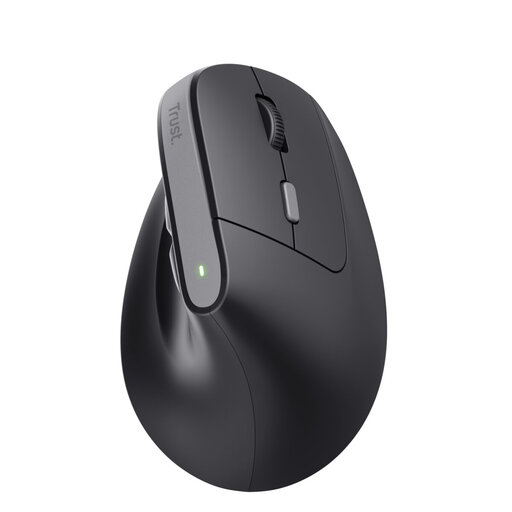 No image available
An option to consider if you’re looking for a wireless vertical mouse for right-handed use; check that this version suits you.
The product name lists RF wireless, an optical sensor and 2400 DPI.
The studies cited have not shown this. Research by Quemelo and Vieira (2013) and Odell and Johnson (2015) describes changes in forearm position and differences in pointing performance, but does not prove that a vertical mouse prevents or treats discomfort for an individual user.
Contour Design recommends adjusting the UniMouse angle and thumb support to suit your preference, and readjusting them if needed. Also check that the connection on your version is compatible with your computer.
In the Netherlands, online consumer purchases generally come with a statutory 14-day cooling-off period after delivery, subject to exceptions and rules on trying out and returning items. ACM ConsuWijzer explains the conditions; check which ones apply to your specific purchase.
No. According to ACM ConsuWijzer, your statutory guarantee depends on what you could reasonably expect from the product with normal use; it is not simply a fixed two-year period for every mouse. If a product is faulty, the seller is responsible for providing an appropriate solution.
Government guidance does not require a vertical mouse. For employees covered by the rules on display screen work, the Ministry of Social Affairs and Employment’s Arboportaal describes options including alternating with other work or taking a break. These employer rules do not automatically apply to every student writing independently.