Start by checking the mouse suits your hand size and whether it’s designed for left- or right-handed use. Then decide whether precise pointing, the right connection or quiet operation matters most for managing your membership records. Research into vertical mice describes differences in forearm posture and pointing performance, so allow time to adjust and remember to vary your screen-based tasks.
Who is this for?
Membership administrator who enters data frequently
You regularly look up and update membership details, and want a grip that suits your hand and allows you to point accurately. A systematic review in Cogent Engineering highlights that your choice of mouse should suit you and the tasks you do.
Student with limited desk space
You manage membership files at a small desk and want to consider the cable, a USB receiver and the available ports on your laptop.
User of a shared study room
You work in the same room as other people and want to check whether the exact mouse version is explicitly described as having quiet buttons.
What should you look for when buying?
First, check whether the mouse suits your hand and preferred hand. Then compare its controls and connection with the way you work with membership files.
| What to consider |
What should you check? |
Who should pay particular attention? |
| Fit and hand preference |
Check your hand size and whether the mouse is designed for left- or right-handed use. Around 178 mm is Evoluent’s guideline for the standard VerticalMouse 4. |
If I enter membership details frequently, I want a mouse that feels comfortable to hold, with buttons I can reach without gripping it awkwardly. Around 36% of consumers put fit first. |
| Pointing and navigation |
Check the adjustable cursor speed and how easy it is to reach the scroll wheel and navigation buttons. If possible, try the tasks you normally do. |
When selecting rows, I want to be able to control the pointer and scrolling in my own files. Around 29% of consumers give precise pointing and navigation top priority. |
| Connection |
Check your device’s ports and Bluetooth, as well as the connection used by the exact mouse version. |
With a laptop and few spare ports, I want to know in advance whether the mouse uses a cable, USB receiver or Bluetooth. Around 21% of consumers consider connection the most important factor. |
| Click noise |
Look for an explicit mention of quiet buttons on the version you’re considering. |
If I share a study room, I want to avoid disturbing others while I work. Around 14% of consumers make quiet operation their top priority. |
Buying points to keep in mind
-
Assuming a vertical shape will automatically feel right
A different arm posture doesn’t automatically mean you’ll point as quickly as you do with a familiar mouse. Research into the mice studied describes a trade-off between arm posture and pointing performance, including in papers published in Work and Ergonomics.
Choose the right size and hand orientation first, then consider extra features. If you can, try tasks such as selecting rows and scrolling through membership lists.
-
Treating a cable, USB receiver and Bluetooth as the same connection
Connections vary between versions, even within the same product range. A USB receiver uses a port, and wireless operation may also mean keeping track of the battery.
Check the full model name and connection details for both the mouse and your computer before choosing.
-
Seeing an extra warranty package as a replacement for your statutory rights
In the Netherlands, statutory guarantees are separate from additional commercial warranties. ACM ConsuWijzer explains that statutory guarantees also apply when the retailer or manufacturer doesn’t offer an extra warranty.
Check which rights and terms apply to your purchase before considering an additional warranty.
Brands worth comparing
Logitech
The Lift range is worth considering if you’re looking for a vertical mouse for small to medium-sized hands. Logitech lists separate left- and right-handed versions. According to Logitech, the MX Vertical has a cursor speed switch.
- The different hand orientations of the Lift and the cursor speed switch on the MX Vertical are features Logitech lists for those specific models.
- The features of the Lift and MX Vertical aren’t interchangeable. The features listed don’t prove that a mouse will prevent discomfort.
Trust
According to Trust, the Verto range includes a wired version and a separate wireless version with a USB receiver.
- Trust lists two DPI settings and a 1.5-metre cable for the wired Verto.
- The wireless Verto uses a receiver and has different DPI settings. Check the exact version, as comfort claims are made by the manufacturer.
R-Go Tools
According to R-Go Tools, the HE Break range is available in different sizes and in left- and right-handed versions.
- The manufacturer lists wired and wireless versions, as well as lights that signal when it’s time for a break via R-Go Break software.
- The software controls the break signals. The brand’s health claims aren’t proof of an individual outcome.
Evoluent
The VerticalMouse 4 range may be worth considering if size guidance or adjustable buttons matter to you. For the standard VerticalMouse 4, Evoluent recommends a hand length of around 178 mm or more.
- According to Evoluent, the wired VM4S is a small model designed for right-handed use.
- Evoluent states that its Mouse Manager software for customising buttons isn’t compatible with macOS. The size guidance doesn’t automatically apply to other models.
Vertical mice on Joybuy
These vertical mice are options to compare for managing membership records. For each version, check that the connection, hand orientation and controls suit your workspace.
 No image available
Vertical wireless mouse with USB-C charging
An option to consider if you want to work wirelessly and compare which connection suits your computer.
Bluetooth and 2.4 GHz; USB-C charging; DPI levels of 800, 1200 and 1600.
View on Joybuy
 No image available
Vertical wireless mouse with six buttons
Compare this version if you’re looking for a wireless mouse and want to weigh the listed DPI settings against the way you use it.
2.4 GHz; USB-C charging; 800–1600 DPI. A USB receiver is required for the 2.4 GHz connection.
View on Joybuy
 No image available
HP 925 Ergonomic Vertical Mouse
A model to compare if you’re looking for a vertical mouse. Before buying, check that the connection and version suit your computer and hand.
View on Joybuy
 No image available
Logitech MX Vertical
An option to compare if you want to weigh up cursor speed and navigation when working with membership files.
Bluetooth and 2.4 GHz via Unifying USB receiver; 4000 DPI sensor; rechargeable battery; four buttons; listed for PC, Mac and iPadOS.
View on Joybuy
 No image available
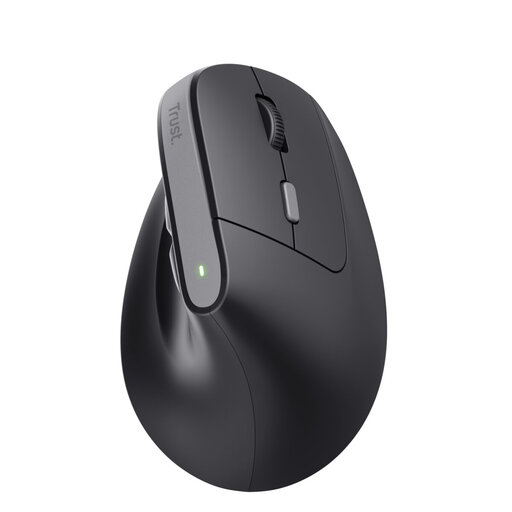
Trust Bayo II Medical, right-handed
This version is designed for right-handed use. Check that it suits your hand before comparing its other features.
Wireless RF; optical; 2400 DPI; black.
View on Joybuy
Frequently asked questions
Will a vertical mouse definitely help prevent wrist discomfort?
No. A vertical mouse doesn’t guarantee that discomfort will be prevented or treated. Research into the mice studied describes differences in arm posture and pointing performance. Choose one to suit your hand and tasks, and vary your screen-based work.
How do you connect a vertical mouse to your laptop?
It depends on the exact version: a wired mouse uses a cable, while a wireless version may use a USB receiver or Bluetooth. Check the model’s connection details and the available ports or Bluetooth on your laptop.
What can help during long sessions managing membership records?
The Dutch Arboportaal recommends varying screen-based tasks, changing your posture and taking micro-breaks. Using a different mouse doesn’t replace the need to vary your work.
What if the mouse doesn’t suit you or breaks after you buy it online?
ACM ConsuWijzer states that online consumer purchases come with a 14-day cooling-off period after delivery, although exceptions apply. This is separate from your statutory guarantee: the retailer remains responsible for ensuring the product meets what you could reasonably expect. Check the terms that apply to your purchase and keep your proof of purchase.
Do you have to use a vertical mouse as a student?
Information from the Dutch Arboportaal describes obligations around safe screen-based work, not a prescribed mouse model. Employer obligations don’t automatically apply to personal use in your student room.


