
Revision-card maker with little room for a mouse
You switch between revision cards, your keyboard and digital resources on a small desk. A grip that suits your hand and leaves enough room to move the mouse are key things to consider.


First, choose a vertical mouse that fits your hand and leaves enough room to move it alongside your revision cards and keyboard. Then decide whether Bluetooth, a USB receiver or a cable is best for your laptop and desk. A study involving 16 participants, published in Ergonomics in 2013, and a 2015 NIOSH/CDC evaluation looked at factors including forearm posture and pointing performance. A vertical mouse may reduce forearm rotation, but it can take time to get used to and has not been proven to treat symptoms.
You switch between revision cards, your keyboard and digital resources on a small desk. A grip that suits your hand and leaves enough room to move the mouse are key things to consider.
You regularly clear your workspace or use several devices. Choose a connection that works with your laptop and avoids having to route an awkward cable around your revision cards.
You do a lot of scrolling and selecting, and want to be able to adjust the cursor speed. Make room in your study session to alternate between screen work and writing revision cards, too.
Start with the fit and the room you have to move the mouse. Then check that the connection, cursor controls and power supply suit your laptop and study space.
| What to consider | What to check before buying | Who is this most important for? |
|---|---|---|
| Fit and room to move | Check which hand the mouse is designed for, the recommended hand size, its dimensions and the space you have to move it. | When I switch between revision cards, my keyboard and mouse on a small desk, I want a grip that suits my hand and doesn't get in the way of my movements. Around 33% of consumers prioritise fit and room to move. |
| Connection and cable routing | Check Bluetooth support, available USB ports and the connection type for the version you have chosen. | I want to connect my laptop without a cable running between my revision cards or a receiver taking up my only available port. Around 27% of consumers prioritise connecting to a laptop. |
| Cursor controls | Check whether you can adjust the cursor speed and whether the clicking, dragging and scrolling suit your tasks. | When selecting and scrolling through digital resources, I want to move the cursor precisely on my small work surface. Around 20% of consumers are most concerned about pointing and scrolling. |
| Power and use | Check whether the model uses a battery, a rechargeable battery or a USB cable, and what you need for your connection. | I don't want to have to stop unexpectedly during a study session to charge my mouse or replace a battery. Around 20% of consumers prioritise uninterrupted power. |
Research published in Ergonomics and a NIOSH/CDC evaluation describe differences in forearm posture and pointing performance, but do not prove that any particular model treats symptoms.
Choose based on fit and what you plan to use it for. Give yourself time to get used to the grip, and take breaks from screen work.
Trust makes both a wired and a wireless Bayo II; the versions differ in their connection and power supply.
Check the full product specification and connection type before ordering.
The mouse also needs room to move when you switch between revision cards and your keyboard. According to Logitech, the Lift is 108 mm high; a detachable wrist rest may also take up extra desk space.
Compare the dimensions with your workspace and consider any wrist rest separately.
ACM ConsuWijzer explains that statutory rights exist alongside a seller's or manufacturer's warranty. What you can expect from a product also depends on normal use.
Keep your proof of purchase and product description, and contact the seller if the product is faulty.
The Lift is worth considering if you have a small to medium-sized hand and want a wireless connection.
The Bayo II is available as a wired or wireless vertical mouse, so you can choose the connection that suits your workspace.
The HP 925 is worth comparing if you switch between devices and are considering a detachable wrist rest.
The VerticalMouse 4 comes in different sizes and versions for either hand; the VM4L is a wired left-handed version.
This selection includes wired and wireless vertical mice for a compact study space, with options for different connections and ways of working.
 No image available
An option if you switch between devices and want the flexibility to remove the wrist rest.
HP lists Bluetooth 5.3 or a dongle, and connection to up to three devices. The wrist rest is detachable, so allow for the space it takes up when in use.
 No image available
Suited to anyone who wants to work wirelessly and choose between Bluetooth and a USB receiver.
The product name lists Bluetooth, a 2.4 GHz USB receiver, a rechargeable battery and a 4,000 DPI sensor.
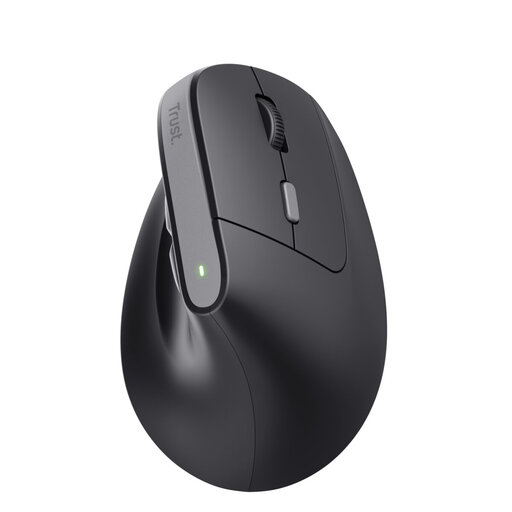 No image available
A wireless option if your laptop has a spare USB port for the receiver.
For the wireless Bayo II, Trust lists a stowable 2.4 GHz USB receiver. This version is for right-handed use.
 No image available
A wired option for a fixed study space with a suitable USB port.
Trust describes this Bayo II version as wired via USB. Allow space for the cable, and note that this version is for right-handed use.
 No image available
A wireless option that Logitech recommends for small to medium-sized hands; check that the right-handed version suits you.
Logitech lists dimensions of 108 × 70 × 71 mm and connection via Bluetooth or a USB receiver. The mouse uses a replaceable AA battery.
Measure the space beside your revision cards and keyboard, leaving room to move the mouse. Check your hand size and which hand you use, too: a mouse's dimensions alone won't tell you whether its grip is right for you.
You might. A study involving 16 participants, published in Ergonomics in 2013, found less forearm pronation when using a vertical mouse, but also slower pointing performance at first. The study does not prove that any specific retail model treats symptoms.
According to Logitech, the Lift can connect via Bluetooth Low Energy if your device supports it. Trust says the wireless Bayo II uses a 2.4 GHz USB receiver, so check the version and the ports available on your laptop.
No. Arboportaal recommends varying your tasks and posture and taking micro-breaks when working at a screen. This is guidance on use; employers' obligations to employees do not automatically apply to someone studying privately.
For a Dutch online consumer purchase, ACM ConsuWijzer says you will usually have a statutory 14-day cooling-off period after delivery; check the applicable exceptions and returns policy. A faulty product is a separate matter: statutory rights against the seller also apply.