What should you look for when choosing one?
First measure the space available for movement and choose a version that suits your hand. Then compare the controls and connection options for your workspace.
| What to consider | What to look for | Who is this important for? |
|---|
| Space to move |
Measure the clear space next to your keyboard and consider how much room you need to move the mouse. Compare the cable route with a wireless connection. |
When I put my programme sheets next to the keyboard, I want to be able to move the mouse without touching the papers. Around 36% of consumers in this use case put desk space first. |
| Fit and working hand |
Check whether the exact version is left- or right-handed and compare the stated hand size with your own. Try the grip if possible. |
I want a mouse that suits my hand size and working hand, not just one with a vertical shape. Around 29% of consumers in this use case prioritise fit and working hand. |
| Working with documents |
Check whether you can adjust the cursor speed and whether the scroll wheel and buttons are easy to reach for the way you work. |
When organising and editing programme sheets, I want to point accurately and scroll through documents easily. Around 21% of consumers give document control the highest priority. |
| Connection and power |
Check whether your computer supports Bluetooth or has a spare USB port for the receiver. Also check how the specific version is powered. |
I want to know in advance whether my computer supports the connection I’ve chosen and whether I’ll need a cable or battery. Around 14% of consumers in this use case prioritise the connection and what they’ll need during use. |
Vertical mice at Joybuy
This selection includes vertical mice for editing documents at a compact desk. Check the hand version, connection and controls for each model.
 No image available
Ergonomic vertical wireless mouse with USB-C charging
The wireless version can keep a mouse cable off your work surface. Check which connection is right for your computer.
Bluetooth and 2.4 GHz connection with USB receiver.
Three DPI levels: 800, 1200 and 1600; six programmable buttons.
The USB receiver is needed for the 2.4 GHz connection.
View at Joybuy
 No image available
Wireless ergonomic vertical mouse with six buttons
The wireless version can keep a mouse cable off your desk. The connection described uses a USB receiver.
800–1600 DPI and six buttons.
USB-C rechargeable battery and four-way scroll wheel.
View at Joybuy
 No image available
HP 925 ergonomic vertical mouse
Bluetooth or a USB receiver lets you use this mouse without a mouse cable across your work surface. Check which connection you want to use.
Six buttons and a 4000 DPI sensor.
The USB receiver uses a port when you choose that connection option.
View at Joybuy
 No image available
Logitech MX Vertical
Bluetooth and a USB receiver offer wireless connection options; the receiver uses a USB port.
4000 DPI sensor, four buttons and a DPI switch.
Rechargeable battery.
View at Joybuy
 No image available
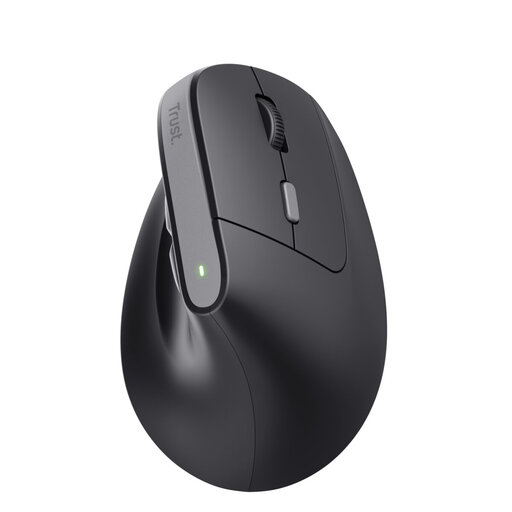
Trust Bayo II wireless right-handed mouse
The wireless RF connection uses a USB receiver and can keep a mouse cable off your work surface.
Optical mouse with thumb buttons and adjustable DPI from 800 to 2400.
View at Joybuy
Frequently asked questions
Can a vertical mouse on its own prevent discomfort during long editing sessions?
No, you shouldn’t assume that from the mouse’s shape. TNO discusses the risks of prolonged screen work, and Arboportaal advises alternating screen work with tasks that don’t require a screen. If discomfort persists, individual advice is more important than a product claim.
How do you set up a vertical mouse in a cramped workspace?
Leave enough room to move the mouse without touching your programme sheets. If you have a wired mouse, route the cable so it doesn’t get in the way. For a wireless model, check that your computer supports the connection you’ve chosen. Then adjust the cursor speed for accurate pointing.
What ongoing requirements should you check?
Check the power type for the exact version. Kensington specifies one AA battery for the Pro Fit Ergo Vertical mentioned above; the Trust Verto works via a USB cable.
What if a mouse bought online doesn’t fit comfortably?
According to ACM ConsuWijzer, online purchases generally come with a statutory cooling-off period of up to 14 days after delivery, with some exceptions. Check the applicable terms and don’t try the product any more than necessary to assess it.
Does a manufacturer’s warranty replace the statutory guarantee in the Netherlands?
No. ACM ConsuWijzer explains that the statutory guarantee exists alongside a seller’s or manufacturer’s warranty. If a product is faulty despite normal use, the seller must provide a solution under the applicable terms; this doesn’t mean that every mouse has a fixed statutory guarantee period of two years.


