What should you look for when choosing?
Start with your hand size and the space available for movement. Then compare the controls and connection options that suit your computer and workspace.
| What to consider |
What should you check? |
Who is this important for? |
| Room to move |
Measure the free space beside your keyboard and compare it with the mouse dimensions and the room your hand needs. |
When I keep drawings open next to my keyboard, I want to move the cursor without hitting papers or other items. Around 31% of consumers say room to move is their main consideration. |
| Hand size and handedness |
Check the stated hand size, whether the version is for left- or right-handed use, and whether you can reach the buttons comfortably. |
I want a grip that suits my hand and a version designed for my dominant hand, especially if I spend a long time navigating plans. Around 25% of consumers prioritise fit. |
| Controls for detailed work |
Check whether the cursor speed is adjustable, how the scroll wheel works and whether the software features you want are available on your operating system. |
When working with dimension lines and small components, I want to position the cursor with control and move quickly around larger drawings too. Around 25% of consumers prioritise controls for detailed work. |
| Connection and power |
Check Bluetooth support, available USB ports and whether the version uses an AA battery, a rechargeable battery or a cable. |
If I want to keep cables and USB ports to a minimum on my small workspace, I consider both the connection and power source of the version I choose. For around 19% of consumers, connection and maintenance are the most important factors. |
Vertical mice at Joybuy
This selection includes vertical mice for wireless use and models with specific controls. Compare the fit, connection and features of each version.
 No image available
Wireless vertical mouse with USB-C and Bluetooth
An option to compare if you want to work wirelessly and adjust the cursor speed for different tasks.
USB-C charging, Bluetooth and a 2.4GHz connection with a USB receiver. Three DPI settings: 800, 1200 and 1600. The description lists six buttons and a four-way scroll wheel.
View at Joybuy
 No image available
Wireless vertical mouse with 6 buttons
Compare this version if you’re looking for a wireless connection and multiple DPI settings.
The title lists DPI settings from 800 to 1600 and a 2.4GHz connection. The description mentions six programmable buttons, a rechargeable battery and USB-C charging.
View at Joybuy
 No image available
Logitech MX Vertical
Compare this established vertical model if you have a larger hand and want to adjust the cursor speed. RTINGS rates the MX Vertical as better suited to larger hands than the Lift.
Bluetooth or 2.4GHz via a Unifying USB receiver, a rechargeable battery and a 4000 DPI sensor. The product name lists four buttons and compatibility with PC, Mac and iPadOS.
View at Joybuy
 No image available
Logitech Lift, graphite, right-handed version
Logitech describes the Lift as suitable for small to medium-sized hands; check that this right-handed version fits your hand.
Bluetooth or a USB receiver, adjustable DPI and one replaceable AA battery. Logitech also offers the Lift separately in a left-handed version.
View at Joybuy
 No image available
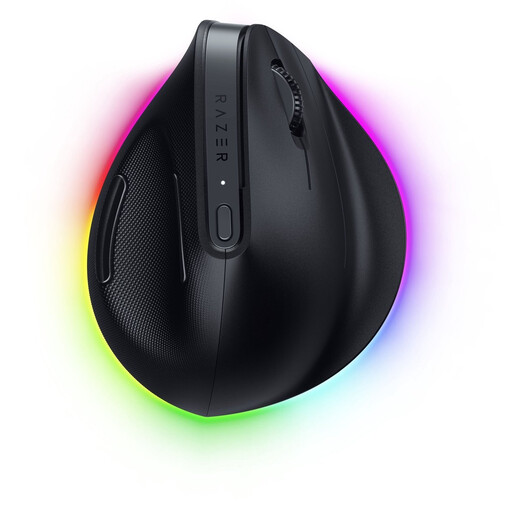
Razer Pro Click V2 Vertical Edition
A model to compare if you’re looking for a wireless connection and adjustable controls.
The product description mentions Bluetooth and Razer HyperSpeed, programmable buttons and settings via Razer Synapse 4.
View at Joybuy
Frequently asked questions
Is a vertical mouse enough for long sessions working on renovation plans?
No. A vertical mouse is no substitute for a properly set-up workstation or taking breaks from prolonged computer work. The Arboportaal highlights taking breaks, microbreaks and adjusting your workstation to suit your body as important considerations.
How can I connect a mouse without adding another cable to my desk?
Check the connection options for the exact version and what your computer supports. Logitech lists Bluetooth Low Energy or a Logi Bolt USB receiver for the Lift; the wireless Trust Verto uses a USB micro receiver. Bluetooth requires support from your computer, while a receiver needs a compatible USB port.
What should I look for when it comes to the battery and maintenance?
It depends on the version: the Logitech Lift uses one replaceable AA battery, while Trust lists a rechargeable battery for the wireless Bayo II. Before buying, check which power source the model uses and what’s included.
What are my rights if I’m unhappy with a mouse bought online or it develops a fault?
For distance purchases from a business, you’ll usually have a 14-day cooling-off period. You also have statutory rights if a product is faulty; the Rijksoverheid states that the Netherlands doesn’t have a fixed statutory two-year guarantee period and that the retailer is your point of contact. Check which terms apply to your purchase.
Is CE marking relevant for a wireless mouse?
EU rules on radio equipment apply to wireless versions. The European Commission describes Directive 2014/53/EU as the framework for placing radio equipment on the market. A mention in an online shop isn’t, on its own, proof that a specific item meets all the requirements.


