What should you consider when choosing?
First, work out what hand size, preferred hand and amount of movement space suit your workspace. Then consider connectivity and the features you need for your teaching tasks.
| What to consider |
What to look for |
Who it matters most to |
| Workspace |
Set out your keyboard and documents as you would when planning lessons; check there’s room for both the mouse and your forearm. |
If I’m using teaching materials and a keyboard together on a small desk, I want to be able to move my mouse and forearm freely. Around 34% of consumers give desk space top priority. |
| Hand size and preferred hand |
Measure your hand using the manufacturer’s size guide and check whether the model is for left- or right-handed use. |
I want a grip and model that suit my hand size and whether I use a mouse with my left or right hand. Around 33% of consumers prioritise how well a mouse fits their hand. |
| Connectivity |
Check for Bluetooth support or an available, compatible USB port, and consider how you’ll manage the battery. |
I want a mouse that connects to my laptop and suits how I prefer to manage a cable, receiver or battery. Around 20% of consumers give connectivity top priority. |
| Navigation |
Check that the buttons and cursor speed work for your tasks and software. |
When preparing lessons, I want to select items precisely and browse materials quickly. Around 13% of consumers prioritise navigation and controls. |
Brands to consider
The brands listed offer different hand sizes, connectivity options and features. The details below apply to the specific product ranges mentioned, not every model from each brand.
Logitech
Logitech describes Lift as suitable for small to medium hands and also offers a left-handed version. According to the manufacturer, MX Vertical is designed for medium to large hands.
- For Lift, Logitech lists a 57-degree vertical angle, quiet buttons and SmartWheel.
- Fit and features vary by model and version; manufacturer claims about comfort aren’t proof of a health benefit.
Trust
Trust offers wireless connectivity with the Bayo II, as well as the wired Verto for a fixed workspace.
- Trust lists a rechargeable battery and 2.4GHz USB receiver for the wireless Bayo II, and a 1.5-metre USB cable for the Verto.
- The receiver needs a compatible USB port, while the Verto’s cable needs to fit on your desk. Ergonomic benefits haven’t been independently proven.
R-Go Tools
R-Go HE Break may be worth considering if hand size, preferred hand or a break reminder is important to you.
- R-Go lists several hand sizes and versions for left- and right-handed use. The break indicator is powered by the accompanying software.
- Check the size, connectivity and software compatibility of the exact version. A reminder isn’t a medical treatment.
BakkerElkhuizen
According to the manufacturer, Evoluent 4 Small is a vertical mouse for small right hands.
- The manufacturer lists four cursor speeds, programmable buttons and a little-finger rest for Evoluent 4 Small.
- These features don’t automatically apply to other sizes or left-handed versions; check the model’s connectivity.
Joybuy products
This selection focuses on wireless vertical mice for anyone who wants to keep cables off a small desk. Check the connectivity and handedness for each model.
 No image available
Wireless vertical mouse with USB-C
The wireless connectivity options may suit you if you want to keep cables off your desk; check which connection works with your laptop.
Bluetooth and 2.4GHz via USB receiver; USB-C rechargeable battery; three DPI levels: 800, 1200 and 1600; six programmable buttons.
View at Joybuy
 No image available
Wireless vertical mouse with six buttons
The USB receiver may suit you if your laptop has a spare compatible port and you want to navigate teaching materials.
2.4GHz via USB receiver; USB-C rechargeable battery; six buttons; four-way scroll wheel; three DPI settings within 800–1600 DPI.
View at Joybuy
 No image available
HP 925 Ergonomic Vertical Mouse
This version may suit you if you want to use Bluetooth or an HP receiver; the listed version is for right-handed use.
Six buttons; 4000 DPI; Bluetooth or connection via an HP receiver; built-in battery; connects to up to three devices.
View at Joybuy
 No image available
Logitech MX Vertical
Bluetooth or a USB receiver may work with your laptop; the listed version is for right-handed use.
4000 DPI sensor; adjustable DPI; Bluetooth or 2.4GHz via Unifying USB receiver; rechargeable battery; four buttons; multi-device control.
View at Joybuy
 No image available
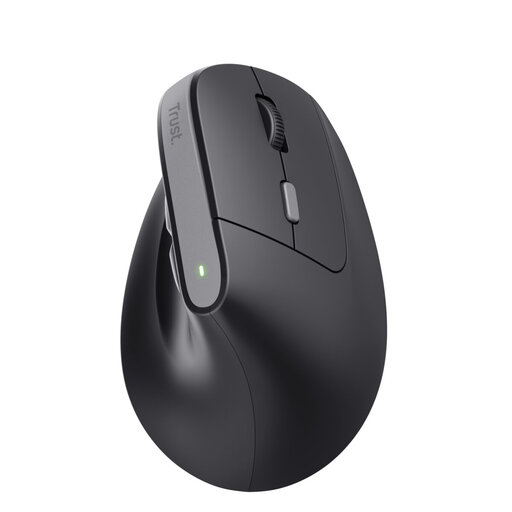
Trust Bayo II, right-handed
This wireless version may suit you if you have a spare compatible USB port; Bluetooth isn’t listed as a connectivity option.
2.4GHz via storable USB receiver; rechargeable battery; adjustable DPI; two thumb buttons for navigation.
View at Joybuy
Frequently asked questions
Can a vertical mouse prevent wrist or arm discomfort?
There’s no guarantee. Studies published in Ergonomics and in the CDC/NIOSH repository found less forearm rotation with the vertical mice they examined, but also found that pointing tasks may be slower. Vary your screen-based work; a mouse can’t replace a suitable workstation setup.
How should I set up my mouse on a small desk?
Check that you can use your keyboard, documents, mouse and forearm alongside one another. Arrange your things as you would when planning lessons, then see whether you can move the mouse freely. Arboportaal recommends varying your screen-based work and taking microbreaks.
Can any wireless vertical mouse connect without a USB receiver?
No. Logitech lists Bluetooth for Lift, while Trust describes the wireless Bayo II as using a 2.4GHz USB receiver. Check the connectivity options for the exact version and what your laptop supports.
How do I choose the right hand size and handedness?
Choose based on your own hand size and whether you use a mouse with your left or right hand, not the size of your desk. Check the size guide and the handedness of the specific version; manufacturers offer different options.
Can I try an online-bought mouse at home to check the fit?
For eligible online consumer purchases, you generally have a statutory 14-day cooling-off period after delivery, according to ACM ConsuWijzer. Check the terms and any exceptions that apply to your purchase, and handle the product carefully while checking the fit.


