First, choose a vertical mouse that suits your hand and whether you’re left- or right-handed, and that you can use close to your keyboard. Then compare its connection, cursor speed and how easy it is to reach the scroll wheel and buttons. A wireless mouse keeps your desk free of cables, but may need a receiver or battery. A vertical mouse is no substitute for a well-set-up workstation or taking breaks from screen work; Arboportaal advises keeping your mouse within easy reach.
Who is this choice relevant to?
Minute-taker with limited desk space
When taking minutes, you switch between typing, pointing and scrolling, and want to keep your mouse close at hand. Arboportaal advises keeping your elbows close to your body and suggests using a narrow keyboard to bring the mouse closer.
Minute-taker who does a lot of navigating
You often move through long documents and want a scroll wheel that’s easy to reach, a suitable cursor speed and, perhaps, customisable buttons. Features vary by model and operating system.
Buyer with a specific hand size or handedness
You want to avoid choosing a model that’s too large for your hand or, if you’re left-handed, one designed exclusively for right-handed use. Manufacturers offer different sizes and versions for left- and right-handed users.
What should you look for?
When editing meeting minutes at a small desk, available space, document navigation, hand fit and connectivity all play a part.
| What to consider |
What should you check? |
Who is this important for? |
| Space and reach |
Compare the dimensions of the exact model with the space available beside your keyboard. Check that you can keep the mouse close to you. |
If your desk is short on space, you’ll want to point and scroll without placing the mouse too far forwards. Around 36% of consumers prioritise desk space and reach. |
| Navigating meeting minutes |
Check how easy it is to reach the scroll wheel and buttons. See whether the cursor speed and any accompanying software suit the way you work. |
If you often work with lengthy minutes, smooth scrolling and accurate pointing matter more than a high DPI figure on its own. Around 29% of consumers put document navigation first. |
| Fit and handedness |
Check the hand size the mouse is designed for and whether it’s intended for left- or right-handed use. Make sure you can reach the buttons comfortably. |
If you have small hands or use a mouse with your left hand, you’ll want a version that suits your hand size and handedness. Around 21% of consumers prioritise hand fit. |
| Connectivity and maintenance |
Check your computer’s ports, how the mouse connects and whether it needs a receiver, adapter or battery. |
If you want to minimise cables, adapters or battery changes, the connection type of the exact model will help determine whether it suits your workstation. Around 14% of consumers start with connectivity and maintenance. |
Common pitfalls
-
Assuming ‘vertical’ automatically means ‘suitable for a small desk’
The shape doesn’t tell you how much space a mouse takes up or how far your arm has to reach. If a mouse only fits well beyond your keyboard, you may end up working with your arm stretched further away from your body.
Compare the dimensions and available room to move the exact model with your desk and hand position.
-
Choosing a right-handed model for left-handed use
Handedness options vary by model. According to the manufacturer, Logitech also offers the Lift for left-handed users; Evoluent says there is no left-handed version of the VM4S.
Before buying, check the handedness of the exact version you’re looking at.
-
Assuming every USB mouse works without anything extra
The Evoluent VM4S uses USB-A. Evoluent says you’ll need an adapter or hub if your computer only has USB-C ports; wireless models may use a receiver and battery.
Compare your computer’s ports with the connection type and box contents of the exact model.
An adapter or hub and replacement batteries may mean extra steps when using the mouse.
-
Taking an ergonomic claim as a guarantee that discomfort will go away
A vertical mouse is no substitute for paying attention to your workstation as a whole and varying your activities during screen work. Arboportaal advises alternating between postures and tasks when working with screens.
Consider how well the mouse fits your hand separately from your workstation setup. If discomfort starts, speak to a prevention officer or occupational health doctor if needed.
Brands to compare
Logitech
According to Logitech, the Lift is designed for small to medium-sized hands and is also available in a left-handed version.
- Logitech says the Lift has a 57° angle and buttons that are easy to reach.
- A PCWorld review describes its grip and adjustability as suitable for smaller hands, but says the Lift isn’t an obvious replacement for specialist aids if you already have more serious problems. This isn’t evidence that the mouse treats discomfort.
Trust
The Verto is available as the wired 22885 and wireless 22879, so you can compare their connection types.
- Trust lists a 1.5-metre cable and 1000 and 1600 DPI settings for the wired Verto 22885. For the wireless 22879, Trust lists a USB micro receiver and 800, 1200 and 1600 DPI settings.
- Trust’s claims about reduced strain are manufacturer claims, not independent measurements of how the mouse will work for you.
Evoluent
According to Evoluent, the wired VerticalMouse 4 Small VM4S is designed for smaller right hands.
- For the regular VerticalMouse 4, Evoluent recommends a hand length of around 178 mm or more, measured from the tip of the middle finger to the wrist crease; the Small may be a better fit for shorter hands.
- The VM4S has USB-A and isn’t available in a left-handed version. Evoluent says Mouse Manager isn’t compatible with macOS; computers with only USB-C ports need an adapter or hub, which isn’t included.
Kensington
According to the manufacturer, Kensington designed the wireless Pro Fit Ergo K75501EU for medium to large hands.
- Kensington lists a nano receiver, several DPI settings and an AA battery.
- The manufacturer says Windows 11 on Arm isn’t supported. A comfort claim on the product page isn’t independent evidence that the model prevents discomfort.
Vertical mice at Joybuy
These Joybuy products are vertical mice with wireless connectivity options. Compare their fit, buttons and connection type with your workstation and the way you edit meeting minutes.
 No image available
Vertical wireless mouse with USB-C charging
A good option if you want to navigate meeting minutes wirelessly and choose your cursor speed.
The Joybuy product listing mentions Bluetooth and 2.4 GHz connectivity, USB-C charging and three DPI settings: 800, 1200 and 1600.
Joybuy
 No image available
Vertical wireless mouse with 6 buttons
An option to compare if you want extra buttons for editing and prefer to work wirelessly.
The Joybuy product listing mentions six buttons, a 2.4GHz connection, a USB-C battery and a DPI range of 800–1600.
Joybuy
 No image available
HP 925 Ergonomic Vertical Mouse
Worth comparing if you’re looking for a wireless vertical mouse for taking minutes and want to see whether its controls suit your hand.
Joybuy
 No image available
Logitech MX Vertical
Worth comparing if a scroll wheel and wireless connectivity matter to you when working with documents.
The Joybuy product listing mentions 4000 DPI, Bluetooth or 2.4 GHz via a Unifying USB receiver, a rechargeable battery and four buttons.
Joybuy
 No image available
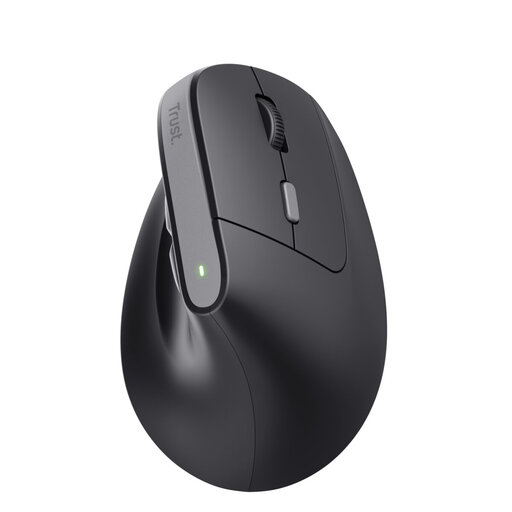
Trust Bayo II for right-handed use
An option to compare if you’re looking for a wireless vertical mouse for right-handed use.
The Joybuy product listing mentions an optical sensor, RF wireless connectivity and 2400 DPI.
Joybuy
Frequently asked questions
Is a vertical mouse enough on its own to set up your workstation properly?
No, the mouse alone doesn’t determine whether your workstation is set up appropriately. Arboportaal advises keeping your mouse within easy reach and varying your posture and tasks during screen work.
What should I check about connectivity and settings?
First, check your computer’s ports and the connection type of the exact model. The wired Evoluent VM4S uses USB-A; if your computer only has USB-C ports, you’ll need an adapter or hub. Evoluent lists Mouse Manager for Windows, but not for macOS.
What are my rights if a mouse bought online doesn’t fit or develops a fault too soon?
Online consumer purchases generally come with a 14-day statutory cooling-off period after delivery, subject to exceptions that must be disclosed in advance. ACM ConsuWijzer also explains that if a product is faulty, the seller is responsible for providing an appropriate solution free of charge. This doesn’t mean every mouse has a fixed statutory two-year warranty.
Are employers required under Dutch rules to provide a vertical mouse?
Arboportaal guidance recommends alternating screen work with other tasks or taking a break. So, assess a mouse in the context of your workstation setup and needs; the guidance doesn’t specify a particular vertical model.


