
Organiser sharing a desk
You plan alongside left- and right-handed people and want to know whether one reversible mouse will suit everyone. R-Go Tools describes the Twister as reversible, but you should also check that it fits each user.


If left- and right-handed people are sharing a mouse, choose a model that can actually switch between the two hand orientations. A separate left- or right-handed version isn’t the same thing. If one person will use the mouse most of the time, consider their hand size, connectivity needs and preferences for pointing and clicking. A vertical mouse doesn’t guarantee that you’ll avoid discomfort, and it may take time to get used to.
You plan alongside left- and right-handed people and want to know whether one reversible mouse will suit everyone. R-Go Tools describes the Twister as reversible, but you should also check that it fits each user.
You regularly work on lists, messages and schedules, and are mainly concerned with hand size, control and getting used to the mouse, even if you share your workspace. Logitech says the Lift is available for small to medium-sized hands.
You use several computers at or around your desk and want to know in advance how the mouse connects and switches between devices. Logitech says the MX Vertical offers several connection options and Easy-Switch for three computers.
| What to consider | What should you check? | Who is this important for? |
|---|---|---|
| Both hand orientations | Check whether the exact model really switches between left- and right-handed use, and whether both users find its shape comfortable. | If left- and right-handed people share a mouse, I don’t want to need a different handed version for each user. Around 28% of consumers prioritise suitability for both hand orientations. |
| Hand size and fit | Check the size information for the specific model and assess the grip and how easy the buttons are to reach. | I want the mouse to fit the main user’s hand well, even if not everyone at the desk has the same hand size. Around 22% of consumers give hand size and fit top priority. |
| Connectivity and devices | Check which USB port or Bluetooth connection is available on each computer, and whether you need to switch between devices. | When I plan on different computers, I want to know whether the mouse can connect to each one. Around 22% of consumers consider compatibility with the computers available to them most important. |
| Control and getting used to it | Try pointing, clicking and scrolling with your own planning software, and assess the cursor speed. | During long planning sessions, I want to move comfortably through calendars, lists and forms. Around 17% of consumers prioritise control and getting used to the mouse. |
| Battery and accessory management | Check whether you’ll need a cable, receiver, charging option or adapter. | If I want to keep things simple at a shared desk, I check which accessories and power supply the chosen connection requires. Around 11% of consumers prioritise simple management. |
The Logitech Lift is available in separate left- and right-handed versions; R-Go Tools describes the Twister as reversible. A version that suits one user won’t necessarily suit everyone sharing the desk.
Make a note of who will use the mouse and check whether the exact model can switch between hand orientations. Also assess how well it fits the intended users.
If a mouse is only suitable for one hand orientation, you may need a second mouse in a different version.
Research into vertical mice describes differences in posture and pointing performance across the devices studied. This doesn’t prove that a particular model will be more comfortable for every user or prevent discomfort.
Try the mouse with your own planning tasks and assess pointing and scrolling. Also vary your working posture and take microbreaks, as advised by Arboportaal.
Connections vary between models and computers. Evoluent lists a USB-A plug for the wired VM4L; according to the manufacturer, you’ll need an adapter or hub if your computer only has USB-C ports.
Check the ports on every computer you want to use the mouse with, and see which connection the exact version requires.
You may need a USB-C adapter or hub if the computer doesn’t have a suitable USB-A port.
Relevant models if you’re considering a reversible mouse or are looking for a specific size and handed version.
The Lift and MX Vertical offer different options for handedness and connectivity, for users who will mainly operate the mouse themselves.
The wired Verto and wireless Bayo II are options for different connectivity preferences.
VerticalMouse models are available in separate handed versions and sizes, which may be relevant if fit for one user is the main consideration.
These Joybuy products are vertical mice for planning work. Check the handed version, connectivity and controls for each model to make sure they suit your shared workspace.
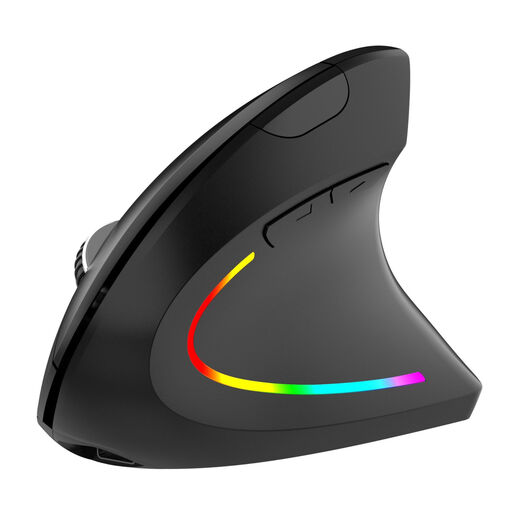 No image available
An option if you’re looking for a wireless mouse with adjustable pointer speed for planning work.
The product description lists a 2.4GHz receiver, USB-C charging, four dpi levels, six buttons and quiet buttons.
 No image available
An option if you want to choose between Bluetooth and a USB receiver; check which connection is available on each computer.
The title lists Bluetooth and 2.4GHz. The description mentions six buttons, three dpi levels (800, 1200 and 1600) and USB-C charging.
 No image available
An option if you want to adjust the pointer speed while planning and work wirelessly.
The product title lists Bluetooth, 2.4GHz, USB-C charging and six buttons. The dpi settings listed range from 800 to 1600.
 No image available
An option for a right-handed main user who switches between several computers; it isn’t designed for alternating between left- and right-handed use.
The product specifications list connections to up to three devices via Bluetooth or dongle, a rechargeable battery and a 4000 DPI sensor.
 No image available
An option for a right-handed user who switches between computers; this version isn’t suitable for alternating between left- and right-handed users.
The product title lists Bluetooth, a 2.4GHz connection via a Unifying USB receiver and a rechargeable battery. The sensor is listed at 4000 DPI; the title also mentions four buttons and compatibility with PC, Mac and iPadOS.
No, you can’t assume that for every user. Research comparing standard and vertical mice, and an evaluation of flat, angled and vertical mice, describes differences in posture and pointing performance across the devices studied. Try the mouse with your own tasks and take breaks from screen work.
According to Logitech, the Lift is available in separate left- and right-handed versions. If one mouse needs to switch between both hand orientations, choose a model designed for that purpose; also check that its shape suits the users.
First, check the USB port or Bluetooth capability of each computer and make sure it matches the connection on the exact model. Set up the workspace for each user and take regular breaks from extended screen work. Arboportaal recommends alternating screen work with other tasks or a break, and taking microbreaks.
Arboportaal’s guidance describes employers’ obligation to make sure employees regularly alternate screen work with other tasks or a break. It doesn’t automatically follow that a specific volunteering arrangement falls under that employment relationship, so don’t present the employer’s obligation as a general requirement for every volunteer.
No, not in every situation. The Dutch government says consumers buying at a distance usually have a 14-day cooling-off period, subject to exceptions. Check who the buyer and seller are: this doesn’t necessarily apply when an organisation buys for business purposes or when you buy from a private individual.