
People sharing a desk
If you want left- and right-handed users to take turns using the same mouse, a model that can be switched between hands is worth considering. R-Go Tools positions the Waver as suitable for shared use.


If people with different dominant hands are sharing a mouse, an ambidextrous model is a good place to start. If one person will mainly be updating the inventory, a suitable hand-specific model and size may matter more. Also check the connectivity and grip of the exact model: a vertical shape is no guarantee of reduced discomfort or comfortable use for everyone.
If you want left- and right-handed users to take turns using the same mouse, a model that can be switched between hands is worth considering. R-Go Tools positions the Waver as suitable for shared use.
If you’ll usually be the one updating the inventory, consider your dominant hand and hand size. The models reviewed differ in this respect: Logitech positions the Lift for small to medium-sized hands, while Evoluent says the VerticalMouse 4 Left Wired is for medium to large left hands.
If you want to use the mouse with the shared computer without any connectivity surprises, check its USB ports and how the exact model connects. Evoluent’s wired VM4L has USB-A; according to Trust, the wireless Trust Verto 22879 uses a USB receiver.
| What to consider | What should you check? | Who is this most important for? |
|---|---|---|
| Sharing one mouse between users | Check whether the exact model can be used by both left- and right-handed users, and whether both users find the grip comfortable. | If you don’t want a separate mouse for each dominant hand, sharing comes first; around 37% of consumers give sharing between users with different dominant hands top priority. |
| Fit and hand size | Check the model’s size recommendation and whether its hand-specific version suits your dominant hand. | If you’ll mainly be the one updating the inventory, you’ll want a mouse that fits your hand; around 27% of consumers put personal fit first. |
| Connecting to the computer | Check the available USB port, Bluetooth support, receiver type and what’s included with the model. | If you want to use the shared computer without connectivity issues, the port and connection type are key; around 18% of consumers give connectivity top priority. |
| Using the mouse while updating inventory | Try pointing, clicking and scrolling. Check that the settings you want to use work without relying on unwanted software. | If you navigate through lots of lists, you’ll want the controls to feel comfortable and easy to use; around 18% of consumers put ease of use first. |
A vertical mouse isn’t automatically comfortable for everyone and can’t guarantee a medical outcome. Research into alternative mice supports choosing one based on your personal needs; it can also take time to get used to the controls.
Check the fit and try the mouse with the inventory tasks you actually do. Take breaks from screen work and have microbreaks; Arboportaal recommends this for screen work.
According to R-Go, the Waver can be switched between hands, while the Logitech Lift is available in separate hand-specific versions. A model that suits one user won’t necessarily work for someone with a different dominant hand.
Discuss who will use the mouse and check the hand-specific version of the exact model. If the other user can’t use it comfortably, you may need a second mouse.
The Evoluent VM4L has a USB-A plug. For a computer with USB-C only, Evoluent recommends an adapter or hub, which isn’t included. The wireless Trust Verto 22879 uses a USB receiver, and Trust doesn’t offer a replacement.
Before buying, check the available ports, receiver type and what’s in the box. You may need a suitable adapter or, if the receiver is lost, a different mouse.
R-Go Tools positions the Waver as a reversible mouse for left- and right-handed use. The HE Break range has separate hand-specific versions and sizes.
Logitech positions the Lift for small to medium-sized hands and offers a left-handed version.
Trust offers the wired Verto 22885 and the separate wireless Verto 22879.
The VerticalMouse 4 Left Wired, model VM4L, is a left-handed wired option that Evoluent positions for medium to large hands.
These product picks are suited to using a vertical mouse while updating inventory at a shared desk. Check the hand-specific version and connection for each model before choosing.
 No image available
A wireless vertical option if you can use the listed connection options with the shared computer.
Bluetooth and 2.4 GHz; USB-C charging; three DPI levels: 800, 1200 and 1600.
 No image available
Consider this model if you want a wireless vertical mouse for updating inventory and its listed connection suits your computer.
2.4 GHz; DPI range of 800–1600; USB-C listed for the battery.
 No image available
This right-handed version is better suited to a desk where the main user is right-handed than to a setup shared by left- and right-handed users.
 No image available
The right-handed version is worth considering if left- and right-handed users want to share the same mouse.
Bluetooth and 2.4 GHz via a Unifying USB receiver; 4000 DPI sensor; rechargeable battery; 4 buttons.
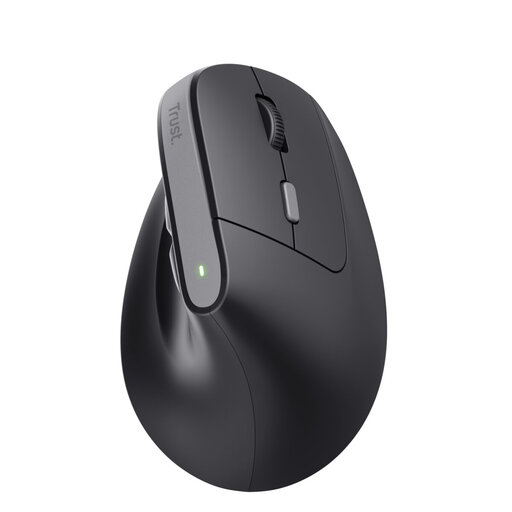 No image available
This right-handed version is most relevant when one user will be operating the mouse and the hand-specific design suits them.
Wireless RF connection via USB receiver; optical sensor; 2400 DPI.
No, a vertical mouse isn’t guaranteed to reduce discomfort for every user. A study in Ergonomics reported that, with the vertical mouse tested, it took longer to reach a target than with the standard mouse. A systematic review in Cogent Engineering recommends considering individual needs and work tasks when choosing a mouse.
Check the hand-specific design and connection of the exact model, and adjust the workstation for the person using it at the time. For screen work, Arboportaal recommends changing your working posture and taking microbreaks.
In the Netherlands, the seller is responsible if the product doesn’t do what you could reasonably expect during normal use. ACM ConsuWijzer says the seller must remedy a justified fault free of charge; the statutory guarantee doesn’t automatically have a fixed two-year term for every product.
Yes. An electronic device sold in the Netherlands must meet the applicable European product requirements and carry the required CE marking, as explained by the Netherlands’ Digital Infrastructure Inspectorate and Ondernemersplein. Wireless mice are also subject to the applicable radio equipment rules; this doesn’t in itself mean that a specific product has been checked.