
Writers who move between workstations
You write or edit at a shared desk and want a mouse that’s easy to connect and take with you. The available ports, access to Bluetooth and storage for a receiver may all affect your choice.


Before choosing a vertical mouse for a shared desk, check that the design suits your hand and that you’re allowed to connect it to the computer. If you do a lot of writing, easy-to-reach buttons and click noise matter too. Research described in Ergonomics and by Johnson and Odell via CDC/NIOSH suggests that a vertical mouse may encourage a different forearm posture, but also indicates that pointing performance may be poorer with a fully vertical mouse. It doesn’t prove that any model prevents discomfort, and you may need time to get used to it.
You write or edit at a shared desk and want a mouse that’s easy to connect and take with you. The available ports, access to Bluetooth and storage for a receiver may all affect your choice.
You want to try a different hand position and are looking for a mouse that suits your dominant hand and hand size. A vertical shape alone doesn’t guarantee a good fit.
You want to keep noise to a minimum while writing, so you don’t disturb people nearby. Check whether quiet buttons are specified for the exact version you’re considering.
First check the fit and whether the connection is permitted on the shared computer. Then consider whether the noise level and power management suit your workspace.
| What to consider | What should you look for? | Who is this important for? |
|---|---|---|
| Hand fit and posture | Check whether the mouse is designed for your dominant hand, whether it suits your hand size and whether the buttons are within easy reach; try the shape if possible. | I want a shape that suits my hand and feels comfortable to use. Around 36% of consumers say hand fit and posture are their top priority. |
| Connecting and carrying | Check which USB ports are available, whether Bluetooth pairing is permitted and whether you can easily store a receiver. | If I move between shared workstations, I want to know which connections are permitted and be able to take my mouse with me easily. Around 29% of consumers prioritise connectivity and portability. |
| Click noise | Check whether quiet buttons are specified for the particular version; this claim doesn’t automatically apply to every model or the scroll wheel. | I want to avoid disturbing colleagues nearby with repeated clicking. Around 21% of consumers put keeping things quiet for colleagues first. |
| Simplicity and power management | Choose between a cable and a wireless connection; for wireless use, check the stated power source or charging method. | If I mainly want to keep things simple, I weigh up using a cable against managing a wireless power source. Around 14% of consumers prioritise ease of use and predictable power management. |
Logitech Lift and Evoluent models have separate left- and right-handed versions. Choosing the wrong one may mean it isn’t suitable for your dominant hand.
Before ordering, check the full model name and whether the version is designed for your left or right hand.
According to Trust, the wireless Trust Bayo II uses a 2.4GHz USB receiver; HP lists Bluetooth and a dongle for the HP 925. The connection options therefore vary by model.
Choose based on the ports and connection options you’re actually allowed to use on the shared computer.
Task-based studies of mouse posture and pointing performance don’t prove that a particular model prevents or treats discomfort.
Assess the fit and controls for yourself. Take breaks from screen work; if discomfort persists, consider seeking appropriate professional advice.
According to Logitech, the Lift is designed for small to medium-sized hands and is available in separate left- and right-handed versions.
The Trust Bayo II is available as a wired USB version and as a wireless version with a USB receiver. The Bayo+ is a different product range.
For the 925, HP lists Bluetooth 5.3, an HP dongle, connectivity with up to three devices and a detachable wrist rest.
Evoluent offers VerticalMouse D models for right-handed users in different sizes, as well as a separate VerticalMouse 4 Left for left-handed users.
These models include wireless and wired vertical mice for writing at a shared desk. For each version, check the connection, hand fit and stated noise features.
 No image available
An option if you want to switch between compatible computers and can use Bluetooth or a dongle.
HP lists Bluetooth 5.3 or an HP dongle, with connectivity for up to three devices. According to the product description, the mouse has a detachable wrist rest and a built-in rechargeable battery.
 No image available
An option if you can connect wirelessly to the shared computer using Bluetooth or a USB receiver.
The product title lists Bluetooth, a 2.4GHz connection via USB receiver and a rechargeable battery. The product description says it can connect to up to three devices.
 No image available
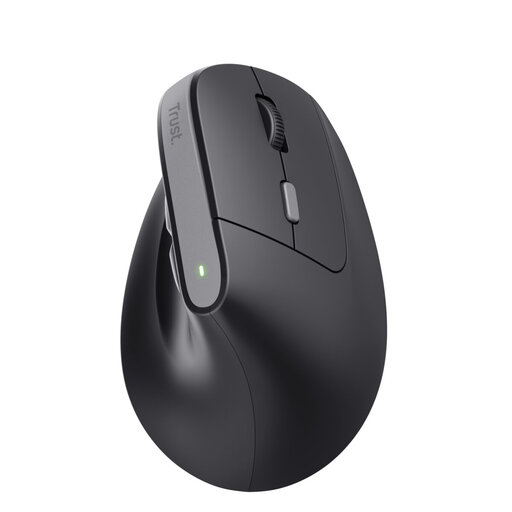
An option if the shared computer has a suitable USB port and you want to take a receiver with you.
According to the product description, this right-handed wireless version has a storable 2.4GHz USB receiver, two quiet buttons and a rechargeable battery. The product title lists 2400 DPI.
 No image available
An option if you have a suitable USB port, can make room for the cable and don’t want to manage a wireless power source.
This version has a wired USB connection. The product description lists adjustable DPI and two thumb buttons.
 No image available
An option if quiet clicks and the choice of Bluetooth or a USB receiver suit your shared workspace.
The product description lists quiet clicks and connection via Bluetooth or a USB receiver. Logitech offers the Lift in separate left- and right-handed versions; check which version you’re ordering.
No, it hasn’t been proven as a guarantee for any individual user. Two task-based studies looked at factors including forearm posture; they don’t prove that a particular model prevents discomfort. In one study, pointing tasks were performed less well with a fully vertical mouse, and you may need time to get used to it.
Position the mouse so you can use it without reaching too far, and alternate screen work with another task or a break. Arboportaal also describes employers’ obligations towards employees; this doesn’t in itself mean they have to provide a vertical mouse.
For many eligible online consumer purchases, you have a 14-day cooling-off period; check the seller’s terms and conditions. According to the Dutch government, if a product is faulty, you can contact the seller for a solution; there is no fixed statutory guarantee period in the Netherlands.
The government guidance consulted doesn’t require a vertical mouse. Arboportaal does recommend that employees alternate screen work with another task or a break, and it sets out requirements for workplace design. Some of these requirements depend on how long you work at a screen and your working situation.