
Users who prioritise fit
If you spend a long time checking results, you may want to consider your hand size, whether you need a left- or right-handed mouse, and your grip. A fixed vertical shape won’t necessarily suit everyone.


Start by checking the size of your hand and whether the mouse is designed for left- or right-handed use. Then make sure it connects to the computers you use at the shared desk. Easily reachable buttons and adjustable pointer speed can be useful when scrolling a lot and checking results. However, a different mouse is no substitute for a properly set-up workstation or taking breaks from screen work.
If you spend a long time checking results, you may want to consider your hand size, whether you need a left- or right-handed mouse, and your grip. A fixed vertical shape won’t necessarily suit everyone.
If you move between workstations, it’s worth checking in advance which connections are available and whether a suitable USB port is free.
When working through tables and reports, scroll controls, easily reachable buttons and the option to adjust pointer speed may all be worth considering.
At a shared desk, fit and connectivity are the first things to check. Then consider navigation and how you’ll manage the cable, receiver or battery.
| What to consider | What should you check? | Who is this most important for? |
|---|---|---|
| Hand size and handedness | Check whether the mouse is designed for left- or right-handed use, the stated hand size and whether your thumb and fingers can reach the buttons comfortably. | If I’m checking results for a long time, I want a model that suits my hand and preferred hand. Around 36% of consumers prioritise fit. |
| Connecting at different workstations | Check whether each model uses Bluetooth or a USB receiver, and whether the computer has a suitable connection and a free port. | If you move between shared workstations, you’ll want a connection that works with the computer you use. Around 29% of consumers prioritise connectivity. |
| Scrolling and pointer speed | Check that the basic controls, scroll wheel and any DPI settings are suitable for reviewing results. | When looking through tables, I want to scroll smoothly and point accurately at small details. Around 21% of consumers prioritise these controls. |
| Battery and day-to-day use | Check whether the model is rechargeable or uses batteries, and bear in mind that you may need to manage a cable or separate USB receiver. | If you use the mouse in a shared space, you’ll want to minimise the hassle of charging, replacing batteries or keeping track of loose parts. Around 14% of consumers make this their top priority. |
Fit also depends on your hand size, grip and the task. Arboportaal considers workstation set-up and breaks from screen work separately from the choice of mouse.
Try the shape with your own hand and workstation in mind. If you’re starting to experience discomfort, seek suitable professional or workstation advice rather than simply replacing your mouse.
According to Trust, the Trust Bayo II Wireless uses a USB receiver. That port may already be in use or unavailable on a shared computer.
Check the connection for the exact model and the available ports on the computers you use.
You’ll also need a regular place to keep the receiver when carrying the mouse between workstations.
Logitech Lift and Contour UniMouse are available in separate versions for left- and right-handed use. So a version you choose won’t necessarily suit everyone at a shared desk.
Choose a version to suit the users, or let everyone use a mouse that fits them.
The Lift range is worth considering if hand size and a separate left- or right-handed version are important to you.
The Bayo II Wireless and Verto offer different connection options if you want to choose between wireless and wired use at a shared desk.
The UniMouse is an adjustable vertical option if you want to customise the angle or thumb rest.
The Evoluent4 range may be worth considering if programmable buttons would suit the tasks you do regularly.
These wireless vertical mice are designed for use at a shared desk. Check the connection, handedness and controls for each model to make sure they suit your workstation.
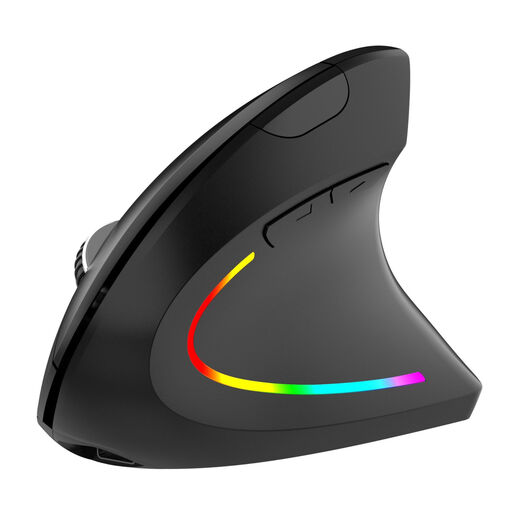 No image available
Could suit you if you want to work wirelessly and customise the navigation and pointer-speed buttons.
The 2.4GHz connection uses a USB receiver. The description lists four DPI levels, quiet buttons and forward and back buttons.
 No image available
Could suit you if you want the option of using both Bluetooth and a USB receiver at different workstations.
The title lists three DPI levels: 800, 1200 and 1600. The description lists six programmable buttons and a rechargeable battery with USB-C; the 2.4GHz connection needs a suitable USB port.
 No image available
Could suit you if you want to navigate wirelessly and adjust the pointer speed while checking results.
The description lists a 4-way scroll wheel, six buttons and three DPI settings. The title specifies 800–1600 DPI and USB-C charging; the 2.4GHz connection uses a USB receiver.
 No image available
Could suit you if you want to choose between Bluetooth and the included dongle at different workstations.
The description lists connections to up to three devices and a detachable wrist rest. This version is designed for right-handed use; using the dongle requires a suitable USB port.
 No image available
Could suit you if you want to scroll while reviewing results and choose between wireless connection options.
The title lists a 4000 DPI sensor and Bluetooth or a 2.4GHz connection via a Unifying USB receiver. The description lists a scroll wheel, four customisable buttons and a rechargeable battery. This version is designed for right-handed use.
The government information consulted doesn’t say that you have to buy a specifically vertical mouse. Arboportaal does say that screen work should be alternated regularly with other work or a break, so consider your mouse as part of your overall workstation.
Check that the computer can connect to your chosen mouse, and adjust the workstation furniture to suit your body. Vary your screen work and posture. If you’re starting to experience discomfort, Arboportaal advises contacting the occupational health doctor and, if necessary, arranging a workstation assessment.
It varies by model: Trust says the Bayo II Wireless is rechargeable, while the wired Trust Verto doesn’t need a mouse battery. According to the Dutch government, if a product is faulty, the seller is your point of contact for the legal guarantee. In the Netherlands, there is no fixed statutory guarantee period.
For many online purchases made by a consumer from a business, you have a 14-day cooling-off period. Check the applicable terms before buying. For example, distance-selling rules don’t apply to an online purchase from a private individual.