
Photo selector with limited connections
You want to point to and select photos when there are few sockets available. Distinguish between a mains socket, a USB port and the mouse’s power source.


A Bluetooth mouse can free up a USB port if your computer supports Bluetooth. A mouse powered by AA batteries or a wired model won’t need a socket or charging adapter while you use it. Then choose based on how it fits your hand and how well you can target small selection areas: a vertical design doesn’t guarantee more accurate photo selection. Try the pointer and buttons with your own editing tasks before you decide.
You want to point to and select photos when there are few sockets available. Distinguish between a mains socket, a USB port and the mouse’s power source.
You often click on small targets and want to know whether the shape, pointer speed and buttons suit your hand and the way you work. Research involving specific test mice describes a trade-off between hand posture and pointing performance.
You’re looking for the right hand size or a left-handed model, and don’t want to rely on a different mouse alone for long periods of work. Arboportaal also recommends varying your activities and taking microbreaks when working at a screen.
| What to consider | What should you check? | Who is this important for? |
|---|---|---|
| Connecting without needing an extra socket | Check whether your computer supports Bluetooth and whether the mouse needs a USB receiver, charging cable or mains adapter. | If I have few connections available, I want to know what the mouse needs while in use and when charging. Around 33% of consumers put connections and power supply first. |
| Pointing and clicking accurately | Try small targets and repeated clicks in your own software; check whether you can adjust the pointer speed. | When selecting photos, I want to be able to target small areas without relying on a DPI figure alone. Around 27% of consumers prioritise pointing and clicking. |
| Fit and length of use | Check which hand the mouse is designed for and what sizes are available, then try it to see whether the grip suits you. | If my hand size or left- or right-handed preference matters, I want to choose the right version. Around 20% of consumers prioritise fit. |
| Batteries and charging | Check whether the mouse uses AA batteries, a rechargeable battery or a USB cable, and where you can charge it if needed. | I want to know in advance whether I’ll need to replace batteries or plan time to charge it. Around 20% of consumers put power and maintenance at the top of their list. |
Bluetooth can remove the need for a USB receiver on a compatible computer, but a rechargeable mouse still needs charging. A receiver uses a USB port, as does a wired mouse.
Before you buy, make a note of the USB ports and charging options you actually have available.
Pointing performance also depends on the mouse shape, settings, task and how used to it you are. CDC Stacks research on specific test mice doesn’t rank the models currently available to buy.
Try small selection areas in your own software and adjust the pointer speed to suit the way you work.
A vertical design won’t automatically suit every hand. Some product ranges include different sizes or left- and right-handed versions.
Check the exact version and try the grip. Remember to vary your activities during long periods of screen work, too.
The Lift and MX Vertical have different connection and control features. These apply to the models mentioned, not every mouse made by the brand.
According to Trust, the Voxx offers Bluetooth and a USB receiver, while the wired Verto connects via a USB cable.
The HE Break range includes different sizes and left- and right-handed versions. One described large, right-handed version offers three connection options.
The MW 4500 is a mouse set at a 45° angle; a separate LEFT version is also available.
These product options are for anyone looking for a vertical mouse for selecting photos and comparing different wireless connections or charging options. Check whether Bluetooth, a USB receiver and the required charging setup suit your workspace for each model.
 Image unavailable
An option to consider if you want to compare Bluetooth and a rechargeable battery with a mouse that uses a USB receiver.
Bluetooth and 2.4 GHz connection; USB-C charging; three DPI levels: 800, 1200 and 1600.
 Image unavailable
An option to consider if you want to compare a USB receiver connection with USB-C charging.
2.4 GHz wireless connection; six buttons; DPI range of 800–1600; USB-C rechargeable battery.
 Image unavailable
An option to consider if you want to compare Bluetooth and a built-in rechargeable battery with models that use a USB receiver.
Bluetooth; built-in rechargeable battery with USB-C charging port; 4000 DPI sensor.
 Image unavailable
An option to consider if you want Bluetooth or a 2.4 GHz connection and the ability to adjust the pointer speed to suit your task.
Bluetooth and 2.4 GHz via a Unifying USB receiver; rechargeable battery; 4000 DPI sensor. The battery needs charging from time to time.
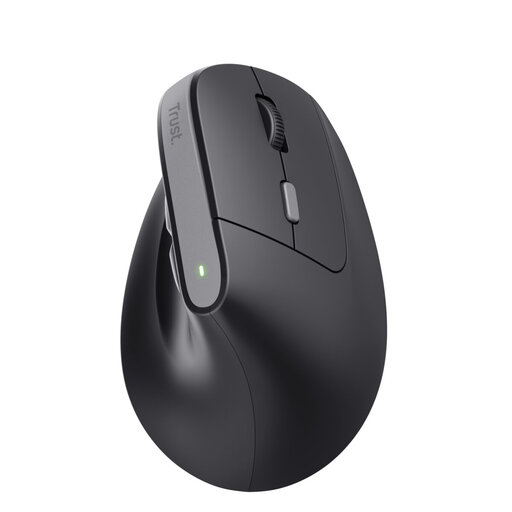 Image unavailable
An option to consider if you’re looking for a right-handed version; check whether the shape suits your hand and the way you work.
Wireless RF connection; optical; 2400 DPI.
No, not always: the Logitech Lift uses an AA battery and the Trust Voxx is rechargeable. Bluetooth can work without a USB receiver on a compatible computer. Check whether each model needs a USB port, charging cable or mains adapter.
Try small targets, repeated clicks and different pointer speeds in your own software. In a study involving twelve participants and specific test mice, the fully vertical test mouse was associated with less forearm rotation, but also the weakest pointing performance in that test. The results don’t rank current models available in shops.
For Bluetooth, choose a computer with Bluetooth. If you’re using a receiver or a wired mouse, check that you have a free USB port. Arboportaal recommends varying your activities and taking microbreaks during intensive screen work, particularly when you need to position the mouse frequently or very precisely.
For online purchases, ACM ConsuWijzer says you’ll generally have 14 days from delivery to change your mind, although exceptions may apply. The seller is also responsible for the statutory guarantee if a product doesn’t meet what you could reasonably expect under normal use.
Arboportaal’s guidance on working with screens places responsibility for safe and healthy working conditions on the employer and doesn’t specify a particular mouse model. That’s different from a requirement applying to every private buyer.