
People who select photos precisely
If you often point to images or small controls, you’ll want to assess whether the clicking action and cursor speed feel comfortable for the way you work.


Start by choosing a vertical mouse that suits your hand size and whether you’re left- or right-handed. Then see how comfortable it is to click and point to small items. DPI settings and a vertical shape alone don’t prove that you’ll work more accurately or prevent discomfort. Finally, check that the connection and any extra buttons are compatible with your computer and photo-editing software.
If you often point to images or small controls, you’ll want to assess whether the clicking action and cursor speed feel comfortable for the way you work.
You’ll want a model that suits your hand size and whether you’re left- or right-handed. So check the exact variant, not just the product range.
Take your workspace and breaks into account, too. Changing your mouse doesn’t replace taking breaks from screen work.
Start with your hand size and which hand you use. Then assess clicking and pointing for the type of photo selection you do, before comparing the connection and extra features.
| What to consider | What should you check? | Who is this important for? |
|---|---|---|
| Hand size and which hand you use | Check whether the exact model is designed for left- or right-handed use, and whether your fingers and thumb can reach the buttons comfortably. | If I use a mouse with my left hand or have a particular hand size, I want to know first whether the shape and controls will suit me. Around 34% of consumers say hand fit and handedness are their main purchasing concerns. |
| Repeated clicking and pointing | Try a representative selection task and decide for yourself which cursor speed and clicking action feel comfortable. | When selecting small items, I want to be able to point accurately without relying on a DPI figure alone. Around 33% of consumers give accurate pointing and clicking top priority. |
| Connection and power | Compare the connection on the exact model with your computer’s ports, and check which components are included. | If my workspace has a particular port or I’d rather not use a cable, I want to know in advance how the mouse connects and gets its power. Around 20% of consumers prioritise connection and power. |
| Work routine and breaks | Check whether any break reminder software works with your computer, and consider varying your tasks and taking microbreaks while you work. | During long sessions, I don’t want to assume that simply changing my mouse will change the way I work. Around 13% of consumers place particular importance on a work routine with enough variety and breaks. |
Models in the same range may be designed for different hands. A right-handed shape won’t necessarily suit someone who uses a mouse with their left hand.
Check the exact variant name and which hand it’s designed for before you order.
A stated DPI setting doesn’t tell you how accurately or comfortably you’ll complete a selection and clicking task. In a study of repeated pointing and clicking with an angled and a vertical mouse, 18 women completed tasks; the study doesn’t establish how well you’ll perform in your photo-editing software.
Try the mouse on a task similar to the photo selection you do, and give yourself time to get used to a different shape.
The indicator on the R-Go model mentioned here is controlled by software. It doesn’t remove the need to vary your activities during screen work.
Arboportaal recommends varying screen work and taking microbreaks. So consider your workspace and work routine, too.
According to the Dutch government, there is no fixed statutory guarantee period in the Netherlands. What you can expect from a product depends, among other things, on the product and the information provided with it.
Compare any additional guarantee with your statutory rights, and keep the seller’s details. If there’s a problem, contact the seller.
The Lift range may be worth considering if hand size and which hand you use are key factors. Logitech positions Lift for small to medium-sized hands and lists separate left- and right-handed models.
The Bayo II range includes, among other models, a wireless version with a 2.4GHz USB receiver and a rechargeable battery; Verto is a separate wired range.
According to CHERRY, the MW 4500 and MW 4500 LEFT are available in versions for different hands. For the LEFT version, CHERRY lists a 45° angle and three resolution settings.
The HE Break range may be worth considering if you want to choose based on hand size and handedness, and are looking for a break indicator.
This selection focuses on vertical mice for repeated selecting and pointing. Check each model to make sure the handedness, connection and controls suit your workspace.
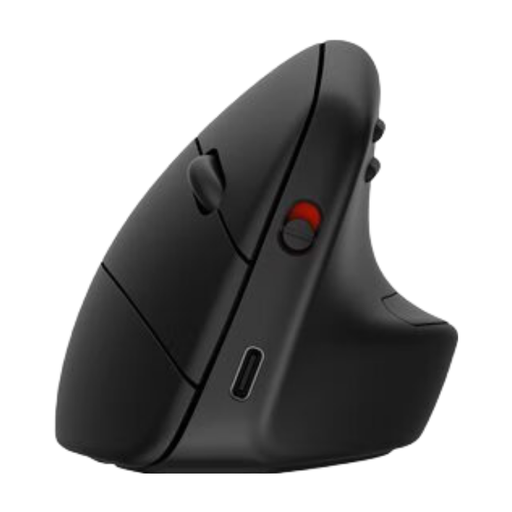 No image available
This right-handed vertical mouse is an option if you use your right hand and want to try a vertical shape.
 No image available
This vertical mouse may suit you if you want to connect multiple devices and use extra buttons.
The product name lists Bluetooth and a 2.4 GHz USB receiver, a 4000 DPI sensor, a rechargeable battery and four buttons. This model is right-handed, and the product name lists PC, Mac and iPadOS compatibility.
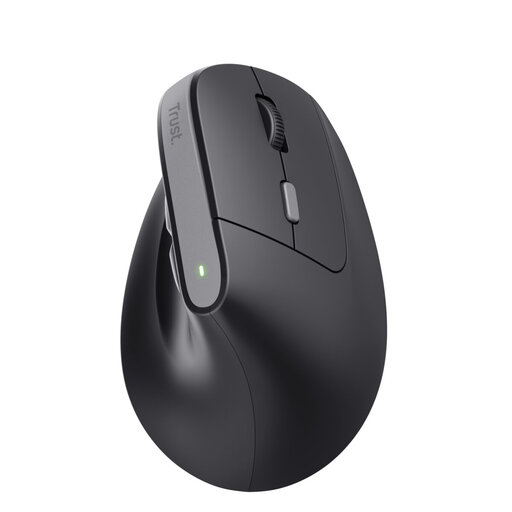 No image available
This wireless, right-handed model may suit you if you want to work without a fixed mouse cable.
The product name lists an optical sensor and 2400 DPI. A 2.4GHz USB receiver is required for the wireless connection.
 No image available
This wired vertical mouse is an option for a fixed workstation where you want to use a USB connection.
This model is wired and right-handed.
 No image available
This model is designed for right-handed use and small to medium-sized hands. Check whether it feels comfortable for you.
The product information lists Bluetooth and a USB receiver, plus four customisable buttons.
No. A DPI figure doesn’t predict how accurately you’ll point to small items. Try the mouse at different settings on a task similar to your photo-selection work; a study of repeated pointing and clicking doesn’t establish how well you’ll perform in your photo-editing software.
It varies by model. Trust lists a 2.4GHz USB receiver for the wireless Bayo II, while CHERRY lists a nano receiver for the MW 4500 LEFT. Bluetooth, 2.4 GHz and USB are listed for the R-Go HE Break model described here; its break indicator is controlled by R-Go software. Check your computer’s ports and software compatibility.
Don’t rely on the shape of the mouse alone. Arboportaal recommends varying screen work and taking microbreaks, so consider your workspace and how you break up your tasks, too.
No. According to the Dutch government, there is no fixed statutory guarantee period in the Netherlands. You’re entitled to a product that works as it should; what you can expect depends, among other things, on the product and the information provided. A manufacturer’s or additional guarantee is separate from your statutory rights. If there’s a problem, contact the seller.
According to the Dutch government, when you buy from a business at a distance, you’ll often have a 14-day cooling-off period. Check who the seller is and which terms apply. As the same guidance explains, this distance-selling arrangement doesn’t apply to purchases from a private individual.