What should you look for when choosing?
At a narrow shared workstation, space and reach, click noise, hand fit and connectivity can each be a different priority.
| What to consider |
What to look for |
Who this matters most to |
| Space and reach |
Measure the clear space beside your keyboard and try moving the mouse normally while keeping your elbow close to your body. |
If I have little room beside my keyboard, I want to be able to move my hand without reaching too far. Around 36% of consumers put usable space and reach first. |
| Noise level |
Check which buttons are described as quiet on the exact model you’re considering. Also check the scroll wheel if you use it often. |
If you share a quiet workspace, you’ll want to minimise click noise for your colleagues. Around 29% of consumers make quiet operation their top priority. |
| Hand size and handedness |
Check the size and whether the model is for left- or right-handed use, and make sure you can reach the buttons without an awkward grip. |
If I need a specific hand size or a left-handed version, I don’t want to assume it will fit just because it’s labelled ‘ergonomic’. Around 21% of consumers choose fit as their main consideration. |
| Connectivity |
Check the available ports, Bluetooth and your workplace’s policy on USB receivers. |
If you use the mouse with a work computer, you’ll want a connection that’s available and permitted. Around 14% of consumers prioritise compatible connectivity. |
Vertical mice at Joybuy
This selection includes vertical mice for anyone with little space beside their keyboard or who wants wireless operation and suitable connectivity in a shared workspace. Check the hand variant and make sure the connection works with your work computer for each model.
 No image available
Wireless vertical mouse with Bluetooth and 2.4 GHz
An option if you’re looking for wireless operation and adjustable cursor speed. Check which connection is available on your work computer.
Bluetooth and 2.4 GHz; 800, 1200 and 1600 DPI; USB-C charging.
View at Joybuy
 No image available
Wireless vertical mouse with six buttons
A good fit if you’re looking for a wireless vertical mouse with adjustable cursor speed.
Six buttons; 2.4 GHz; 800–1600 DPI.
View at Joybuy
 No image available
HP 925 Ergonomic Vertical Mouse
Worth comparing if you’re right-handed and looking for a vertical mouse for wireless use. Check that its connection options work with your work computer.
View at Joybuy
 No image available
Logitech MX Vertical
An option if you want a vertical mouse with a choice of Bluetooth or a USB receiver. Check compatibility with your work computer.
Bluetooth and 2.4 GHz via a Unifying USB receiver; 4000 DPI sensor; rechargeable battery; four buttons; graphite.
View at Joybuy
 No image available
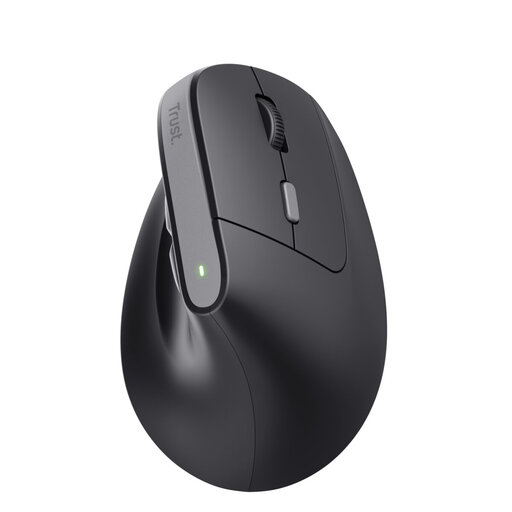
Trust Bayo II, right-handed version
A good fit if you’re looking for a wireless vertical mouse for right-handed use. Check that the connection works with your work computer.
RF wireless; optical; 2400 DPI; black.
View at Joybuy
Frequently asked questions
How should I set up my mouse area if my desk is narrow?
Position the mouse so you can keep your elbow close to your body. According to the Arboportaal, a narrower keyboard can help you place the mouse closer to you. Recheck your set-up when you move to a different desk.
Do I need to get used to a vertical mouse?
You might, especially when pointing precisely. Research published in Ergonomics found that, with the mouse studied, it took longer to reach a target than with a standard mouse, alongside differences in posture and muscle activity. This doesn’t prove that the models in this selection perform differently. Try the mouse with the tasks you do.
What should I check before connecting the mouse to my work computer?
Check which connection or Bluetooth functionality is available and what your workplace allows. Logitech describes the Lift as using Bluetooth or a Logi Bolt receiver; Trust describes the wireless Bayo II as using a 2.4GHz USB receiver.
Can a vertical mouse prevent discomfort?
You can’t assume so from the mouse shape alone. The Arboportaal highlights the importance of a suitable workstation set-up and varying your tasks. Studies of mouse shapes measure factors such as posture and task performance, not whether a particular retail model prevents discomfort.
Does Dutch law require a vertical mouse in the office?
The Arboportaal’s official guidance doesn’t specify a mandatory vertical mouse model. It does explain employers’ responsibilities for safe computer work and workstation set-up, so choosing a vertical mouse isn’t automatically a legal requirement.


