
Student who regularly organises folders
You often select and move digital files, and want your mouse, posture and controls to suit you during longer study sessions.


Start with a mouse that suits your hand and whether you’re left- or right-handed. Then check that its connection and buttons work with the way you study. A wired mouse saves you having to charge it, but you’ll need room for the cable. A wireless mouse may require a receiver or another compatible connection, as well as battery management. A vertical design won’t automatically prevent discomfort: your workspace and varying your activities matter too.
You often select and move digital files, and want your mouse, posture and controls to suit you during longer study sessions.
You share a limited workspace with a laptop and study materials, and need to weigh up space for a cable against a wireless connection and battery management.
You’re looking for a model genuinely designed for left-handed use, with buttons you can reach easily. Switching the mouse buttons on a right-handed model doesn’t make it suitable for left-handed use.
First, choose the right handed version and fit. Then consider the connection, the space available for a cable or receiver, and what the buttons do.
| What to consider | What should you look for? | Who is this important for? |
|---|---|---|
| Fit and strain on your hand | Check whether the mouse is designed for left- or right-handed use and whether a hand size is specified. Make sure you can reach the buttons without gripping tightly. | If I’m organising folders for a long time, I want a shape that suits my hand. Around 33% of consumers prioritise fit and strain. |
| File navigation | Check what the buttons do by default and whether you can customise them for your operating system. | When I’m selecting and navigating a lot, I want the controls to feel comfortable to use, without assuming that browser buttons move files. Around 27% of consumers prioritise navigation. |
| Connection and desk space | Check which connections your laptop has and whether you want to use a cable, USB receiver or Bluetooth. | At a small desk, I want to know whether a cable or receiver will get in the way, and which connections my laptop supports. Around 20% of consumers prioritise connection and desk space. |
| Left-handed use | Check that the model is explicitly designed for left-handed use and that you can reach the buttons. | If I use a mouse with my left hand, I’m looking for a model that’s actually designed for it. Around 20% of consumers prioritise left-handed use. |
A mouse won’t change everything about repetitive movements or staying in one position. The way your workspace is set up and varying your activities matter too.
Consider the fit alongside your workspace, and vary the tasks you do.
Extra buttons may be designed to move forwards and backwards in a browser. That doesn’t mean they’ll move files.
Check what the buttons do by default and whether you can customise them for your operating system before adding them to your file-management routine.
A wireless model may require a USB receiver and battery management. A wired mouse, on the other hand, needs space for its cable.
Check the connection and power requirements for the model you’re considering, and which accessories are included.
Logitech’s Lift is a vertical mouse for small to medium-sized hands, with a separate version for left-handed use.
Trust’s range includes the wired Verto 22885 and the wireless, rechargeable Bayo II 25145.
According to CHERRY, the MW 4500 and MW 4500 LEFT are wireless versions for right- and left-handed use respectively.
Evoluent offers the VerticalMouse 4 in different hand sizes and versions for left- and right-handed use.
This Joybuy selection focuses on vertical mice for navigating digital folders. Check the handed version, connection and controls for each model.
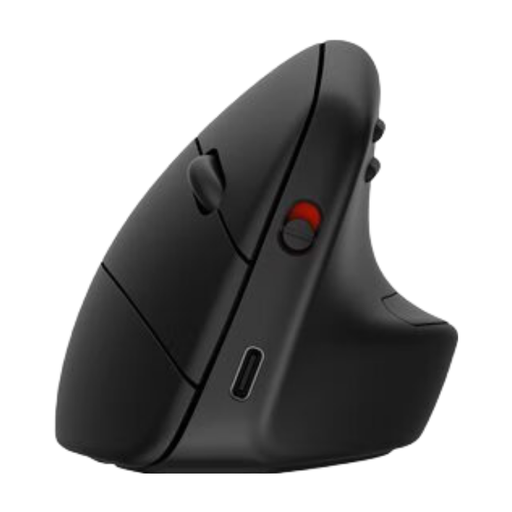 No image available
An option to compare if you’re looking for a vertical mouse with more than one connection option.
The version described is for right-handed use and has a rechargeable battery, USB receiver, Bluetooth, a multi-surface sensor and six buttons. The description says it can connect to up to three devices.
 No image available
An option if you’re looking for a vertical mouse with adjustable cursor speed and customisable buttons.
The version described is for right-handed use. The product name lists a 4000 DPI sensor, Bluetooth, a 2.4GHz connection via a Unifying USB receiver, a rechargeable battery and four buttons.
 No image available
A wired option to compare if you study at a fixed desk and have room for a cable.
The product name specifies a wired version for right-handed use. The description lists adjustable DPI from 800 to 2400 and buttons for moving forwards and backwards in a browser.
 No image available
An option if you have small to medium-sized hands and are looking for a vertical mouse with customisable controls.
The version described is for right-handed use. The description lists connection via USB receiver or Bluetooth, customisable buttons and a SmartWheel for scrolling.
No. A particular mouse shape can’t guarantee that you’ll use it without discomfort. Repetitive movements, arm support, your workspace setup and varying your activities also matter when you spend a long time at a screen. If your discomfort persists, it’s better to seek personalised advice than simply buy a different mouse.
According to Trust, the Verto 22885 connects via USB, while the Bayo II 25145 uses a 2.4GHz USB receiver and has a rechargeable battery. Check which connections your laptop supports, and don’t assume the Bayo II uses Bluetooth based only on the word ‘wireless’.
When you buy from a business online, you’re generally entitled to a 14-day cooling-off period. According to the Dutch government, you also have a legal right to a product that meets expectations, with no fixed statutory guarantee period. If a product is faulty, contact the seller.
Wireless radio equipment must meet the requirements of Directive 2014/53/EU, including requirements relating to conformity assessment, an EU declaration of conformity and CE marking. Wired electronic equipment is also subject to relevant EMC requirements. The European Commission sets out these requirements, but the rules alone don’t establish whether a particular product on sale complies with them.