
A student looking for a mouse that fits
You create lots of flashcards on your computer and want a vertical mouse that suits your hand size and dominant hand. Its shape alone is no proof that it prevents or cures discomfort.


Start by choosing a mouse that suits your hand size and dominant hand. Then consider whether quiet clicks and easy storage matter more to you than an adjustable grip or a wired connection. Quiet buttons and a stowable receiver can be useful at a shared desk, but a vertical mouse is not, in itself, a proven solution for aches and pains.
You create lots of flashcards on your computer and want a vertical mouse that suits your hand size and dominant hand. Its shape alone is no proof that it prevents or cures discomfort.
You work alongside others and want to avoid disturbing them with mouse clicks. Check that the quiet-click feature applies to the exact version you’re considering.
You regularly connect your mouse, then put it away again. Check in advance whether Bluetooth, a USB receiver or a cable will work with your device and desk.
First, check the hand size and handedness the mouse is designed for. Then compare the click noise, connection and power options for your shared workspace.
| What to consider | What should you look for? | Who is this important for? |
|---|---|---|
| Fit | Check whether the version is for left- or right-handed use, and look at the size guidance for the exact model. | When I’m making flashcards, I want to be able to reach the buttons and thumb rest comfortably. Around 33% of consumers give top priority to fit and handedness. |
| Click noise | Look for an explicit mention of quiet clicks for that version; this doesn’t automatically tell you anything about other noises. | When I’m studying alongside others, I want repeated clicking to be as unobtrusive as possible. Around 25% of consumers prioritise keeping a shared table quiet. |
| Connecting and storage | Check whether your device has Bluetooth or a suitable free USB port, and where you can store a receiver. | When I share my workspace and put my mouse away after a study session, I want a connection that works with my device. Around 25% of consumers give top priority to connection and storage. |
| Power | Check whether the exact version is wired or wireless, and whether it uses a rechargeable battery, replaceable batteries or a cable. | When I use my mouse regularly, I want to know whether I need to charge it or would rather connect a cable. Around 17% of consumers focus mainly on power and running costs. |
Research into vertical mice has looked at things such as movement and task performance. That doesn’t make a particular model a proven treatment. It can take time to get used to a different way of using a mouse.
Consider whether the mouse suits your hand and workspace, and break up long periods of screen work.
Some models come in separate versions for left- and right-handed use, or for different hand sizes. Choosing the wrong one could mean returning the mouse; any costs will depend on the returns policy.
Measure your hand if the manufacturer recommends it, and check the exact version on the product page.
According to Trust, the wireless Trust Bayo II and Verto use a USB micro receiver. That’s not the same as a Bluetooth connection.
Check the connection type for the exact version and make sure your device has a suitable free USB port.
According to ACM ConsuWijzer, your statutory rights exist alongside any warranty offered by the retailer or manufacturer. What you can reasonably expect from the product also matters.
Keep your proof of purchase and contact the retailer if the product is faulty.
The Lift range is designed for small to medium-sized hands, with separate versions for left- and right-handed use.
The Bayo II and Verto come in different versions; it’s worth checking their connection and power options in advance.
The UniMouse is worth considering if you’re looking for an adjustable vertical grip.
The VerticalMouse 4 includes, among other options, a wired left-handed version and a separate Small version for smaller right hands.
This selection features vertical mice for a shared desk, with a focus on handed versions, wireless connections and use between study sessions.
 No image available
Worth a look if you’re after a vertical mouse with wireless connection options.
Bluetooth and 2.4 GHz; USB-C charging; three DPI settings: 800, 1200 and 1600.
 No image available
This version is worth a look if you’re after a wireless vertical mouse with USB-C charging.
Wireless 2.4 GHz connection; USB-C; 800–1600 DPI; six buttons.
 No image available
A model to consider if you’re specifically looking for a vertical mouse from HP.
 No image available
Worth a look if you’re after a vertical mouse with wireless connection options for several listed devices.
Bluetooth and 2.4 GHz via a Unifying USB receiver; rechargeable; 4000 DPI sensor; four buttons; compatibility listed for PC, Mac and iPadOS.
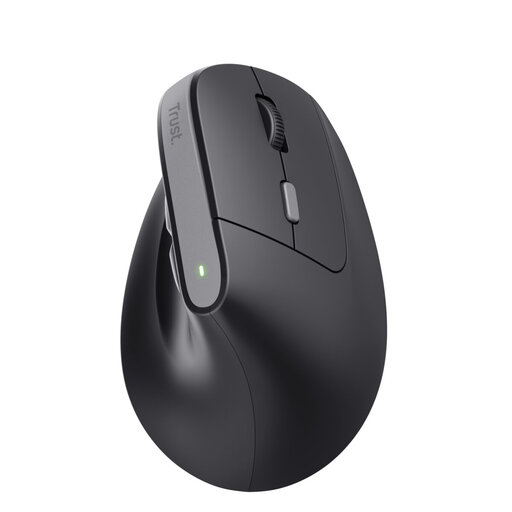 No image available
This version could suit you if you’re right-handed and looking for a wireless vertical mouse.
Wireless; optical; 2400 DPI; black. A suitable USB port is needed for the receiver’s wireless connection.
A vertical mouse is not a guaranteed treatment for wrist pain. One study comparing the use of a standard and a vertical mouse looked at 16 participants and found differences in forearm movement and muscle activity; task performance and getting used to the mouse also played a part. The study published in Ergonomics, with an abstract available via PubMed, doesn’t show that a particular model cures discomfort.
At each desk, check that the connection works with your device and adjust the workspace to suit your own measurements. Arboportaal advises alternating screen work with other tasks or a break; a mouse won’t do that for you automatically.
It depends on the version. Trust says the wireless Bayo II has a rechargeable battery, while the wired Trust Verto uses a USB cable. Check the power requirements of the exact model before buying.
For online purchases from a business in the Netherlands, you’ll generally have a statutory cooling-off period of up to 14 days after delivery; statutory exceptions may apply. ACM ConsuWijzer advises checking the terms and any return costs in advance. This is separate from your statutory rights if a product doesn’t meet what you could reasonably expect.
No. Dutch regulations on screen work don’t specifically require a vertical mouse. Arboportaal does say that screen work should be alternated at set intervals with other tasks or a break. Those workplace rules don’t necessarily apply to independent study.