
Frequent folder organiser
You regularly select, move and search for files, and want to know whether you can keep pointing and navigating accurately.


Start with a model that suits your hand size and whether you’re left- or right-handed. Then see how comfortable it feels to point, drag and scroll while managing your folders. Choose a wired mouse if you’d rather not manage a battery or wireless connection, or go wireless if freedom of movement and connectivity matter more. Research into mouse shapes suggests there may be a trade-off between wrist posture, getting used to the mouse and pointing performance; a vertical mouse is not a proven treatment for symptoms.
You regularly select, move and search for files, and want to know whether you can keep pointing and navigating accurately.
You’re looking for a model that suits your hand size and whether you’re left- or right-handed. Left- and right-handed models aren’t interchangeable.
You’re weighing up a wired connection with no battery to manage against the freedom of movement offered by a wireless mouse.
First check the hand orientation and grip, then try pointing and dragging. Finally, choose a connection that suits your computer and workspace.
| What to consider | What to look for | Who is this important for? |
|---|---|---|
| Fit and handedness | Check the size guide, whether the model is for left- or right-handed use, and how easy the buttons are to reach. | If I use a mouse for long periods, I want a grip and model that suit my hand. Around 33% of consumers prioritise fit and handedness. |
| Control when working with files | Try pointing at small targets, dragging files and scrolling through long lists. | When selecting and dragging a lot, I want to move files accurately without the mouse shape getting in the way. Around 27% of consumers prioritise control when working with files. |
| Connection to your computer | Check whether your computer supports the required USB connection or Bluetooth. | When I’m working on my home computer, I want to make sure the connection I choose is available. Around 20% of consumers prioritise compatibility with their device. |
| No battery to manage | Weigh up the space taken by a cable against managing batteries, recharging or pairing wirelessly. | At a fixed workstation, I’d rather not have to think about batteries or charging, but a cable mustn’t get in the way of my desk layout. Around 20% of consumers prioritise ease of use without battery management. |
Research published in Ergonomics (2013) and Work (2015) describes changes in wrist posture when using vertical mice. One comparison found that a fully vertical mouse performed less well on pointing tasks. This doesn’t prove that it treats or prevents symptoms for every user.
Try the mouse with your own tasks and allow time to get used to it. If symptoms persist, simply choosing a different mouse isn’t a proven solution.
A mouse designed for the wrong hand may not be the model you’re looking for, even if the rest of the name is correct.
Check the hand orientation and full model name on the product page.
Choosing the wrong model could mean returning it and having to interrupt your work.
Logitech’s specifications for the MX Vertical distinguish between Bluetooth, a USB receiver and a USB-C charging connection. These serve different purposes.
Check which port or wireless connection your computer supports, and which one you want to use with your chosen mouse.
The Lift and MX Vertical are worth comparing if hand size, handedness or connectivity matter to you.
The wired Verto 22885 is worth considering for a fixed workstation with a suitable USB connection.
The HE Break may suit anyone who wants to compare different sizes and hand orientations, and is looking for a software-controlled break indicator.
The models below are vertical mice for different workspaces and preferences. When comparing them, pay particular attention to hand orientation, connectivity and the controls you need.
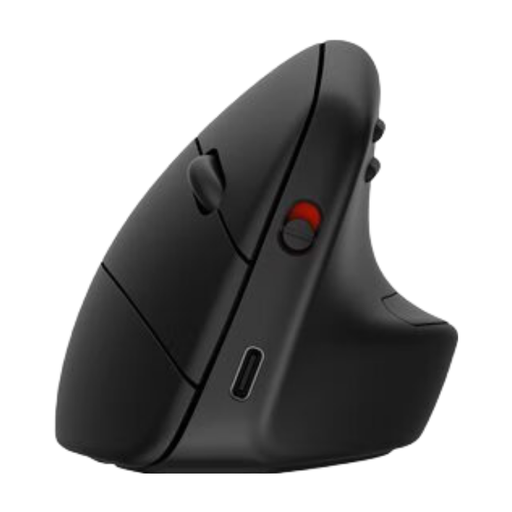 No image available
An option if you’re looking for a vertical mouse and the right-handed model suits you.
Check that the Bluetooth or dongle connection described is compatible with your computer.
 No image available
A wireless vertical mouse to compare if the right-handed model suits you.
The product name mentions Bluetooth, a Unifying USB receiver and a rechargeable battery. Bear in mind that it needs charging.
 No image available
A wired, right-handed model to compare if you have a fixed workstation with a USB connection.
The product description advises against this grip for very small or very large hands.
 No image available
Logitech describes the Lift as suitable for small to medium-sized hands; this model is for right-handed use.
Logitech says the Lift’s SmartWheel switches between precise and fast scrolling.
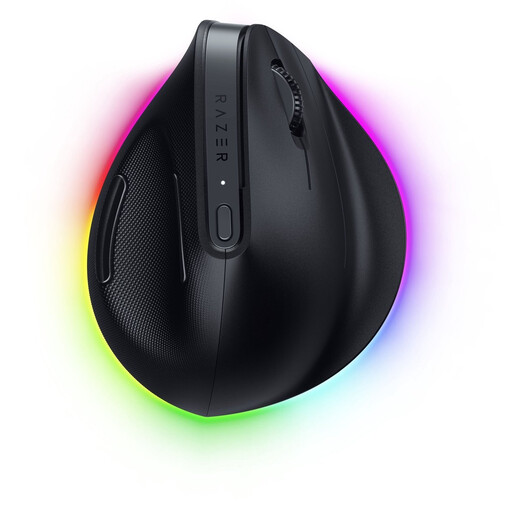 No image available
A right-handed vertical model to consider if you’re looking for programmable buttons.
The product information mentions Razer Synapse 4 for setting up AI shortcuts; check whether this feature suits the way you work.
No. Start with the grip and how much control you have when pointing and dragging. Then adjust the cursor speed. Research into pointing tasks doesn’t prove that a stated DPI setting will help you organise files faster.
Use your own hand and workspace to test pointing at small targets, dragging files and scrolling through long lists. A study published in Ergonomics found less pronation with the vertical mouse tested, but also noted that users may need more time to get used to it.
Not if both your mouse and computer support Bluetooth. Logitech lists Bluetooth and a USB receiver for the MX Vertical; check which connection your device needs for the option you want to use.
Check that the exact model has the required CE marking. The Dutch Authority for Digital Infrastructure states that wireless radio equipment must also meet the applicable requirements of the Radio Equipment Directive and the EMC Directive; an ergonomic label doesn’t replace these checks.
For online consumer purchases in the Netherlands, you generally have a statutory 14-day cooling-off period from delivery; check the applicable conditions for trying and returning the product. This is separate from your statutory rights if the product is faulty: according to the Dutch government, the seller is your point of contact.