First, choose a connection and power source that suit your workspace: Bluetooth can free up a USB port, a mouse with a replaceable battery doesn’t need charging, and a wired mouse doesn’t need a separate mouse charger but does take up a USB port. Then check the fit and adjustable cursor control. A vertical shape doesn’t guarantee that precise pointing will feel natural straight away.
Who is a vertical mouse suitable for?
Plan reviewers with limited ports
You want to navigate large or detailed plans, while keeping an eye on both available sockets and free USB ports. The Dutch Occupational Health and Safety Portal lists precise positioning and frequent movement among the characteristics of screen-based work.
Precision workers considering a different mouse shape
You want controlled cursor movement, while checking whether a different grip and an adjustment period suit the tasks you use a pointer for. Research published via PubMed notes that it can take time to get used to a vertical mouse.
Buyers who prioritise a good fit
You’re looking for a mouse that suits your left or right hand and hand size, rather than relying on the word ‘ergonomic’ alone. Logitech, CHERRY and Kensington specify the fit or handedness of particular models.
What should you look for when choosing one?
Compare the connection and power source first, then consider cursor control, handedness and fit. This helps you avoid a suitable connection becoming a practical limitation when reviewing plans.
| What to consider |
What should you check? |
Who should prioritise this? |
| Connection and power |
Check Bluetooth support, whether a USB receiver is needed, the battery type and how many USB ports are free. |
If I don’t want to give up a socket or USB port, I’ll choose a connection and power source that work with my setup. Around 29% of consumers make this their top priority. |
| Cursor control |
Check whether the cursor speed is adjustable and try some precise pointing tasks in your own planning software. |
When selecting details precisely, I want to control the cursor’s movement and assess how it works in my own software. Around 29% of consumers prioritise this level of cursor control. |
| Handedness and fit |
Check whether the model is designed for left- or right-handed use and whether it suits your hand size. |
If the mouse doesn’t fit my hand properly, a suitable connection won’t help. Around 24% of consumers prioritise handedness and grip. |
| Purchase and maintenance |
Check what’s included, whether you’ll need to replace batteries or recharge a battery, and which connections you’ll need. |
Once the controls feel right, I want to know how much maintenance the power source needs and which accessories I’ll need. Around 18% of consumers prioritise ease of purchase and use. |
Common buying mistakes
-
Assuming wireless means Bluetooth
The wireless Trust Bayo II uses a USB receiver and a rechargeable battery. The Logitech Lift also offers Bluetooth and runs on a replaceable AA battery. So a wireless mouse may still need a USB port.
Check the connection, power source and included accessories for the exact model separately.
A receiver can take up a USB port, while a rechargeable battery will need charging later.
-
Assuming a higher dpi figure means better precision
Dpi describes an adjustable sensor specification, but it doesn’t show how well you can point in planning software. In a study of twelve participants, a fully vertical reference mouse reduced forearm pronation but performed less well on the pointing task studied. This wasn’t a test of the models on this page.
Try controlling the cursor and selecting details in your own software before basing your choice on a dpi figure.
-
Taking a general warranty claim as a fixed legal period
The Government of the Netherlands states that there is no fixed statutory warranty period covering all products in the Netherlands. So a period mentioned for a product doesn’t automatically give a complete picture of your legal rights.
Keep your proof of purchase and contact the seller if a product is faulty. What you can reasonably expect under the law also depends on the product and the circumstances.
Brands to consider
Logitech
The Lift and MX Vertical offer different options for connection, power and cursor adjustment.
- The Lift has Bluetooth, a USB receiver as an alternative and a replaceable AA battery. Logitech designs this model for small to medium-sized hands and offers a separate left-handed version.
- The MX Vertical is rechargeable and has a cursor-speed switch. It doesn’t use a replaceable AA battery.
Trust
The Bayo II Wireless and Verto suit different priorities around cables, USB ports and battery management.
- The Bayo II Wireless uses a storable USB receiver and a rechargeable battery. The wired Verto has a 1.5-metre cable and two dpi settings.
- The Bayo II needs charging and uses a USB port; the Verto’s cable needs desk space and a free USB port.
CHERRY
According to CHERRY, the MW 4500 range includes a separate LEFT version with a nano receiver.
- CHERRY lists three resolution settings, up to 1,200 dpi, and a separate left-handed version.
- The receiver uses a USB port. When buying, check that the model is explicitly marked LEFT.
Kensington
The Pro Fit Ergo K75501EU is an option for anyone looking for a model suited to medium to large hands.
- Kensington lists adjustable dpi settings and an AA battery for this model.
- The product information notes a limitation for Windows 11 on Arm-based PCs. Check whether this applies to your device.
Vertical mice at Joybuy
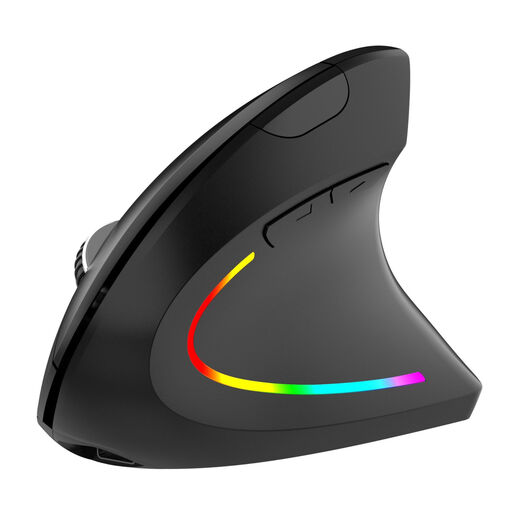
This selection focuses on vertical mice for wireless use with a rechargeable battery. Check whether each model connects via Bluetooth, a USB receiver or both.
 No image available
NAXSIR wireless vertical mouse
A 2.4GHz connection via USB receiver is listed for wireless use.
Rechargeable battery with USB-C connection; four dpi settings: 800, 1200, 1600 and 2400.
The battery needs to be recharged periodically via USB-C.
Joybuy
 No image available
Vertical wireless mouse with Bluetooth and 2.4GHz
The product name lists Bluetooth and a 2.4GHz connection. Check which connection suits your device.
Rechargeable battery with USB-C charging and three dpi settings: 800, 1200 and 1600.
The battery needs to be recharged periodically via USB-C.
Joybuy
 No image available
Vertical wireless mouse with 2.4GHz and USB-C
The product information lists a 2.4GHz wireless connection via USB receiver.
Integrated rechargeable battery with USB-C charging and three dpi settings: 800, 1200 and 1600.
The battery needs to be recharged periodically via USB-C.
Joybuy
 No image available
HP 925 Ergonomic Vertical Mouse
The product information lists Bluetooth 5.3 and an included dongle. Check which connection you want to use.
Rechargeable built-in battery and a stated sensor resolution of 4000 dpi.
The battery needs to be recharged periodically via USB-C.
Joybuy
 No image available
Logitech MX Vertical
Bluetooth and a USB receiver are listed as connection options. Check which suits your device.
Rechargeable battery, stated sensor resolution of 4000 dpi and a switch to adjust cursor speed.
The battery needs to be recharged periodically.
Joybuy
Frequently asked questions
Do limited sockets mean I need a wireless mouse?
No, not necessarily. The wired Trust Verto connects via USB and doesn’t need a separate mouse charger plugged into a socket, but it does need a free computer port. If USB ports are in short supply, Bluetooth may be an alternative on a compatible device.
How can I use Bluetooth without a USB receiver?
Check whether your device supports Bluetooth Low Energy. Logitech specifies both Bluetooth and Logi Bolt via a USB receiver for the Lift. Bluetooth can free up a USB port if your device is compatible.
Will I need time to get used to a vertical mouse for precise pointing?
You may need to try out the grip and cursor speed in your own software. In a study of twelve participants, one fully vertical reference mouse performed less well on the pointing task studied than the other shapes tested; this wasn’t a test of the models on this page.
Are breaks during screen-based work required by law?
For applicable screen-based work, Article 5.10 of the Dutch Working Conditions Decree requires work to be regularly alternated with other tasks or a break. The Dutch Occupational Health and Safety Portal describes this as an employer’s obligation; it doesn’t prescribe a particular type of mouse.
What are my rights when buying online or if my mouse is faulty?
Many distance purchases generally come with a 14-day cooling-off period, as explained by the Government of the Netherlands. If a product is faulty, contact the seller about your statutory rights; there is no fixed statutory warranty period that applies to every product in the Netherlands. How these rights apply depends on the circumstances and the purchase.


