
Vandaag of morgen in huis

Kwaliteit gegarandeerd

Welkomstaanbiedingen ontgrendelen: GRATIS bezorging | Tot 80% korting | Gratis 30 dagen JoyPlus-proefperiode
Download de app
A vegetable slicer can make preparing cucumber, carrot, potato, cheese and fruit much easier. Yet many buyers end up with an awkward kitchen gadget that gets relegated to the cupboard. The problem often isn’t the number of blades on the packaging, but the construction, cleaning and method of use.
Joybuy’s Product Recommendation Officer selects products based on verifiable features. This helps you see more clearly which type suits your kitchen, cooking frequency and available space.
A multi-functional vegetable slicer with several blades sounds handy. In practice, loose parts can get lost or take up a lot of cupboard space. So check whether a holder, collection tray or storage solution is included. A set with seven or ten parts is only practical if you actually use those functions.
With a mandoline slicer or vegetable slicer, the ingredient slides along a sharp cutting surface. Without a non-slip base, safety handle or food holder, your fingers come relatively close to the blade. A safety handle is no substitute for careful use, but it does help to hold small pieces securely.
Always use a manual vegetable slicer on a stable, dry surface. Stop slicing as soon as the remaining piece becomes too small to hold safely.
Food residue tends to get stuck around blades, grating openings and snap-fit connections. So check beforehand whether the parts can be separated and what cleaning method the manufacturer recommends. For the Alpina Multi Grater 7pc, for example, it is advised to clean the product with a damp cloth and not to put it in the dishwasher. That is relevant information if you plan to grate daily.
Don’t just look at the number of blades, but especially at the applications:
Check whether the product description clearly states which blades are included. With the Alpina set, for example, a thin and thick cutting blade, a flat cutting blade and a grater are included.
Stainless steel is widely used for blades because it is suitable for contact with food and less prone to rust than ordinary steel. That in itself says nothing about the sharpness, stability or lifespan of a complete product. Also look at the material of the holder and collection tray.
Plastic is lightweight and often affordable. A metal housing can feel sturdier, but usually makes the tool heavier. Also check that the tray fits securely and does not shift easily during slicing.
Measure the space in your kitchen cupboard or drawer before you buy a vegetable slicer. A compact model is easy to store, while a larger set can offer more functions.
A collection tray prevents sliced ingredients from falling directly onto the work surface. According to the product information, the 5five Multifunction Vegetable Slicer Set has a collection container with a usable volume of 0.3 litres and dimensions of 31.2 × 11.5 × 14 cm. That is sufficient for smaller preparations, but may be limited if you cook for a large family.
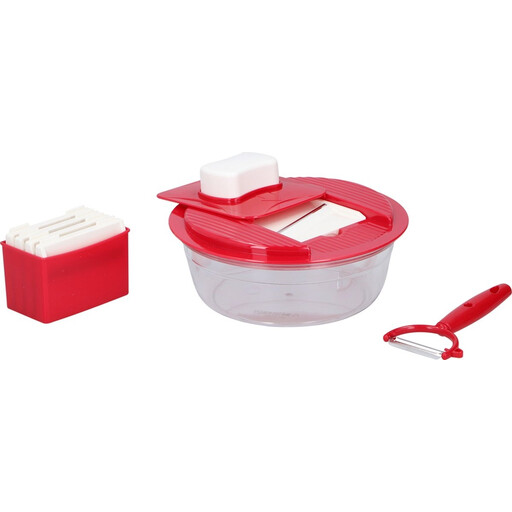
Why this fits the profile: This set combines various grating and slicing functions with a collection tray and safety handle. It is therefore suitable for simple daily preparations without an electric motor.
The included storage holder keeps loose parts to a minimum. The safety handle helps to hold ingredients securely; manual operation avoids electricity consumption.
Seven parts; stainless steel blades; collection tray; suitable for coarse and fine grating and slicing.
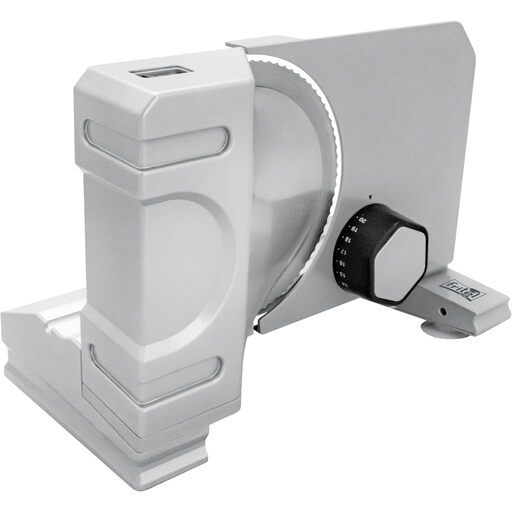
Why this fits the profile: This electric model suits households that, besides vegetables, also want to slice bread, cheese, cold meats and other ingredients regularly at an adjustable thickness.
The product information mentions a food holder, non-slip feet and a slicing thickness of 0–20 mm. The manual also advises setting the dial to 0 after use and allowing the machine to cool down.
Adjustable thickness from 0–20 mm; blade diameter of 190 mm; 15° tilted carriage; included collection tray and food holder.
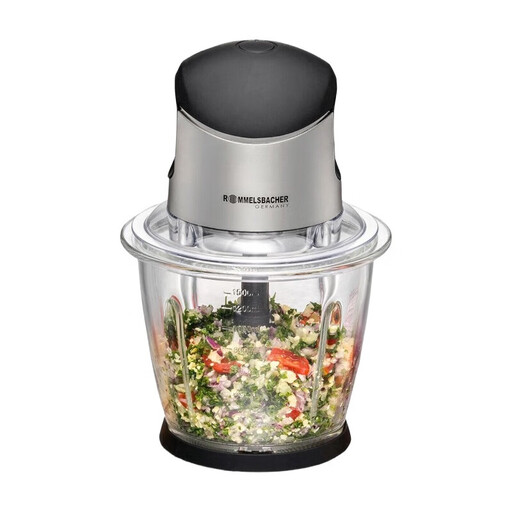
Why this fits the profile: If you often process onions, herbs, nuts or meat, an electric chopper can be more useful than a classic vegetable slicer.
The bowl has a capacity of 1.5 litres, meaning you don’t have to work in small batches as often. An internal safety system is present according to the product description.
500 watts of power; glass bowl of 1.5 litres; stainless steel blade with four wings; removable parts are dishwasher-safe according to the product information.
A manual vegetable slicer is usually compact, quiet and ready to use straight away. You don’t need a power socket and you maintain control over the pace. This type works well for small quantities and simple salads.
An electric chopper or slicer makes more sense when you often prepare larger portions. In that case, pay attention to the power, bowl capacity, maximum operating time and cleaning instructions. A motorised appliance generally takes up more space and uses electricity, but can work faster with larger quantities.
Note the difference between a vegetable slicer and an electric food slicing machine. Models like the Fritel Slicer SL 3710 are also intended for bread, cheese and cold meats. They are therefore versatile, but not the same as a compact vegetable grater or mandoline.
We have compiled a full, up-to-date list of products that fully meet these strict selection criteria and comply with current European safety regulations.
That depends on the blade and the product description. A grater is often suitable for hard cheese and some types of fruit. A slicer works mainly for firm ingredients. Soft or very ripe products can get crushed during slicing. So check the stated applications and do not force the blade.
The lifespan depends on the material, storage, cleaning and frequency of use. Stainless steel blades can remain usable for a long time if you clean them carefully and store them dry. A plastic holder may show scratches or wear over time. For products with a statutory guarantee, consumers in the EU generally have a minimum of two years’ legal guarantee, during which the product must conform to the contract.
A manual version has no electricity costs. With an electric slicer or chopper, the cost per use is usually limited, but the power and operating time determine consumption. More important is often how many parts you have to clean and whether the appliance takes up space. So don’t automatically choose the most functions, but rather the functions you use weekly.
