
Vandaag of morgen in huis

Kwaliteit gegarandeerd

Welkomstaanbiedingen ontgrendelen: GRATIS bezorging | Tot 80% korting | Gratis 30 dagen JoyPlus-proefperiode
Download de app
A vegetable slicer can speed up everyday kitchen tasks, but not every model is suited to the same job. If you mainly prepare cucumber, carrots and potatoes, you’ll have different requirements from someone who also wants to slice bread, cheese, meat or cold cuts evenly.
When comparing models, don’t just look at the number of blades or the power rating. A machine may promise lots of features, yet be difficult to clean, offer little grip or lack space for larger ingredients. Keep these points in mind to avoid a disappointing purchase.
A vegetable slicer with multiple blades sounds versatile, but control over slice thickness is just as important. Some basic models let you switch between blades, but offer very little adjustment to the thickness. That’s inconvenient if you want thin cucumber slices, thicker potato slices or julienne vegetables.
So check:
A label such as ‘stainless steel’ doesn’t automatically tell you what the whole appliance is made of. Check whether it refers only to the blade or also to the frame and food holder. For example, the PURECOOK set lists 304 stainless steel as its material and has a smooth surface. According to the product description, the parts are dishwasher-safe.
For a plastic housing, stability is especially important. A lightweight mandoline vegetable slicer can be handy for small quantities, but it needs to stay firmly on the worktop during use.
A blade stays sharp, even on a manual model. With an electric food slicer, there’s also a rotating blade to consider. A pusher, finger guard, non-slip feet and a stable carriage aren’t just extras.
Never use your bare hand near the blade when slicing small pieces. For electric models, always unplug the appliance before removing the blade or cleaning it.
A manual vegetable slicer is compact, quiet and suitable for fruit and vegetables. For potatoes, carrots and cucumber, a basic potato cutter or chip cutter may be enough. An electric food slicer makes more sense if you regularly prepare bread, meat, cheese or larger quantities.
For electric models, look out for:
A serrated blade is practical for crusty bread and firmer foods. A smooth blade is often used for meat or fine slices. An appliance with two blades offers more versatility, but also needs extra storage space and careful cleaning.
The Fritel models in this selection have an adjustable range of 0–20 mm. The Severin AS 3915 has a range of 0–15 mm and comes with a smooth blade and a serrated blade.
Check whether the blade can be removed and whether loose parts can be cleaned by hand or in the dishwasher. A simple design has fewer places for food residue to get trapped. Never immerse the motor housing of an electric appliance.
Dry a stainless steel vegetable slicer thoroughly after rinsing it. Don’t use wire wool or harsh abrasive cleaners if you want to protect the surface.
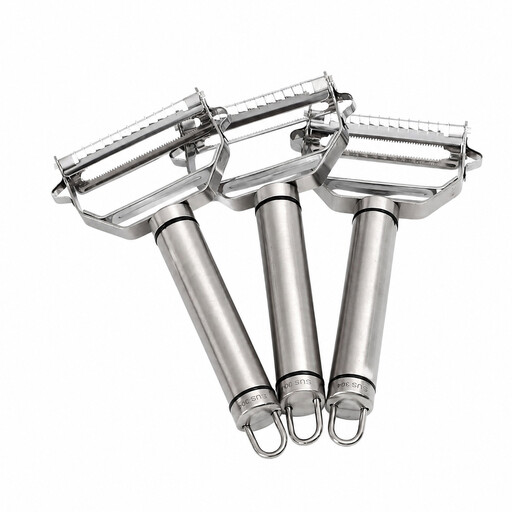
Why it suits this profile: A compact manual option for everyday peeling and simple cutting tasks involving potatoes, carrots, apples, tomatoes and other fruit.
The two ends have a straight and a serrated edge. Their uses are clearer than those of a set with blades that aren’t clearly specified.
304 stainless steel, three pieces per set, each measuring 16.8 × 6.6 cm and, according to the product information, dishwasher-safe.

Why it suits this profile: Designed for people who want to use an electric slicer regularly for bread, meat, cheese and vegetables.
The product description lists a removable carriage, a safety momentary switch and slice thickness of up to 23 mm.
Metal construction, variable speed control according to the product description, and two blades for different slicing tasks.
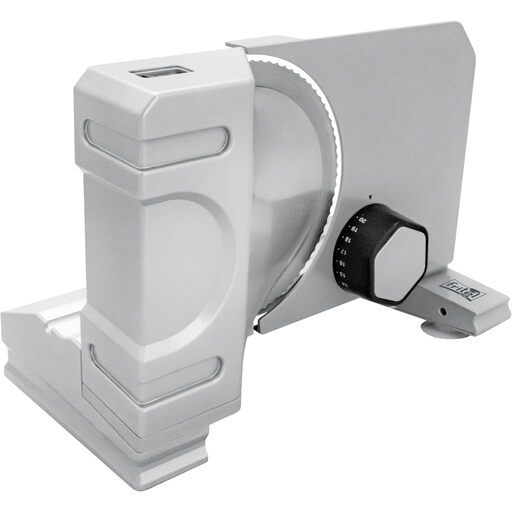
Why it suits this profile: A good choice for households that want one appliance for bread, cheese, cold cuts, vegetables and meat.
The thickness is adjustable from 0–20 mm. The specifications include a food holder, non-slip feet and a carriage angled at 15 degrees.
150 W, a 19 cm serrated blade and a stated maximum continuous operating time of 10 minutes per session.
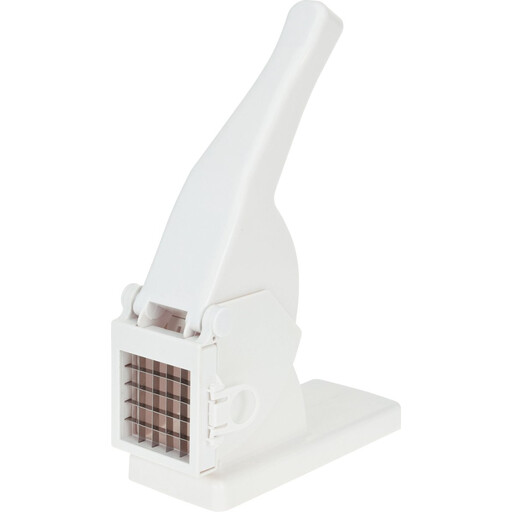
Why it suits this profile: A straightforward choice for chips and simple vegetable cutting, with no electric motor or complicated settings.
Its purpose is clearly defined: cutting potatoes and vegetables. That means you won’t pay for features you’re unlikely to use.
Measures 26 × 13.5 × 9 cm and combines plastic with stainless steel. According to the product information, it isn’t dishwasher-safe.
We’ve put together a complete, up-to-date list of products that meet these strict selection criteria and the applicable European safety regulations.
A manual model doesn’t use electricity and is usually compact. It’s often enough for small quantities of vegetables. An electric food slicer takes up more storage space and uses electricity, but saves time if you regularly slice bread, meat, cheese or larger quantities.
First remove any loose residue and follow the product instructions. Unplug an electric appliance before removing the blade or carriage. Check whether the parts are dishwasher-safe; this varies from model to model. Dry metal parts thoroughly afterwards.
Its lifespan depends on the materials, how often it’s used and how well it’s maintained. A model used only for soft vegetables will be put to a different level of use than a chip cutter or electric meat slicer. Before buying, check the warranty, availability of replacement parts and maximum operating time. Keep the sharp blades, fittings and non-slip feet in good condition with regular checks.
