
Vandaag of morgen in huis

Kwaliteit gegarandeerd

Welkomstaanbiedingen ontgrendelen: GRATIS bezorging | Tot 80% korting | Gratis 30 dagen JoyPlus-proefperiode
Download de app
An overflowing wardrobe, duvets taking up the entire attic, or a suitcase that won't close before your holiday. These are common problems with what seems like a simple solution: vacuum storage bags. Yet, an impulse buy often leads to frustration. The bags slowly reinflate, tear on first use, or the valve doesn't fit your vacuum cleaner.
As a Joybuy Product Recommendation Officer, I see a lot of products come and go. I'm here to help you see through the marketing jargon and focus on what really matters. Before you invest in space-saving bags, it's wise to be aware of a few common pitfalls.
To avoid wasting money on a product that doesn't work, there are a few objective specifications you can check. These determine the quality and usability of vacuum bags.
Look beyond vague claims and pay attention to the specific materials. The most reliable reusable vacuum bags are made from a combination of Polyamide (PA) and Polyethylene (PE).
A bag made only of PE is often cheaper but also significantly more vulnerable to punctures and tears. The PA+PE combination offers a great balance between flexibility and robustness, allowing the bags to be reused more often.
A good seal is crucial. Pay attention to the following two components:
Not every bag is suitable for every purpose. The shape is just as important as the dimensions.
Based on these objective criteria, we have selected a number of products that suit different user profiles.
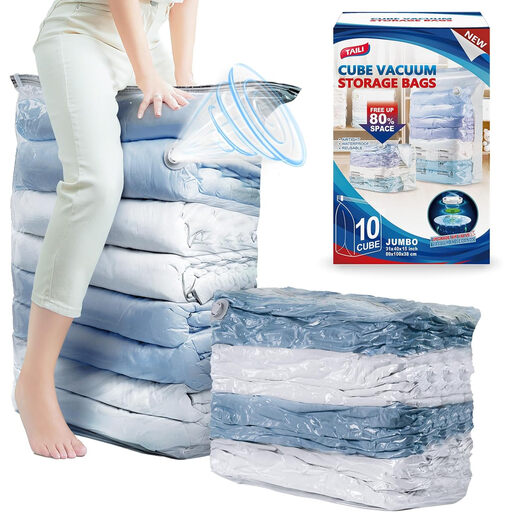
Why This Fits Their Persona: Ideal for storing bulky items like winter duvets, pillows, and seasonal clothing. The cube shape maximises space in closets or in the attic.
The material is a PA+PE blend for durability. The cube shape with a stable base is easy to fill without the bag tipping over, which prevents the frustration of awkward handling.
Large volume (Jumbo size) and a set of 10. The structure is self-supporting, allowing you to easily fill the bags by yourself.
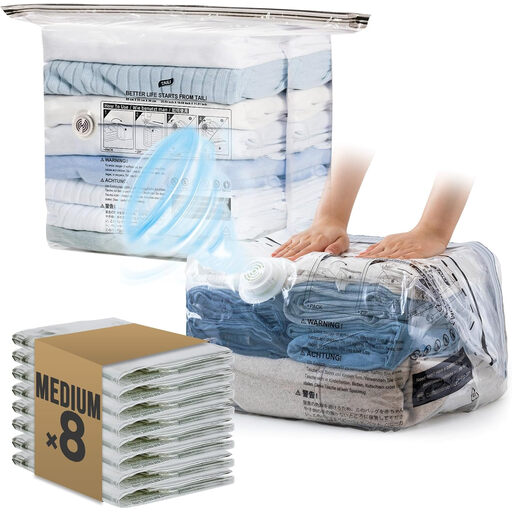
Why This Fits Their Persona: Perfect for those who want to save luggage space without relying on a vacuum cleaner. Suitable for carry-on luggage, backpacks, and organising clothes in a suitcase.
These bags don't require a pump or vacuum. According to the manufacturer TAILI, the patented ESY SHRINK valve allows you to press the air out by hand. This solves the problem of cumbersome pumps or incompatibility while travelling.
Manual compression without extra tools. The medium cube size is specifically designed to fit in most standard carry-on suitcases.
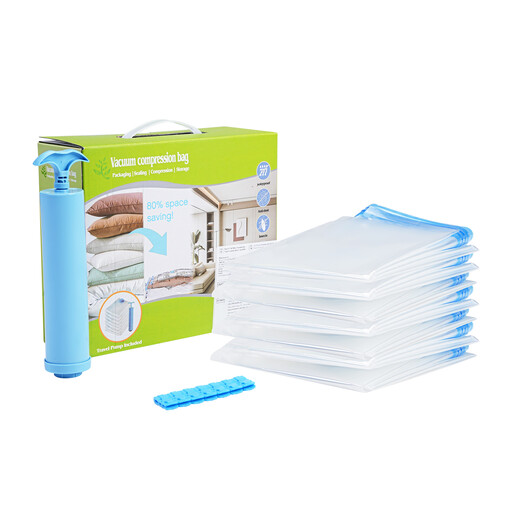
Why This Fits Their Persona: A complete starter kit for anyone trying vacuum bags for the first time. Suitable for various items like clothing and bedding, with everything you need in one package.
This set comes with a hand pump, so you're not dependent on your vacuum cleaner. The combination of a double-zip closure and a triple-seal turbo valve is designed to minimise air leaks.
An all-in-one solution. The bags are also compatible with a standard vacuum cleaner, which offers flexibility.
We've curated a complete, up-to-date list of products that fully meet these strict selection criteria and applicable regulations.
The duration heavily depends on the quality of the bag, especially the valve and the seal. A good vacuum storage bag made of PA+PE material with a double zip and a screw valve can remain airtight for months, or even a year or more. Cheaper models may start to leak air after just a few weeks. Always ensure the zipper is completely closed and free of debris.
Most valves are designed to fit the standard circular nozzle of a vacuum cleaner hose. However, they often don't work well with attachments that have a non-standard shape, such as a flat or oval brush head. If you're in doubt, choose a set that includes a vacuum bag with a pump (hand pump or electric).
For most textiles, vacuum storage is not a problem. However, for materials with natural fillings, such as down and feathers, it is recommended not to remove all the air. Compress the bag to about 50% of its volume instead of 75-80%. This prevents the feathers from breaking and permanently reducing the duvet's insulating properties. For delicate fabrics like leather or silk, vacuum packing is generally not recommended.
