
Anyone who freezes portions
You cook several portions and want to label and freeze them separately. Bear the Netherlands Nutrition Centre’s storage advice in mind, and choose packaging that suits the portion size.


For individual meal portions you want to freeze, a vacuum sealer is handy if you want to cut bags to size. Reusable vacuum containers are a better fit if you prefer to store portions in containers and have room to keep them. With moist dishes, the instructions for your specific model and the packaging you use matter: a moist setting doesn’t mean you can draw up free-flowing liquids without limit. Vacuum sealing doesn’t replace the Netherlands Nutrition Centre’s storage and temperature advice.
You cook several portions and want to label and freeze them separately. Bear the Netherlands Nutrition Centre’s storage advice in mind, and choose packaging that suits the portion size.
You often pack dishes that release liquid and want to stop it getting into the appliance. In this case, check the instructions for your chosen model and whether you can use containers.
You share worktop, cupboard and fridge space with housemates, and want to know in advance how much room the system and packaging will take up, and how to clean the parts.
Start by thinking about the kinds of portions you usually store. Then compare the packaging you’ll need, how the system handles moisture and how much storage space you have.
| What to consider | What should you check? | Who is this important for? |
|---|---|---|
| Portions that fit in your freezer | Check the maximum bag width, what packaging is included, and whether you have room to note the contents and date. | If I want to freeze portions separately and find them easily, I look at bag size and labelling. Around 33% of consumers mainly want freezer portions that are the right size. |
| Moist dishes | Read the instructions for your specific model on packing moist food, and check whether manual operation or suitable containers work for the dishes you make. | I want to pack moist meals without liquid being drawn into the appliance. Around 27% of consumers put this need first. |
| Storage space and cleaning | Measure your storage space and check the manufacturer’s instructions for cleaning the drip tray, pump and containers. | In a shared kitchen, I want a system that’s easy to store and clean. Around 20% of consumers prioritise space and cleaning. |
| Reusing packaging | Compare what’s included in the set, which refill materials are compatible, and the instructions for using and cleaning reusable parts. | If I want to rely less on new bags for every portion, I compare refill bags with reusable parts. Around 20% of consumers give reuse and packaging choice top priority. |
Vacuum packaging doesn’t give cooked meals a new use-by date. The Netherlands Nutrition Centre advises keeping cooked food in the fridge for no more than 2 days.
Date your portions and continue to follow storage and temperature advice.
The LAICA VT3120 manual warns that liquid drawn into the appliance can damage internal parts. So a moist food setting doesn’t automatically mean you can pack every wet dish in the same way.
Follow the instructions for your chosen model when packing very wet food, and consider suitable containers if you often store liquid portions.
Vacuum sealers and container systems use different packaging and parts. Materials that come into contact with food are also subject to food contact regulations.
Before buying, check which packaging is included, which refills are compatible, and whether the material is suitable for food contact and your intended use. The European Commission refers, among other things, to Regulation (EC) No 1935/2004.
The Vac Quick type 576 is a vacuum sealer for anyone looking for automatic operation and straightforward sealing.
The Princess 492970 is a vacuum sealer with features for different packaging tasks.
The VT3120 is designed for households that want to pack both dry and moist foods.
Fresh & Save is a system with a pump, glass vacuum containers and reusable bags.
The VC 10 is a vacuum sealer with a vacuum stop function, for anyone who also packs delicate ingredients.
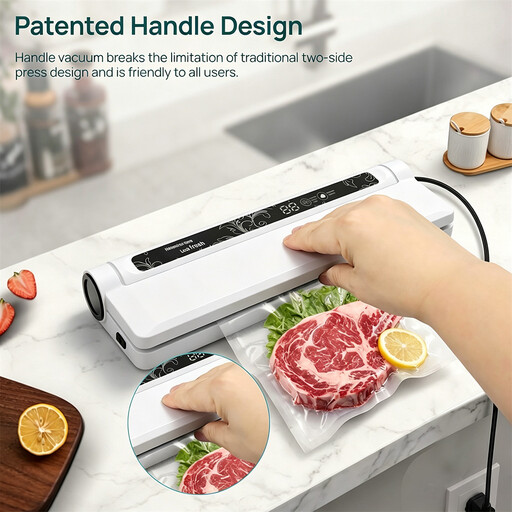
This product selection features a vacuum sealer for packing meal portions in bags.
 No image available
A vacuum sealer for anyone who wants to pack meal portions in vacuum bags.
Set includes: 20 bags measuring 17 × 25 cm.
Check that the bags are suitable for food contact and your intended use, such as freezing.
Don’t assume they do. The Netherlands Nutrition Centre advises keeping cooked food in the fridge for no more than 2 days; if you won’t eat it within that time, freeze it. It recommends 4 °C for the fridge and -18 °C for the freezer. This advice isn’t an extra freshness guarantee for any particular appliance.
Let cooked food cool, but don’t leave it out of the fridge for more than 2 hours. Then refrigerate or freeze the portions, and note what they contain and the date they were frozen. The Netherlands Nutrition Centre advises reheating meals until they’re steaming hot.
No. Don’t assume you can just because the sealer has a moist food setting. The LAICA VT3120 manual describes using manual operation for very wet food to stop liquid being drawn into the appliance. Check the instructions for your chosen model and use suitable packaging.
Food contact materials placed on the EU market must comply with the relevant EU rules, including Regulation (EC) No 1935/2004, as explained by the European Commission. For the specific bag or container, check that its stated uses are suitable for the food and for uses such as freezing or heating.
Choose bags if you want to pack portions in a size that suits you. Choose a container system if you prefer storing portions in reusable containers and have room for them. With either option, check which packaging is compatible and follow the instructions for moist dishes.