
Dividing rice into portions for each meal
You want to divide an opened supply of uncooked rice into individual dry portions. Compare the bag size and sealing method with those of a well-sealed container.


There’s no need to vacuum-seal an opened pack of uncooked white rice: the Netherlands Nutrition Centre advises storing it in a cool, dry, dark place in a well-sealed container. A sealer is most useful if you want to divide dry rice into individual portions in advance. Choose a compact model for occasional use, or one with a roll holder and cutter if you’ll be making lots of bags in a row. Cooked rice needs to be cooled quickly and stored separately in the fridge or freezer.
You want to divide an opened supply of uncooked rice into individual dry portions. Compare the bag size and sealing method with those of a well-sealed container.
If you regularly package larger quantities, a roll holder, cutter or manual controls can come in handy. Rommelsbacher and LAICA list these features for specific models.
If you repeatedly scoop rice from the same supply, compare a well-sealed storage container with a reusable vacuum container. The Netherlands Nutrition Centre advises storing opened white rice in a well-sealed container. If you choose a vacuum system, check whether the pump is included.
Best for: occasionally packing dry rice into separate portions when you have limited space for an appliance.
Bear in mind: you’ll need suitable bags or rolls, and may need to buy more over time.
Best for: regularly making several portions and choosing your own bag length.
Bear in mind: extra features and a larger appliance aren’t necessarily needed for a single opened pack of rice.
Best for: opening the same supply repeatedly without sealing individual portions in advance.
Bear in mind: a storage container doesn’t make separate portions, while a vacuum container may require a compatible pump.
The main decision is whether you want to divide the rice into portions in advance or simply keep an opened supply well sealed. The percentages below show which need takes priority for each row in this use case.
| What to consider | What should you check? | Who is this important for? |
|---|---|---|
| Sealing individual portions | Check that the bag size suits your portions and that the bags are suitable for food contact and compatible with your chosen sealer. | If I want to measure out the right amount for each meal, I want to divide dry rice into separate bags in advance. Around 40% of consumers prioritise sealing individual portions. |
| Making lots of bags in a row | Check the maximum film width, roll holder, cutting option and instructions for the exact model. | When I package a larger supply of rice in one go, I want to make bags to size and seal several of them. Around 30% of consumers prioritise this. |
| Opening the supply often | Check a storage container’s capacity and seal. If you choose a vacuum system, check that the set includes a compatible pump. | If I scoop rice from the same supply each time, I want to seal it properly again after use, rather than opening a new portion bag every time. Around 20% of consumers prioritise being able to open the same supply repeatedly. |
| Packaging other products too | Check the features and settings of the exact model. For cooked rice, follow the separate advice on cooling it quickly and storing it in the fridge or freezer. | If I want to use the machine for more than just dry rice, I look for settings designed for those other uses. Around 10% of consumers are mainly looking for versatility. |
The storage advice for uncooked rice doesn’t apply to cooked rice. The Netherlands Nutrition Centre warns that rice dishes stored for too long or not kept cold enough can pose a risk of Bacillus cereus.
Keep your dry supply separate from cooked portions. Cool cooked rice quickly and follow the separate advice for storing it in the fridge or freezer.
For opened white rice, the Netherlands Nutrition Centre recommends a well-sealed container in a cool, dry, dark place. You don’t necessarily need a machine for this.
First decide whether you really want to make individual portions. If not, a well-sealed storage container may be enough.
You may also need to buy bags or rolls to use with the appliance.
Sealers can have limits on film width and bag type. Any packaging that comes into contact with the rice must also be suitable for food contact.
Before buying a machine or replacement bags, check the bag construction, food-contact suitability and instructions for the exact appliance.
You may need a different compatible bag or roll if the packaging you already have isn’t suitable for the machine.
The VAC 385 is worth comparing if you regularly make portions and want to choose your own bag lengths.
The VC 10 is a compact bar sealer worth comparing for individual bags.
The FS 3601 is a compact model worth comparing for occasional portions.
The VT3120 is worth comparing if you want to package other products as well as dry rice.
The 492967 is an automatic bag sealer worth comparing for straightforward portioning.
This selection is aimed at portioning dry rice with a bar sealer that has a roll holder or manual controls.
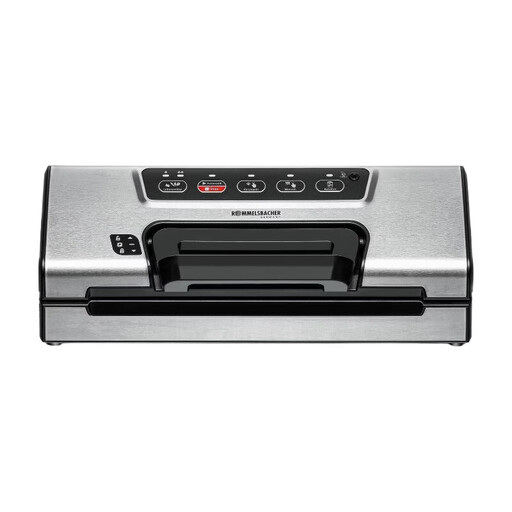 No image available
Suitable for cutting bags to size and sealing several portions of dry rice. The roll holder and manual controls are useful for this.
The product description lists a roll holder, cutter and support for film up to 30 cm wide, along with automatic and manual vacuum settings.
The sealing bar and seam get hot during sealing and immediately afterwards, so don’t touch them with bare hands. Before use, check the safety information for the exact model and make sure your chosen bags are suitable for food contact and compatible with the appliance.
No, vacuum-sealing isn’t necessary. The Netherlands Nutrition Centre advises storing opened white rice in a cool, dry, dark place in a well-sealed container. Vacuum-sealing can be a way to package individual portions.
No, vacuum-sealing doesn’t replace refrigeration. The Netherlands Nutrition Centre advises cooling cooked rice quickly, leaving it out of the fridge for no longer than 2 hours, and storing it in a well-sealed container for up to 2 days in the fridge or 3 months in the freezer.
Check that the bags are intended for food contact and are compatible with your exact machine. Also check the maximum film width and the instructions for positioning and sealing the bags.
The Government of the Netherlands states that electrical appliances placed on the EU market must carry a CE marking. Bags and containers that come into contact with rice must meet food-contact requirements. The Netherlands Food and Consumer Product Safety Authority (NVWA) states that food-contact materials must not release harmful amounts of chemicals. Check the information for the exact appliance and bag combination.
For eligible online consumer purchases, there is generally a 14-day cooling-off period, as explained by the Government of the Netherlands. You’re also entitled to a product that meets reasonable expectations; the Netherlands has no fixed statutory warranty period of exactly two years. If there’s a fault, contact the seller.