
Batch cook who freezes portions
You cook several meals at once and want to freeze individual portions in an organised way.


For individual portions, especially solid ones for the freezer, a heat sealer with compatible bags or a roll is a sensible choice. Choose a pump if reusable system bags or containers matter more to you, and consider a chamber model if you regularly want to pack runny soup or sauce. Chamber models take up space: CASO, for example, lists the VacuChef 77 as weighing 24 kg, so check that its size and chamber suit your kitchen and portion sizes. Vacuum sealing does not replace chilling or freezing: the Netherlands Nutrition Centre (Voedingscentrum) advises keeping cooked food in the fridge for no more than 2 days, and freezing it if you need to keep it for longer.
You cook several meals at once and want to freeze individual portions in an organised way.
You often pack dishes with plenty of free liquid, so both the machine and the packaging need to be suitable for what you want to seal.
You’re looking for a compact system with resealable bags or containers, and are mindful of which packaging works with it.
Choose this if: you mainly prepare solid or slightly moist portions and want to use different bag sizes.
The trade-off: check which bags are compatible; a stop function doesn’t mean you can seal runny soup straight into a bag.
Choose this if: compact storage, resealing or portioning into containers is important to you.
The trade-off: you’ll need packaging with valves that fit the system; the pump doesn’t seal film from a roll.
Choose this if: you regularly want to vacuum-seal runny soup or sauce in bags and have room for a chamber model.
The trade-off: the chamber limits the portion and bag size; check the dimensions and weight of the specific model.
| What to consider | What should you check? | Who is this important for? |
|---|---|---|
| Individual portions for the freezer | Compare the bag size with your usual portions and check that the seal is suitable for the packaging you’ve chosen. | If you freeze individual portions, you’ll want bags that fit them; around 36% of consumers prioritise separate portions for the freezer. |
| Soup and sauce | Check whether the model can handle runny contents in bags; a moist-food setting or container function doesn’t automatically mean that it can. | When you’re packing soup or sauce, you’ll want to know which method is intended for that type of food; around 29% of consumers mainly focus on moist dishes. |
| Preparing portions repeatedly | Check the specific model’s roll holder, cutter, maximum sealing width and ease of cleaning. | If you prepare lots of portions at once, you’ll want a process that works for different portion sizes; around 21% of consumers prioritise portioning food repeatedly. |
| Space and packaging | Check how much storage space the appliance needs and which bags or containers work with it. | If cupboard space is limited, you’ll want to know where you can keep the appliance and packaging; around 14% of consumers mainly consider space and compatible packaging. |
Removing the air doesn’t replace storing food at the right temperature. The Netherlands Nutrition Centre (Voedingscentrum) advises keeping cooked food in the fridge for no more than 2 days, and freezing it if you need to keep it for longer.
Cool portions quickly, then put them in the fridge or freezer. Label each one with its contents and the date you freeze it.
A container for liquids doesn’t automatically mean you can vacuum-seal runny soup straight into a heat-seal bag.
Check the instructions for your chosen model and packaging to see which method the manufacturer recommends for liquid contents.
A pump may require system bags or containers with compatible valves, while a heat sealer uses bags or rolls.
Before buying, check which packaging works with the appliance and what sizes you need for your portions.
The VC 200 is a heat sealer, while CASO describes the VacuChef 77 chamber model as suitable for wet and liquid products.
The DOMO DO331L combines a heat sealer with a roll and storage container included.
Fresh & Save is a pump-and-valve system for compatible bags and containers, not a traditional heat sealer.
This selection of Joybuy products focuses on packing meal portions with a heat sealer.
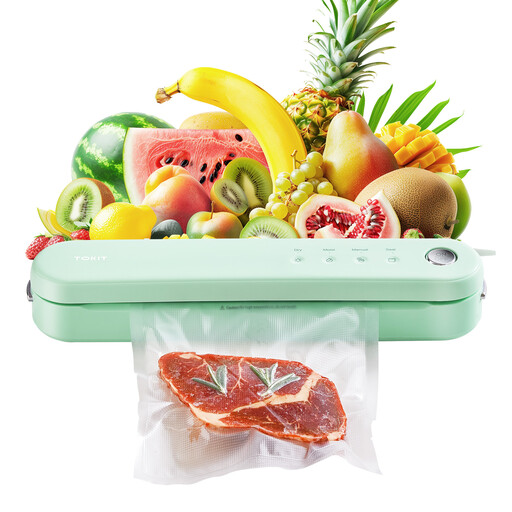 No image available
A good fit if you want to pack meal portions with a heat sealer. Check which bags are compatible with the model and whether the method you choose is suitable for moist contents.
Follow the usual refrigeration guidance: the Netherlands Nutrition Centre (Voedingscentrum) advises keeping cooked food in the fridge for no more than 2 days. If you won’t eat it within that time, freeze it; vacuum sealing doesn’t extend its time in the fridge.
Don’t assume you can: a container function or moist-food setting doesn’t prove that runny soup can be sealed straight into a heat-seal bag. DOMO lists a container for liquids with the DO331L, while CASO describes the VacuChef 77 as suitable for wet and liquid contents. Check the method and packaging for the exact model.
Not necessarily; check that the packaging is compatible with the pump system. ZWILLING says its Fresh & Save pump is intended for that system’s valve packaging.
The Dutch government (Rijksoverheid) says CE marking applies to product groups covered by the relevant EU requirements, so check whether the rules apply to the specific electrical appliance. The Netherlands Food and Consumer Product Safety Authority (NVWA) sets out the legal requirements for packaging materials that come into contact with food.
No. According to the Dutch government (Rijksoverheid), you’re entitled to a product that works properly, and the seller must provide a solution if it doesn’t. Under the guidance, the Netherlands has no fixed statutory guarantee period; the manufacturer’s guarantee is in addition to your other rights.