
Everyday coffee drinker
You often take beans from the same supply and want a canister you can reseal time and again. Store the beans somewhere cool, dry and dark.


If you regularly take beans from the same supply, a resealable vacuum canister is often the simplest option without needing a separate vacuum sealer. If you want to divide larger quantities into portions, or seal other foods in bags too, compare a compact pump with compatible containers or a bag sealer. Bear in mind the parts you’ll need and the storage space required. Vacuum sealing is no substitute for storing beans somewhere cool, dry and dark.
You often take beans from the same supply and want a canister you can reseal time and again. Store the beans somewhere cool, dry and dark.
You want to use as little worktop and storage space as possible, so you’re comparing a canister or small pump with a bag sealer.
You want to divide larger quantities of beans into sealed portions, so you don’t have to open the whole supply each time.
First decide whether you’ll reopen the supply frequently or prefer to portion it out in advance. Then consider how much space you have, as well as the containers and accessories the system requires.
| Concern | What to look for when buying | Who should pay particular attention? |
|---|---|---|
| Opening and closing repeatedly | Check how to reseal the container, whether it’s suitable for whole beans and whether it blocks light or will fit in a dark cupboard. | If I take beans out every day, I want to be able to reseal the supply easily after use. Around 36% of consumers say resealing is their main buying concern. |
| Space for the appliance and containers | Measure your cupboard and worktop, and check the dimensions of the appliance and the containers it requires. | With limited cupboard space, I want to know where I can keep both the appliance and the coffee supply. Around 29% of consumers cite space as their main buying concern. |
| Making individual portions | Check whether the machine can seal bags, which bags are compatible and what portion sizes you can store. | If I want to divide a larger supply into portions, I want to be able to take out one portion at a time without opening the rest. Around 21% of consumers prioritise portioning. |
| Containers and accessories required | Check what’s included in the set you’ve chosen and which bags, canisters or adapters you’ll need to buy separately. | I want to know in advance which additional parts my chosen system requires. Around 14% of consumers cite these requirements as their main buying concern. |
A general claim about food doesn’t specify how long your coffee beans will keep. The Voedingscentrum advises storing opened beans in a cool, dry, dark place in a well-sealed container.
Choose a container that suits the amount you use and where you store it. Think of vacuum sealing as a way of packaging, not as a new use-by date.
The ZWILLING Fresh & Save pump reviewed here works with containers fitted with compatible valves; a bag sealer seals bags in a different way.
Compare the sealing mechanism and what’s included in the set you’ve chosen before deciding.
You may need compatible bags or canisters to use it.
CASO lists a hose for vacuum containers with the VC 10, but doesn’t include an adapter for VacuBox canisters.
Check that the adapter you need is compatible with the exact model.
You may need to buy a separate adapter to connect certain canisters.
The Atmos range consists of resealable vacuum canisters for coffee. A Dutch product listing describes a 0.7-litre manual model in matte black stainless steel.
Fresh & Save combines a compact cordless pump with compatible vacuum canisters and reusable bags. It could be a good option if you’d also like to use the same system for other foods.
The VC 10, item number 1340, is a bag sealer for anyone who wants to make individual portions in bags and package other foods too.
Turn-N-Seal is a manually operated vacuum canister, offering an alternative to a bag sealer. WB.coffee describes the 2.4-litre model as having a rotary dial in the lid.
This selection focuses on resealable vacuum canisters for coffee beans, for anyone who regularly takes beans from their supply and doesn’t need to seal individual portions in bags.
 No image available
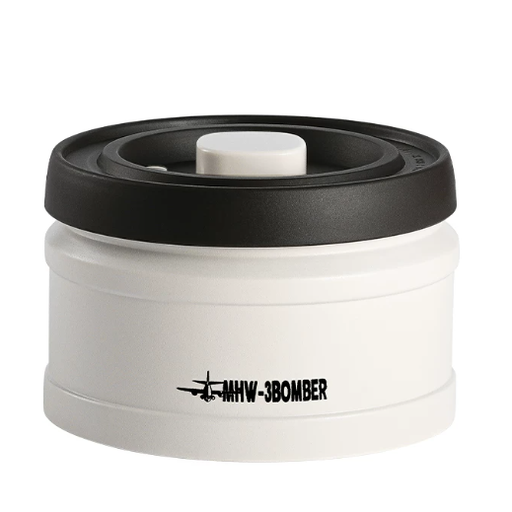
A manually operated vacuum canister for coffee, ideal if you want to reseal your supply rather than seal individual portions in bags.
Before buying, check that the capacity suits your needs and that the canister is suitable for food contact.
No, not if you mainly use a supply that you open regularly. The Voedingscentrum advises storing opened beans in a cool, dry, dark place in a well-sealed container; a resealable canister could be suitable. A bag sealer is most useful if you want to make individual portions in bags.
Check the instructions for the specific canister. Fellow advises against storing ground coffee in the Atmos because fine particles can clog the inlet valve. This advice applies to this product and not necessarily to all vacuum canisters.
Fellow says you create the vacuum by twisting the lid and release it using the release button. Fellow advises twisting the lid again every 4–5 days; the canister isn’t dishwasher-safe.
It depends on the system and the set. The ZWILLING starter set described includes glass containers and bags, while the standalone pump needs compatible containers. CASO lists ten bags and a canister hose with the VC 10, but no adapter for VacuBox canisters.
Check that the container you choose is suitable for food contact and for the intended use. A claim that a container can maintain a vacuum doesn’t, by itself, confirm that it’s suitable for coffee beans.
The Voedingscentrum says the freezer is less suitable for opened coffee beans and advises storing them in a cool, dry, dark place in a well-sealed container. Vacuum sealing isn’t a reason to assume the recommended storage period can be extended.