
Livraison le jour même et le lendemain

Qualité garantie

Débloquez vos offres de bienvenue: Livraison GRATUITE | Jusqu'à -80 % | 30 jours d'essai gratuits à JoyPlus
Téléchargez l'application
A vacuum cleaner should suit your home, floors and cleaning routine. Yet many buyers focus mainly on a high wattage, a large number of accessories or an impressive kPa figure. This can be misleading. A high-powered model is not automatically more convenient in a flat, while a cordless vacuum cleaner with a long battery life may be less practical if the battery is mainly used on the highest setting.
In this buying guide, you’ll learn what to look for in a stick vacuum cleaner, handheld vacuum cleaner, cordless vacuum cleaner or traditional corded model. The selection below is based on verifiable product specifications and intended use.
The motor power in watts does not directly indicate how much dirt a vacuum cleaner will pick up. High suction power in kPa should also be considered in context. Check the nozzle, brush, filtration and operating time as well.
A powerful vacuum cleaner with the wrong floor head can be less pleasant to use on hard floors than a lighter model with a suitable floor brush. On carpets, the key question is whether the brush can loosen dirt and hair from the pile.
With a cordless vacuum cleaner, the stated operating time often applies to the most economical setting. In turbo mode, the battery may run down considerably faster. So check:
A long battery life is particularly useful when it matches the area you normally clean.
A bagless vacuum cleaner does not need dust bags, but the dust container and filter must be emptied and cleaned regularly. With a bagged vacuum cleaner, hygiene and emptying are often straightforward, but you will need the correct replacement bags.
Also check for hair around the floor brush. An anti-tangle brush can reduce maintenance, but you should still inspect the roller and ends regularly. No brush eliminates the need for manual maintenance entirely.
For a home with both carpets and hard floors, an adjustable or multi-purpose floor brush is practical. A separate parquet or hard-floor brush can help prevent damage and scratches, while a motorised brush may be suitable for pet hair and carpets.
Don’t look only at the marketing phrase “powerful suction”. Consider the full combination of:
A 0.5-litre container is compact, but will need emptying more frequently when dealing with a lot of dirt. For larger households, 1 to 2 litres may be more practical. A bagged model often offers greater capacity, but the bags must be readily available.
With a bagless vacuum cleaner, check whether the container is easy to remove and whether the filter is washable. Allow washed filters to dry completely before replacing them.
A HEPA filter is designed to filter fine particles from the expelled air. Its precise performance depends on the complete filtration system, the seals and maintenance. A brand’s product claim about a particular filtration percentage should therefore be read as a claim based on that brand’s own research, not as a universal guarantee.
Check the availability of replacement filters, whether they are washable and the cleaning instructions. Do not use a vacuum cleaner without the filter correctly fitted.
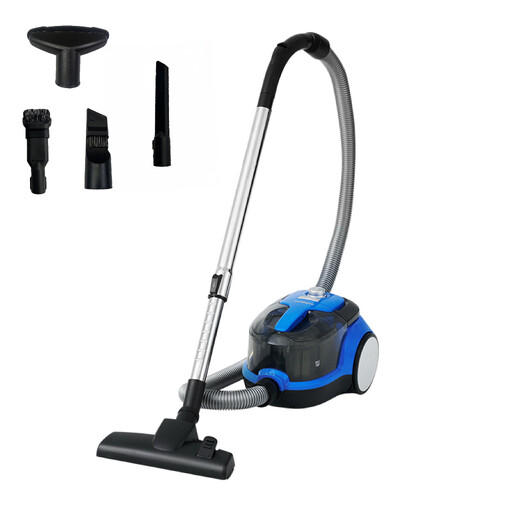
Why it suits this profile: This model is suitable for anyone looking for a straightforward vacuum cleaner with continuous mains power for hard floors, carpets, furniture and crevices.
There’s no need to estimate battery life. This corded vacuum cleaner has a 1.1-litre dust container instead of disposable bags.
800 W, stated suction power of approximately 17.5 kPa, automatic cord rewind and a washable filter.

Why it suits this profile: A practical choice for anyone who wants a compact bagged vacuum cleaner with generous capacity and a wide operating range for several rooms.
The specifications list both a HEPA filtration system and a 3-litre dust capacity. This means you don’t have to rely solely on motor power.
800 W, a 9-metre cord according to the product description, a range of up to 12 metres and an adjustable multi-purpose brush.
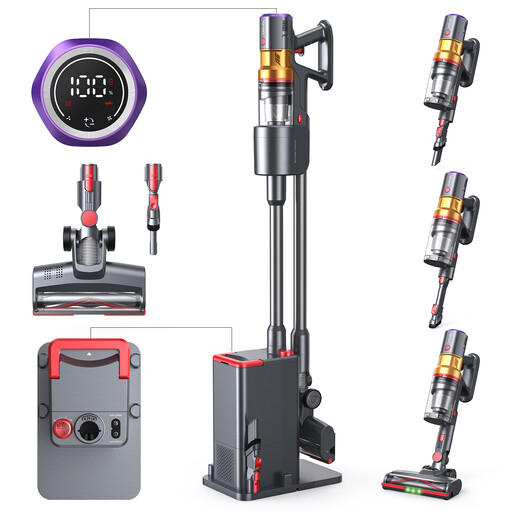
Why it suits this profile: This model is aimed at households with pets, carpets and hard floors that want to clean without a cord.
The product description mentions an anti-tangle brush and a self-emptying charging station. However, check the cost and availability of dust bags for the station.
Stated maximum suction power of 27 kPa, multi-stage HEPA filtration, an anti-tangle brush and a freestanding charging and emptying base.
We’ve put together a complete, up-to-date list of products that fully meet these strict selection criteria and the applicable European safety regulations.
For crumbs, keyboards, furniture and the inside of your car, a compact handheld vacuum cleaner is often sufficient. According to the product information, the ROUNY Xs Pro weighs approximately 0.3 kg, has a dust container of around 50 ml and offers two settings. The Aspiron AS-CA038 has a 500 ml container, two suction settings and a charging station.
These appliances are designed for dry dirt and short cleaning jobs. They generally do not replace a full-sized vacuum cleaner for large floor areas. When cleaning your car, look for a long crevice tool, a brush nozzle and charging via a suitable connection.
That depends on the property, the flooring and the setting selected. Compare the stated battery life with the time you normally spend cleaning. For large areas, an extra battery or a corded model may be more practical.
Its lifespan depends, among other things, on maintenance, filter cleaning, blockages and intensity of use. Empty the container or replace the dust bag in good time, keep the brush free of hair and follow the instructions for filters and batteries. Also check the warranty terms; several models in the range state a statutory warranty of at least two years.
With a bagged vacuum cleaner, you’ll pay for replacement bags. With a bagless or cordless model, filters, batteries or bags for a self-emptying station may determine the recurring costs. So, alongside the purchase price, consider parts, energy consumption, charging costs and maintenance.
