
Vandaag of morgen in huis

Kwaliteit gegarandeerd

Welkomstaanbiedingen ontgrendelen: GRATIS bezorging | Tot 80% korting | Gratis 30 dagen JoyPlus-proefperiode
Download de app
Buying a vacuum cleaner may seem straightforward, until you have to choose between a cordless vacuum cleaner, stick vacuum, robot vacuum or traditional bagged model. Marketing terms such as “extreme suction power”, “smart navigation” and “full automation” sound appealing, but do not always tell you enough about everyday use.
So focus mainly on the practical details: how long can you clean for, how often will the appliance need maintenance, and is it suitable for your floors, furniture and pets?
A higher wattage does not automatically mean that a vacuum cleaner cleans better. With a cordless vacuum cleaner, it is more important to consider the combination of suction power, brush design, airflow and battery life. Navigation also plays a major role with robot vacuums.
Pascal ratings, such as 27 kPa or 55 kPa, are manufacturer product specifications. They are not directly comparable when the testing conditions differ. Use them as an indication and also check the suitable floor types and available settings.
The stated battery life often applies to an energy-saving setting. In turbo mode, the operating time can be considerably shorter. So check whether the battery is removable and how long it takes to charge.
A large dust container is not always more practical either. A 1.8-litre container needs emptying less often, but it can make the appliance heavier. With a bagged vacuum cleaner, there is less contact with dust when emptying it, but you do need to keep buying suitable bags.
A vacuum cleaner with a mopping function can be useful on hard floors, but it requires extra maintenance for the water tanks, mop pads and pipes. A robot vacuum also needs clear space around its charging station. Measure the area beforehand and check that thresholds, cables and loose objects will not cause problems.
For a vacuum cleaner for carpets and hard floors, a motorised floor brush with different settings is practical. An anti-tangle brush helps prevent hair from becoming wrapped around the roller as quickly. This is particularly relevant for a pet vacuum cleaner.
Also consider the dust-container capacity. A compact model is easy to manoeuvre, but will need emptying more often. For a larger household, a bagged model or self-emptying robot vacuum may reduce the amount of daily work.
A cordless vacuum cleaner with a stated operating time of 45 to 65 minutes is mainly suitable when you use eco or standard mode. For intensive carpet cleaning, you will usually use more power. A removable battery can be useful if you want to use a spare battery.
With a corded model, look at the cable length and operating range. The Philips 2000 Series, for example, states a range of up to 9 metres in the product information, while the Rowenta RO3927 states an operating range of 8.8 metres. If specifications conflict, always check the current product page.
If you are sensitive to dust, you may wish to look for a vacuum cleaner with a HEPA filter or another fine-particle filter. A product listing for a HEPA filter is a technical specification; performance in your home also depends on a well-sealed system, timely filter maintenance and correct use. No medical or health claims should be attached to it.
Washable filters must be completely dry before you put them back. Also check whether replacement filters, brushes, dust bags and batteries are available. Maintenance costs contribute to the overall cost of a vacuum cleaner over the longer term.
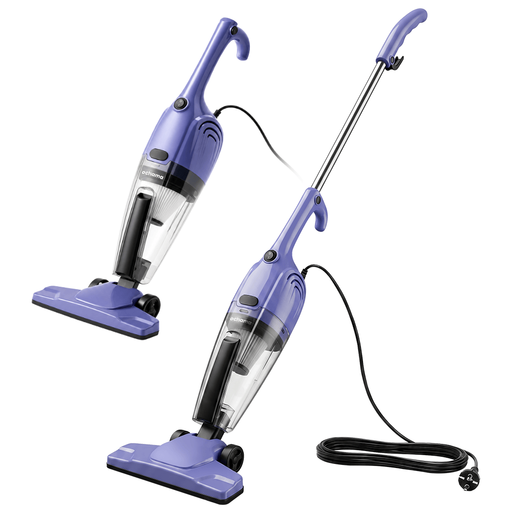
Why it suits this profile: This model runs on mains power and can be converted from a stick vacuum into a handheld vacuum. It is therefore suitable for small homes, furniture and quick cleaning sessions without having to worry about battery life.
The fixed mains connection means that the operating time does not depend on the selected setting. According to the product information, the filter is washable and reusable.
550 W motor, 0.5-litre dust container, several settings and a 4.5-metre cable.

Why it suits this profile: This robot vacuum is designed for households looking for a high level of automation. According to the product information, the OMNI station functions include automatic emptying, washing mop pads with 75 °C water, hot-air drying and water refilling.
According to the product specification, the robot uses mapping and obstacle detection. You will still need to remove cables and small objects, and maintain the tanks and brushes.
Stated suction power of 20,000 Pa, mopping function, carpet detection, multi-floor mapping and a self-cleaning station.
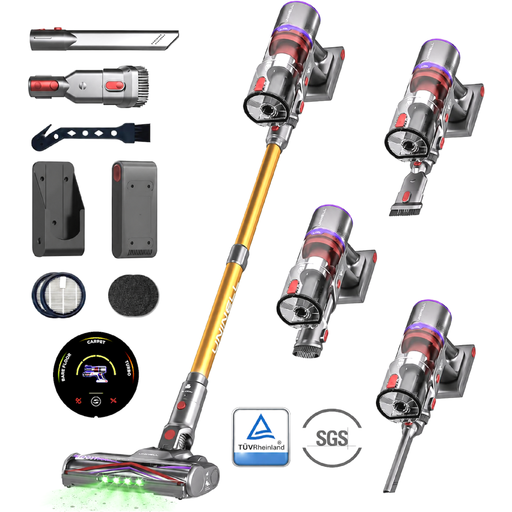
Why it suits this profile: This is a cordless vacuum cleaner for households with pets, carpets and multiple cleaning tasks. According to the product information, it can be used as both a stick vacuum and a handheld vacuum.
The removable battery and anti-tangle brush design help minimise practical issues during longer cleaning sessions. According to the product information, the stated 65 minutes does not necessarily apply to the highest setting.
Stated peak suction power of 60 kPa, up to 65 minutes of operating time, touchscreen, green lighting and seven-stage filtration.
We have put together a complete, up-to-date list of products that fully meet these strict selection criteria and the applicable European safety regulations.
Its lifespan depends on the battery, motor, filters and maintenance. Clean the filters regularly, remove hair from the brush and use turbo mode only when necessary. Also check whether a replacement battery is available before you buy.
A bagged vacuum cleaner can be practical when emptying it, as you can usually dispose of the contents in one go. However, there are ongoing costs for dust bags. Make sure you use the correct bag type and replace the bag when it is full to prevent loss of airflow.
In addition to the purchase price, you may incur costs for filters, brushes, mop pads, dust bags and cleaning fluid. A station without a disposable bag can reduce certain consumable costs, but always check which parts need to be replaced according to the product information.
