
Vandaag of morgen in huis

Kwaliteit gegarandeerd

Welkomstaanbiedingen ontgrendelen: GRATIS bezorging | Tot 80% korting | Gratis 30 dagen JoyPlus-proefperiode
Download de app
Buying a new vacuum cleaner seems simple, until you have to choose between a cordless vacuum cleaner, stick vacuum, handheld vacuum or wet and dry vacuum cleaner. Marketing copy often focuses on a high wattage, impressive suction power or smart features. However, these figures do not tell the whole story when it comes to everyday use.
The right choice mainly depends on your home, flooring, pets and cleaning routine. A compact handheld vacuum can be useful for crumbs and the car, while a wet and dry vacuum cleaner is better suited to a garage or workshop. Also watch out for these common pitfalls.
A higher wattage does not automatically mean that a vacuum cleaner will clean every floor better. The brush, airflow, filters and connection between the nozzle and floor also make a difference. A model with a well-designed floor brush can work more efficiently on hard floors than a heavier appliance with only a powerful motor.
Practical advice: as well as the motor power, check the stated suction power, floor settings and included nozzles.
With a cordless vacuum cleaner, the maximum run time usually applies to the most economical setting. In turbo mode, the operating time can be considerably shorter. So check whether the run time is specified for eco, standard or maximum mode.
A replaceable battery is practical for larger homes. A built-in battery can be perfectly suitable if you mainly do short daily cleans, but make sure you check the charging time and availability of replacement parts.
A vacuum cleaner with a HEPA filter can help filter fine particles from the exhaust air, but only when the filter is fitted and maintained correctly. Washable filters must be completely dry before you put them back. With bagged models, you also need to consider the price and availability of suitable bags.
Check in advance:
Suction power is often shown in kPa. This is a technical indication of negative pressure, but it does not fully predict cleaning performance. For a vacuum cleaner for hard floors and carpets, different settings are useful. A soft brush can pick up fine dust from parquet or tiles, while a motorised brush may be better suited to carpets and pet hair.
An anti-tangle brush helps to limit hair wrapping around the roller. However, regular maintenance is still necessary, especially with a pet vacuum cleaner.
A larger dust container or tank means you need to empty it less often, but it often makes the appliance heavier. For everyday use in a flat, a lightweight stick vacuum with a smaller dust container may be more comfortable. For a garage, renovation project or workshop, a larger tank is more useful.
A wet and dry vacuum cleaner requires extra attention: use the correct filter for dry or liquid dirt and empty the tank after use. Do not vacuum flammable liquids, hot ash or sharp objects when the manual prohibits it.
A vacuum cleaner with a HEPA filter may be appealing to households that want to minimise fine dust particles as much as possible. Always check exactly what the manufacturer measures and under which conditions. A claim about a particular filtration percentage is a brand-specific product specification, not a general guarantee for every usage situation.
The same applies to a vacuum cleaner with UV light. According to some brands’ own research, UV light may help reduce certain micro-organisms or mites under test conditions. Do not present this as a medical function. Use UV features only according to the safety instructions and do not point the light at eyes or skin.
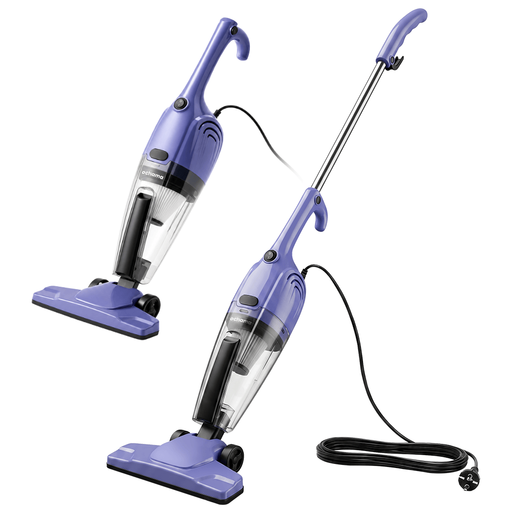
Why it suits this profile: The combination of stick and handheld modes is suitable for smaller homes, furniture and quick daily cleaning. The cord provides a constant power supply.
There is no need to compare run time or battery capacity. The 4.5-metre cable means you do not need to recharge during cleaning, although it does restrict you to areas within reach of a socket.
550 W motor, visible 0.5-litre dust container, several cleaning modes and a washable filter.
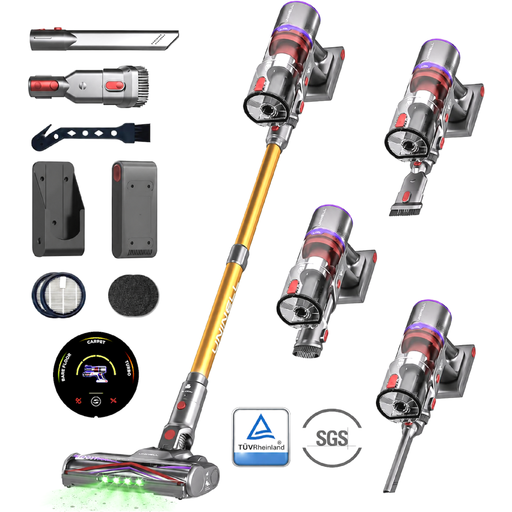
Why it suits this profile: This model is designed for households that want to use one cordless vacuum cleaner on hard floors, carpets, furniture, stairs and in the car.
The stated run time is linked to the operating settings. The removable battery and maintenance alerts make battery and filter management easier to keep track of.
Stated peak suction power of 60 kPa, up to 65 minutes’ run time, anti-tangle brush, 7-stage filtration and handheld mode.
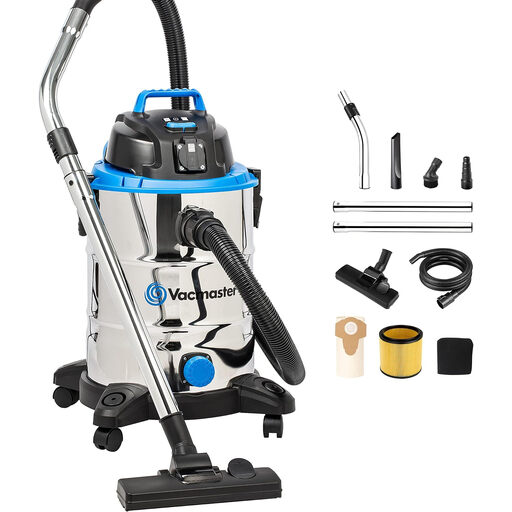
Why it suits this profile: For garages, workshops, DIY enthusiasts and intensive cleaning, this model offers functions for dry vacuuming, wet cleaning and blowing.
The filters are intended for different applications: a cartridge filter or dust bag for dry dirt, and a foam filter for wet vacuuming. This prevents one filter from being used incorrectly.
1500 W motor, 30-litre stainless-steel tank, EU socket for power tools, dual-mode floor head and blowing function.
We have put together a complete, up-to-date list of products that fully meet these strict selection criteria and the applicable European safety regulations.
The lifespan depends on usage, maintenance and the availability of parts. Clean the filters, remove hair from the brush and empty the dust container or tank in good time. With a cordless vacuum cleaner, the battery is also an important wear component. So check whether a replacement battery is available.
Not necessarily. A cordless model does not use a power cable while cleaning, but it does need to be charged. Power consumption depends on charging habits, operating time and the selected mode. A corded model may be suitable when you want to clean for long periods without interruption.
Choose a model with an adjustable floor brush or separate nozzles. A soft brush is often practical for hard floors, while a motorised brush can help loosen dirt from carpet fibres. Also compare the weight, noise level, filter maintenance and actual run time in each mode.
