
Vandaag of morgen in huis

Kwaliteit gegarandeerd

Welkomstaanbiedingen ontgrendelen: GRATIS bezorging | Tot 80% korting | Gratis 30 dagen JoyPlus-proefperiode
Download de app
Choosing a new vacuum cleaner seems straightforward, until you start comparing specifications. A high suction power rating does not tell the whole story, a long battery life often applies only to the lowest setting, and a robot vacuum cleaner does not automatically take care of every cleaning task. For UK households, the type of flooring, pets, stairs and available storage space are particularly important considerations.
Brands often quote a figure in Pa or kPa. This is a technical indication of maximum suction power, but real-world performance also depends on the floor head, airflow, seals and selected mode. A vacuum cleaner with a high peak figure may therefore be less practical on a hard floor if the brush does not make good contact.
Pay attention to the combination of:
With a cordless vacuum cleaner, the maximum running time is usually measured in the most economical setting. The battery runs down much faster in turbo mode. Check whether the stated running time applies to the floor setting, automatic mode or maximum suction power.
A removable battery can be useful in a larger home. You can use a spare battery or charge the battery outside the appliance. Also take the charging time and the cost of a replacement battery, if needed, into account.
A standard stick vacuum cleaner is not designed for liquids. For spilled drinks, mud, pet accidents or stains on a sofa, you need a spot cleaner or carpet cleaner with separate clean- and dirty-water tanks. Never use a dry vacuum cleaner on wet surfaces unless the product manual explicitly permits it.
For a vacuum cleaner for carpets and hard floors, a motorised brush with different settings is useful. On carpets, a brush helps loosen dirt from the fibres. On delicate hard floors, a softer setting or brush is often more suitable.
For homes with pets, an anti-tangle brush is practical. A V-shaped roller or a brush with rubber strips can help reduce hair wrapping, but regular maintenance is still necessary. Check the roller for hair and threads, even if the manufacturer claims to reduce tangles.
A multi-stage filtration system can trap fine particles in the expelled air. A HEPA filter is a commonly used term, but check whether the filter is washable, replaceable or can only be cleaned with a brush. A filter must be completely dry before being refitted. A clogged filter reduces airflow and can affect suction performance.
Claims such as “99.99% filtration” or a particular particle size should be treated as the brand’s product specifications. According to some brands’ own product information, these figures are established under specific test conditions; they are not a guarantee of the same results in every home.
As well as power, consider:
A self-emptying vacuum cleaner can reduce the need for daily emptying, but the base, filters and dust bag or collection container still require maintenance. With a robot vacuum cleaner, you also need sufficient clear space around the charging station.
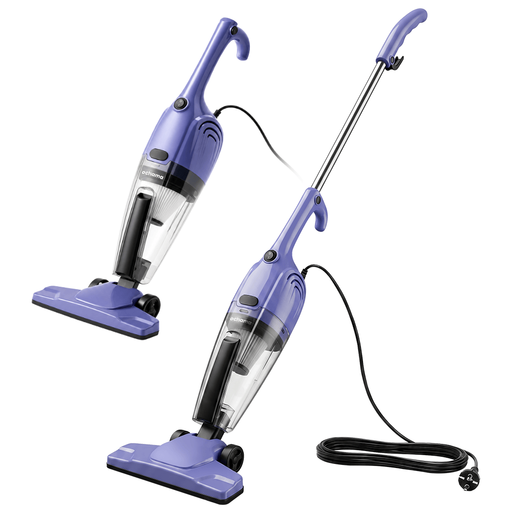
Why it suits this profile: This compact stick vacuum cleaner is suitable for small homes, student rooms and households that do not want to charge a battery. The 4.5-metre power cord provides a constant supply of power.
Its running time is not dependent on a battery. The product description also mentions a washable filter and use as either a stick or handheld vacuum cleaner.
550 W motor, 0.5-litre dust container, multiple settings and a power cord for consistent performance.
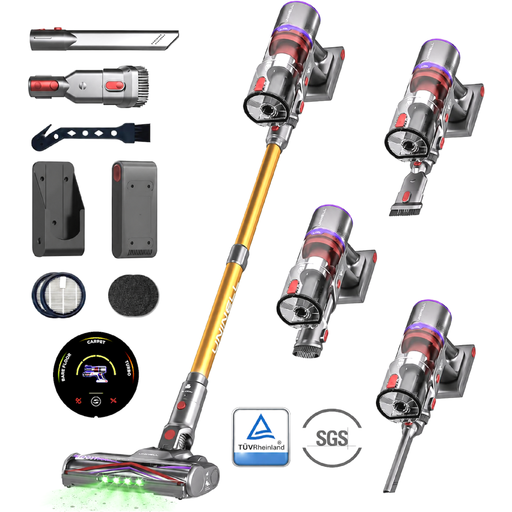
Why it suits this profile: The combination of a touchscreen, LED lighting, adjustable movement and handheld vacuum mode is ideal for anyone who wants to use one appliance on floors, furniture, stairs and in the car.
According to the product description, the battery status and maintenance alerts are shown on the screen. The stated running time of up to 65 minutes is a maximum and may vary depending on the mode.
Stated peak suction power of 60 kPa, anti-tangle brush, 7-stage filtration and 180° flat cleaning.
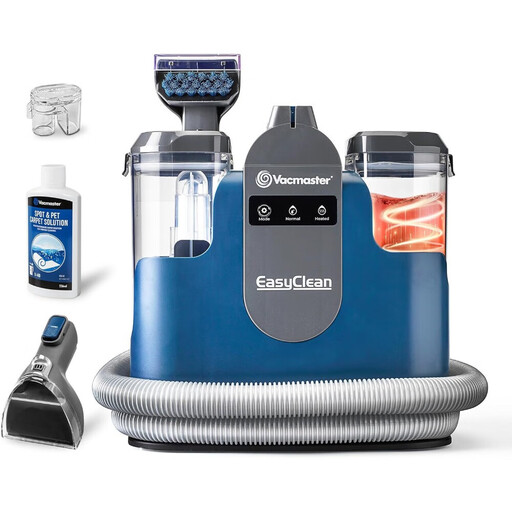
Why it suits this profile: This appliance is designed for wet cleaning of carpets, sofas, stairs and car seats. It complements a standard vacuum cleaner rather than replacing it for everyday dry vacuuming.
The separate tanks prevent clean and dirty water from being mixed. Both tanks must be emptied and rinsed after use.
500 W of power, 1.6-litre clean-water tank, 0.95-litre dirty-water tank and a 1.8-metre hose.
A robot vacuum cleaner is particularly useful for daily maintenance on hard floors and low-pile carpets. Look at the navigation system, threshold height, noise level and how the robot detects cables and loose items. A model with a mopping function is designed for light damp cleaning; it is not a substitute for a carpet cleaner when dealing with deep stains.
A self-emptying vacuum cleaner or robot with a base station reduces the need for daily emptying. However, check the capacity of the collection container, the cost of dust bags and the amount of space taken up by the station.
We’ve put together a complete, up-to-date list of products that fully meet these strict selection criteria and the applicable European safety regulations.
That depends on the battery life in each cleaning mode and the size of the dust container. For a large home, a removable battery, a second battery or a model with long battery life can be practical options. Always check the running time in the setting you actually use.
This varies by model, frequency of use and maintenance instructions. Washable filters must be completely dry before being refitted. Replaceable filters should be replaced according to the manual, or sooner if they are damaged, remain clogged or airflow noticeably decreases.
For pet hair, choose a vacuum cleaner with a motorised anti-tangle brush, multiple suction settings and an easily accessible filter. For liquids and ingrained stains, use a separate spot cleaner or carpet cleaner with dual water tanks. This helps prevent a dry vacuum cleaner from being used incorrectly.
