
Vandaag of morgen in huis

Kwaliteit gegarandeerd

Welkomstaanbiedingen ontgrendelen: GRATIS bezorging | Tot 80% korting | Gratis 30 dagen JoyPlus-proefperiode
Download de app
A UV-protective umbrella is useful for commuters, travellers, walkers and festival-goers who do not want to carry a large parasol. However, a dark canopy or the term “black coating” alone does not tell you enough. Some models prioritise compactness, while others focus more on rain, wind or maximum shade.
That is why choosing the right one should start not with colour or print, but with verifiable features such as UV rating, open diameter, folded size, weight, materials and use in windy conditions.
Product pages often use terms such as “UV-blocking”, “cooling” and “sun protection”. Check whether a specific value is also provided, such as UPF 50+, and whether it is clear who is making the claim. According to Beneunder’s own information, several models offer UPF 50+ or a higher internal rating and block more than 99% of the full UV spectrum. This is a brand product claim, not a general guarantee for every situation.
A UV-protective umbrella is not a replacement for other precautions, such as seeking shade or wearing suitable clothing. It is a portable shade solution for everyday use.
A folding umbrella measuring less than 20 cm fits easily into a bag, but often has a smaller canopy. That may be sufficient for one person, but less practical in windy rain or when you are also carrying a rucksack.
So pay attention to three measurements:
A compact umbrella with an open diameter of around 90 to 95 cm is easy to carry, but offers less coverage than a 99 cm model.
A frame made with aluminium and fibreglass ribs may contribute to stability and wind resistance, according to the product description. This does not mean that an umbrella will remain safely open in strong winds or storms. Use a wind-resistant umbrella according to the manufacturer’s instructions and close it during gusts.
A water-repellent umbrella should also be allowed to dry fully after use. Storing it while wet can damage the canopy, coating and folding mechanism more quickly.
A black coating can help reduce sunlight and heat. Also check the stated UPF rating. For models with UPF 50+, this is a clear product specification. Higher ratings stated by a brand, such as UPF 2000+, should be understood as a brand classification rather than a universal European standard.
A double canopy can provide additional shade, but usually also makes an umbrella larger or heavier. For everyday commuting, a five- or six-fold model is often more practical than a large rain and sun umbrella.
A combination of aluminium and fibreglass offers low weight with a relatively flexible construction. Check the number of ribs and the type of folding mechanism. Six reinforced ribs, for example, are more specific than a general description such as “extra strong”.
Different requirements apply to a garden parasol. A large cantilever parasol needs sufficient ballast, especially when it has a side pole. A cross base alone is generally not enough: always check whether water weights, sandbags or ballast slabs are included.
Carefully shake raindrops from the canopy, allow the umbrella to air-dry completely and then store it in the supplied cover. Clean it with a damp cloth. For parasols, use a soft brush and mild soapy water; abrasive products can damage the coating.
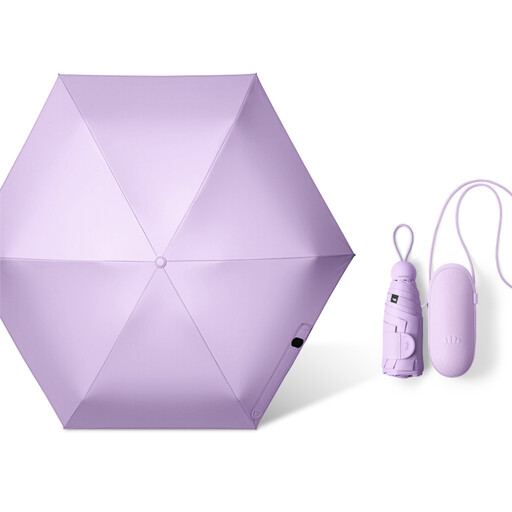
Why it suits this profile: This model is ideal if you are looking for a simple UV umbrella that takes up very little space in a bag or coat pocket. The capsule cover is designed to be carried by hand or attached to something.
The stated dimensions make the folded size easy to verify: approximately 19 cm long and 7.5 cm wide, rather than simply being described as “compact”.
According to the product description: UPF 50+, aluminium frame, six reinforced ribs and a five-fold folding mechanism.

Why it suits this profile: The BM666 is a good choice if you are looking for a slim rain and sun umbrella for everyday use, travelling or commuting.
In addition to the UV claim, the product information gives specific folded dimensions of approximately 15.5 by 6.6 cm and a weight of around 170 grams.
According to Beneunder: UPF 50+, five-fold aluminium construction, fibreglass ribs and a cover that can be carried by hand or over the shoulder.
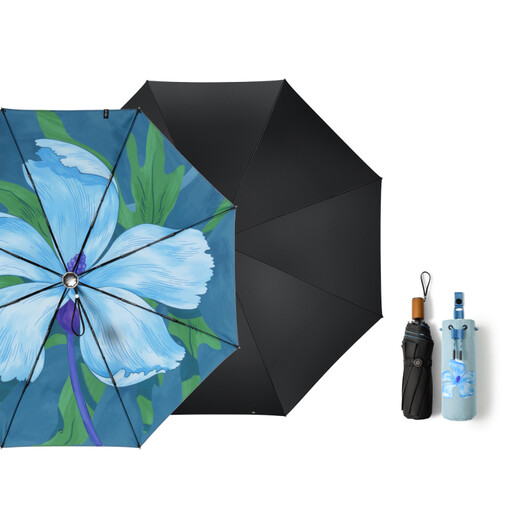
Why it suits this profile: This model is intended for anyone who wants greater body coverage during walks, outdoor activities or rainy days.
The product information states an open diameter of 99 cm and a fibreglass and aluminium frame. This makes the choice of coverage and construction clear.
According to Beneunder’s own information: double canopy, UPF 2000+, a weight of approximately 370 grams and protection from both sun and rain.
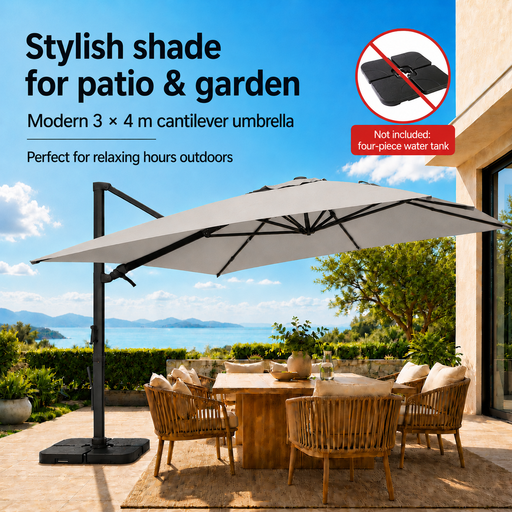
Why it suits this profile: The side pole leaves the space beneath the large patio parasol clear for a table, lounge set or garden furniture.
The specifications clearly state that ballast is not included. You can therefore budget in advance for the additional costs and installation.
3 × 4 metre canopy, 360° rotating base, tilts left and right, fully aluminium frame and PA-coated fabric weighing 280 g/m².
We have put together a complete, up-to-date list of products that fully meet these strict selection criteria and the applicable European safety regulations.
That depends on the product description. A model with a water-repellent or quick-drying canopy can also be used in light rain. Allow the umbrella to dry completely afterwards. Always check that the model is explicitly described as suitable for both sun and rain.
Its lifespan depends on use, exposure to wind, folding and care. An umbrella that is often stored while wet or used in strong winds may wear out more quickly. Allow the canopy to dry, do not force the frame and store the model in its cover.
Yes. For the models mentioned, ballast plates, water weights or other weights are not included. A cross base is only a foundation. Use sufficient ballast according to the instructions and close the parasol in strong winds or storms, or whenever you are not using it.
