
Vandaag of morgen in huis

Kwaliteit gegarandeerd

Welkomstaanbiedingen ontgrendelen: GRATIS bezorging | Tot 80% korting | Gratis 30 dagen JoyPlus-proefperiode
Download de app
A UV-protective umbrella is useful during a sunny walk, bike ride, commute, or trip. Many models are also suitable as a sun and rain umbrella. However, a dark canopy or eye-catching product name does not automatically tell you enough about protection, portability, or durability.
Focusing solely on marketing terms can leave you with an impractical umbrella: too small to provide sufficient shade, difficult to store, or vulnerable in windy conditions. Below, we outline the most important considerations along with several product picks suited to different use cases.
Product pages often feature terms such as UPF 50+, UPF 2000+, or “more than 99% UV blocking”. According to Beneunder’s product description, these values are associated with its L.R.C. black coating. This is a brand claim, not a general guarantee for every situation.
Also pay attention to:
A UPF rating refers to the amount of UV radiation that passes through a material. The protection provided around the umbrella also depends on the position of the sun, open sides, and reflection from the surroundings.
A wind-resistant umbrella may feature a reinforced frame, fibreglass ribs, or an aluminium construction. That does not mean every umbrella is suitable for strong gusts or stormy weather. A large canopy also catches more wind than a compact model.
Check the frame, the number of ribs, and the manufacturer’s instructions. In very strong winds, closing the umbrella is often wiser than continuing to walk with it open.
A lightweight, folding sun umbrella is convenient to carry in a bag, but a large canopy may compromise stability or take up more room. A model weighing around 150 grams is practical for everyday use, while a double-layer model may provide more shade at the cost of additional weight.
Always consider the combination of:
A black coating can help reduce light and heat, but its precise performance varies by material and construction. According to Beneunder’s own product descriptions, several models feature an L.R.C. black coating and a claimed UPF 50+ level of protection. Treat this as a brand-specific product specification and compare it with the other available information.
A water-repellent umbrella is not the same as a fully waterproof construction. Water-repellent finishes help rain roll off more easily, but seams, folds, and prolonged exposure to rain can affect performance. Allow the umbrella to dry completely after use before storing it.
For one person, an open diameter of approximately 83 to 95 cm is often practical. According to the product specifications, the Beneunder BM531 has a diameter of around 83 cm. The BM527 and BM528 models measure approximately 94.5 cm. A larger canopy provides more shade but may be less convenient on busy shopping streets or terraces.
For a garden or balcony, a 3 x 4 metre garden parasol belongs to a different product category. It provides considerably more shade but requires a suitable surface and sufficient ballast.
Fibreglass-aluminium combinations are designed to balance low weight with strength. According to the product description, models with six reinforced ribs are designed to provide additional stability. Also consider storage: keeping a wet umbrella in its case for an extended period can put stress on the material and coating.
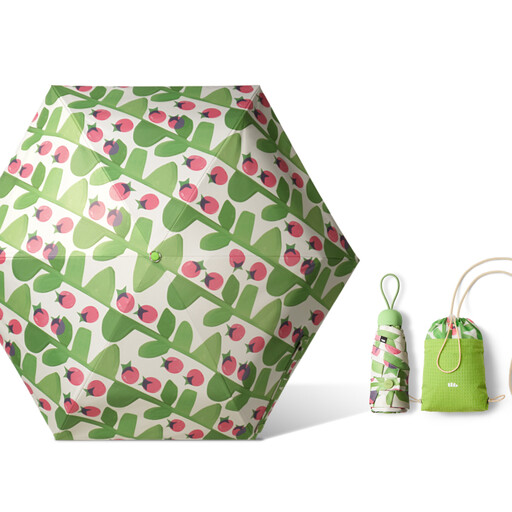
Why it fits: A practical choice for everyday travel to work, shops, or public transport. According to the product specifications, it has an open diameter of approximately 94.5 cm, a folded length of around 19 cm, and a weight of approximately 255 grams.
The design does not focus solely on minimising storage space. According to Beneunder, the umbrella has six reinforced ribs and a water-repellent finish.
Five-fold construction, a carrying case for hand or shoulder carrying, and a UPF 50+ specification stated by the brand.

Why it fits: For travellers, cyclists, and commuters with limited space in their bag. The brand lists a weight of approximately 150 grams and a slim profile of around 5 cm.
The compact design is combined with a carbon-fibre and aluminium frame; always check the current dimensions on the product page.
A UPF 50+ claim stated by Beneunder, a multifunctional cord, and an open diameter of approximately 83 cm.
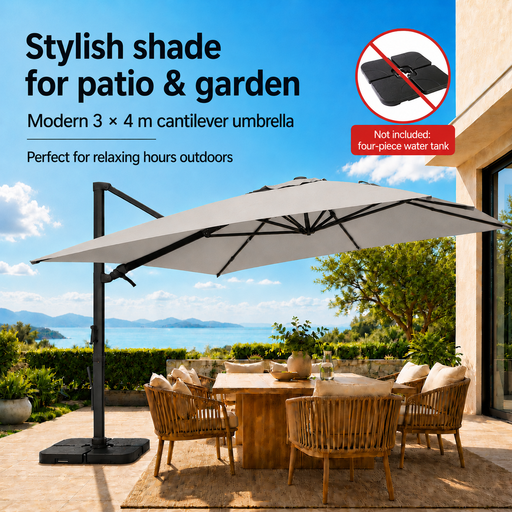
Why it fits: For a terrace, balcony, or garden where a personal umbrella does not provide enough shade. The side-mounted pole keeps the area beneath the canopy clear for a table or lounge set.
The product information clearly states that cross-base weights are not included. You must purchase this ballast separately to ensure stable placement.
A 3 x 4 metre canopy, 360° rotation, left- and right-side tilt adjustment, and a fully aluminium frame.
Gently shake rainwater from the canopy and allow the umbrella to dry fully while open or extended. Store it afterwards in the supplied case. Clean stains with a damp cloth and do not use aggressive cleaning products. After a windy day, inspect the ribs, sliding mechanism, and shaft.
For a parasol, it is advisable to close the canopy in strong winds and secure the structure with suitable ballast. The supplied cross base alone is not always sufficient.
Browse a current selection of products with different sizes, coatings, and carrying solutions for outdoor sun protection.
That depends on the canopy finish and product description. Several Beneunder models state that they feature a water-repellent coating and are suitable for sun and rain. Always allow each model to dry completely after exposure to rain before storing it.
Its service life depends on use, wind exposure, folding, and storage. Strong winds can damage the frame more quickly, while the coating may wear down through frequent use. Storing the umbrella dry, opening it carefully, and using a case will help preserve its condition.
For one person on the move, a compact travel umbrella is usually sufficient. For a table, lounge set, or several people, a beach umbrella or garden parasol is more practical. A 3 x 4 metre model provides more shade but also requires a sturdy surface and separate ballast.
