
Working with limited desk space
You want to store recordings locally without a stick sticking out too far alongside other equipment. Kingston, SanDisk and Samsung describe compact USB-A options; check which type of port is available first.


Choose a stick that fits the ports on your recording device and computer. A low-profile design is useful if you’ll leave it plugged in on a cramped desk, while USB-A and USB-C are handy when you use devices with different ports. Work out the capacity you need based on your recording files, keep a separate backup and consider what security measures you need for identifiable interviews; the Dutch Data Protection Authority considers identifiable audio recordings to be personal data.
You want to store recordings locally without a stick sticking out too far alongside other equipment. Kingston, SanDisk and Samsung describe compact USB-A options; check which type of port is available first.
You transfer interviews between devices with different connections. SanDisk describes the Ultra Dual Drive Luxe as a model with USB-A and USB-C; check the ports on both devices.
When voices are identifiable or conversations are sensitive, access, retention period and the risk of loss are important considerations. The Dutch Data Protection Authority considers identifiable audio recordings to be personal data.
Start by checking the connections on your recording device and computer. Then choose a design, capacity and security features that suit the way you store and transfer interviews.
| What to consider | What to check when buying | Who should pay particular attention? |
|---|---|---|
| Minimal protrusion | Check the type and position of the USB port, and compare the dimensions of the model you’re considering. | On a cramped desk, I don’t want a plugged-in stick to protrude too far; around 28% of consumers say a low profile is their top priority. |
| Connection | Check the ports on the recording device and computer separately, and make sure the stick will fit both directly. | If I want to transfer recordings between devices, I check the ports on both; around 22% of consumers prioritise compatible connections. |
| Confidentiality | Assess the risk posed by identifiable recordings and check the security features of the exact model. | When conversations are identifiable, I want to limit the risk of unauthorised access; around 22% of consumers make confidentiality their top priority. |
| Storage and retention | Work out the storage you need based on your files and plan a separate, up-to-date backup. | For a growing interview archive, I want enough space and a second copy; around 17% of consumers prioritise storage and retention. |
| Transfer time | For frequent transfers of large files, compare the specified read and write speeds of the exact model. | If I often copy large files, I want to know how quickly they’ll be written to the stick; around 11% of consumers say transfer time is their top priority. |
A low-profile USB-A stick won’t plug directly into a device with USB-C only.
Check the connections on both your recording device and computer. Choose a dual connector only if you need one.
A compact design or metal casing doesn’t prove that files are encrypted. The Dutch Data Protection Authority points out that losing a stick containing unencrypted personal data can lead to a data breach.
Assess the risks posed by identifiable interviews and check the security features of the exact model, as well as your procedures for access and storage.
If the stick is lost or stops working, you won’t have another copy of the files unless you’ve made a separate backup. VeiligInternetten describes a backup as a copy of files stored on another device.
Make and check a recent, separate copy, and choose a storage location that suits the sensitivity of the interviews.
Read and write speeds are different specifications. Maximum speeds quoted by manufacturers aren’t a measure of performance on your computer.
For frequent transfers of large files, compare the write specification for the exact model and take the receiving device into account.
The DataTraveler Micro is a low-profile option; the IronKey Locker+ 50 G2 is a separate range with hardware encryption.
The range includes compact models designed to stay plugged in, a model with USB-A and USB-C, and one designed for transferring files.
The FIT Plus is a compact USB-A option; the BAR Plus has a metal casing and a carrying loop.
The JetFlash 790 has a retractable USB-A connector, making it a good option if you regularly unplug your stick.
These USB sticks are designed for storing and transferring files. The models vary in capacity, connections and stated security features; check that the connections match those on your recording device and computer.
 No image available
The listed connections may be useful if you want to transfer files between devices with different ports; check that they match your recording device and computer.
Capacity: 32 GB. Listed connections: USB 3.0, Lightning, USB-C and Micro-USB.
 No image available
The product description mentions password protection and software-based 128-bit AES file encryption; check that this approach is suitable for the sensitivity of your interviews.
Capacity: 64 GB. Connection: USB-A.
 No image available
The two listed connections are useful if you transfer files between devices with USB-A and USB-C; check which ports your devices have.
Capacity: 512 GB. Read speed: up to 150 MB/s according to the product description; no write speed is specified.
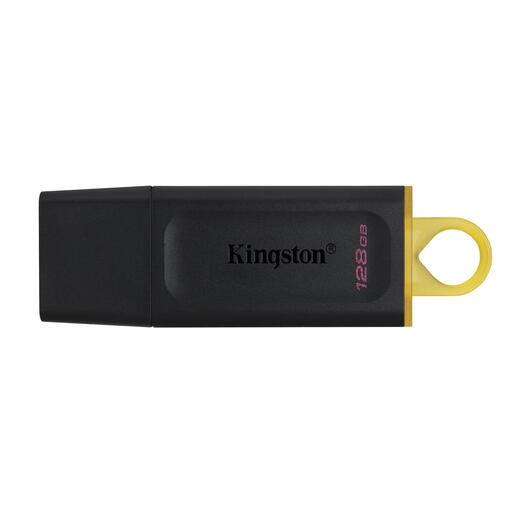 No image available
A storage option for interviews if 128 GB is enough for your files; remember to keep a separate backup too.
Capacity: 128 GB. The product information mentions a protective cap and a carrying loop.
 No image available
A storage option for interviews if 64 GB is enough for your files; plan a separate copy of important recordings as well.
Capacity: 64 GB. The product information mentions a protective cap and a carrying loop.
No, not if the stick contains the only copy of your recordings. Keep a separate, up-to-date copy and choose a storage location that suits the content.
It depends on the recording format, settings and file size. Measure a representative recording, work out how much space you’ll need for your planned interviews and allow for the fact that usable capacity is lower than the advertised figure.
Check the port and supported file system of every device involved. Kingston lists exFAT as an option for Windows and macOS on the DataTraveler Micro, but warns that some other devices can’t read exFAT. Formatting erases existing files.
According to the Dutch Data Protection Authority, identifiable audio recordings are personal data. Organisations must decide on security measures based on the risks; personal data must not be kept for longer than necessary, and the GDPR doesn’t set a general fixed retention period. The Authority lists consent as one possible legal basis; the appropriate legal basis and retention period depend on how the data is processed.
Before buying, check the terms for the exact model. Kingston states that the DataTraveler Micro and IronKey Locker+ 50 G2 have a five-year limited warranty; this doesn’t mean that lost interview files will be retained or recoverable.