
Pianist with limited power sockets
You play through a computer and don’t want a separate mains adapter for your controller, while still looking for the piano keyboard that suits you. Studiologic and M-Audio describe models that are USB-powered.


If you play through a computer and don’t want a separate mains adapter for your controller, choose a model whose manufacturer confirms it’s USB-powered. Then decide whether a full-size keyboard with hammer action, a semi-weighted model or a smaller keyboard best suits your playing and available space. Also check your piano software, audio output and any pedal connection. A MIDI controller doesn’t produce piano sounds on its own.
You play through a computer and don’t want a separate mains adapter for your controller, while still looking for the piano keyboard that suits you. Studiologic and M-Audio describe models that are USB-powered.
You’re mainly comparing keyboard size and key action. Studiologic describes a model with hammer action, while M-Audio specifies semi-weighted keys. These are different types of keyboard.
You want to play virtual piano sounds, but need to weigh the keyboard’s range against the space you have available. Models with fewer keys take up a different amount of space from a full-size piano keyboard.
First check that the exact model is USB-powered through the computer connection you plan to use. Then choose based on the keyboard, the space you have and the controls you need for your piano software.
| What to consider | What should you check? | Who should pay particular attention? |
|---|---|---|
| Power without an extra socket | Check that the manufacturer confirms USB power for the exact model and the connection you intend to use. | If I play through a computer, I don’t want to need a separate adapter for the controller. Around 34% of consumers prioritise power via a computer. |
| Keyboard and key action | Compare the number of keys and whether the model has hammer action or semi-weighted keys. Also check the pedal connection. | If the keyboard’s size and key action affect how I play, I want to compare the key mechanism and range in advance. Around 33% of consumers prioritise the piano keyboard. |
| Space for the instrument | Measure the space available and compare it with the dimensions of the exact version and its number of keys. | If I have limited desk space, I want to know whether the keyboard will fit and how many keys will be within easy reach. Around 20% of consumers prioritise the space available. |
| Software controls | Check that your piano software supports MIDI input and that the buttons or faders you want to use work with it. | If I want to control settings from the keyboard, I want features that work with my software. Around 13% of consumers prioritise software controls. |
A USB-MIDI connection doesn’t automatically mean that the instrument gets its power through that connection. So don’t assume you can set it up without an extra adapter until you’ve checked the power requirements of the exact model.
Check the product specifications for explicit confirmation that it’s USB bus-powered.
Fewer keys limit the range you can play straight away. For example, Arturia lists 25 slim keys for the MiniLab 3; that’s a different choice from an 88-key keyboard.
First decide what range and key action you need, then compare the instrument’s dimensions with the space you have available.
Power can vary depending on the computer connection. Nektar warns that some computer ports don’t always provide a consistent enough power supply. For the KeyLab Essential mk3, Arturia recommends connecting directly to the computer rather than using a USB hub.
Follow the instructions for your model and test the connection you plan to use before buying any accessories.
A standard MIDI controller sends performance data, but it isn’t a sound source in itself. You’ll need suitable piano software or another connected sound source to hear anything.
Check which software you use, how to set up MIDI input and which audio output you’ll listen through. Also check whether the pedal you want is included.
The SL88 MK2 is an option if you’re looking for an 88-key model with hammer action and USB-C power.
The Keystation 88 MK3 is a USB-powered controller with 88 semi-weighted keys.
The KeyLab Essential 88 mk3 and MiniLab 3 offer different keyboard sizes and controls for music software.
Novation says the Launchkey 61 MK4 combines a USB-powered keyboard with controls for music software.
The Impact LX88+ is designed around an 88-key keyboard with controls for music software.
The products below are standalone 61-key keyboard pianos, not confirmed USB-powered MIDI controllers. USB-MIDI indicates that MIDI data can be sent via USB, but on its own it doesn’t confirm that the keyboard is powered via USB.
 No image available
This may be worth considering if you’re comparing standalone keyboards with USB-MIDI. Don’t treat USB-MIDI as proof that it’s USB-powered.
61 keys; the product name specifies weighted keys and a headphone connection.
 No image available
This keyboard is designed as a standalone instrument. Check how it’s powered separately before choosing it for a setup without an extra power socket.
61 keys; the product name specifies a MIDI controller function and speakers.
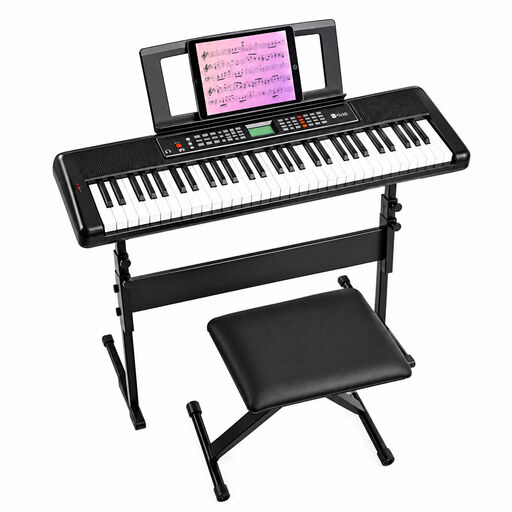 No image available
This kit may suit you if you’re looking for a stand and stool as well as a keyboard. Check the power requirements if you want to avoid using an extra power socket.
61 keys; the product name specifies a stand and stool, as well as USB-MIDI.
Not for the controller, if the exact model gets enough USB power through your computer connection. Your computer and any other equipment will still need their own power. USB-MIDI alone doesn’t prove that a device is USB-powered. Nektar notes that some setups may require a different port or cable, and possibly a powered hub.
A standard MIDI controller doesn’t make any sound itself. You’ll need piano software or another sound source, and you’ll need to set up the correct MIDI input and audio output.
Check the USB connection, computer compatibility and pedal input for the exact model. For the KeyLab Essential mk3, Arturia recommends using a computer port directly rather than a hub. Follow the manual for your version when cleaning and maintaining it.
For qualifying distance sales to consumers, you generally have a 14-day cooling-off period, although the Dutch government lists some exceptions. You’re also entitled to a statutory guarantee. ACM ConsuWijzer explains that this doesn’t have a fixed duration for all products, and that the seller is your point of contact if a product doesn’t meet reasonable expectations under normal use.
No. According to the European Commission, the CE mark is the manufacturer’s declaration that the product complies with applicable EU rules; it isn’t a general independent quality approval. The rules that apply depend on the specific product.