What should you look for when buying?
First decide whether you’ll mainly practise solo or record several voices at once. Then choose a suitable polar pattern and check whether you can monitor your recording as you practise.
Focused pattern for solo lines
Suitable for: mainly practising alone with the microphone in front of the speaker.
Bear in mind: this pattern doesn’t offer the switchable recording options of a model designed for groups; placement still matters.
Multiple patterns for ensemble practice
Suitable for: two performers facing each other or several voices around one microphone. JBL lists bidirectional and omnidirectional modes among those available on the Quantum Stream Studio.
Bear in mind: a wider pattern also picks up more of the room. Make a short test recording with the performers in their intended positions.
| What to consider |
What should you check? |
Who is this important for? |
| Recording your lines clearly |
Check the polar pattern and microphone position; a focused pattern doesn’t guarantee a noise-free recording. |
If I’m practising solo in a room with other sounds, I want my voice to remain clear. Around 36% of consumers say clear solo recordings are their top priority. |
| Recording several voices |
Check whether a bidirectional or omnidirectional pattern is available and suits the performers’ positions. |
For dialogue or a group around one microphone, I want the setup to suit where the performers are sitting. Around 29% of consumers prioritise recording ensemble performances. |
| Monitoring while you practise |
Check for a headphone output and level or monitoring controls; separately check whether headphones are included. |
Anyone who wants to check their pronunciation and the difference between quiet and loud delivery during rehearsal will benefit from direct monitoring. Around 21% of consumers choose this as their most important need. |
| Setting up in different places |
Check your device’s connection, the included cable and the stand. |
If I practise in different rehearsal spaces, I want to know whether the microphone will be easy to connect and set up. Around 14% of consumers say ease of setup is their top priority. |
Joybuy products for solo practice
These product picks are aimed at recording individual lines and voices; check that each model’s connections and controls suit your rehearsal.
 No image available
USB condenser microphone with cardioid pattern
An option for solo lines if you want a focused polar pattern and headphone monitoring.
The product title specifies a cardioid pattern. The product description lists gain control, a mute button, a 3.5 mm headphone output, a boom arm stand and a USB cable.
View at Joybuy
 No image available
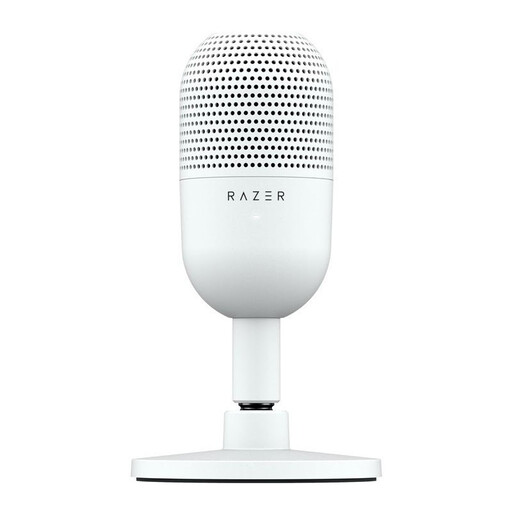
Razer Seiren V3 Mini White
A compact USB microphone for solo practice if you want a focused polar pattern.
Razer lists a supercardioid pattern, tap-to-mute controls and an adjustable tilt stand. This model doesn’t offer the choice of patterns found on a group model.
View at Joybuy
Frequently asked questions
Which polar pattern is suitable when two performers are facing each other?
Check whether the microphone has a bidirectional mode and look at the recommended positioning. JBL describes this mode on the Quantum Stream Studio as suitable for recording someone on the other side of the microphone; make a short test recording of both voices first.
Can you connect a USB microphone to any laptop without an extra cable?
No. Check the connections on both devices and the cable included. RØDE lists a USB-C-to-USB-A cable for the NT-USB Mini and describes a different cable for a device with USB-C only.
What can you do if softly and loudly delivered lines sound different on playback?
Make a test recording at both volumes and check the recording level. According to JBL, the Quantum Stream Studio has a level meter and adjustable gain; a test recording will help you judge how the settings work with your setup.
What are your rights if a microphone bought online doesn’t work properly?
For online purchases from a business in the Netherlands, you’ll often have 14 days to change your mind, subject to legal exceptions, as explained by the Dutch government. You’re also covered by statutory warranty: if a fault means the product doesn’t meet what you could reasonably expect with normal use, the seller is responsible for providing an appropriate solution. ACM ConsuWijzer explains that there’s no fixed statutory period of just two years.
Can a theatre group simply post a recording featuring identifiable fellow performers online?
Don’t assume that you can. The Dutch Data Protection Authority says that an organisation needs a legal basis under the GDPR to process personal data, and that in most cases permission is needed to publish other people’s information online. The rules that apply to a particular recording depend on how it’s used, so agree with everyone involved on why the recording is being made and how it will be shared.


