
Performers in a quiet room
If you want to make clear recordings from a fixed position, listen back to a test recording to check that both quiet and powerful lines come through well.


If you’re recording in a quiet room and want to get started from a fixed position, compare cardioid USB condenser microphones with a desktop stand and direct headphone monitoring. If you can hear echo or background noise, a dynamic USB microphone for close-up speaking may be worth considering, provided you can maintain that distance while performing and have a suitable stand or boom arm. Make a test recording in your own space: a higher stated sample rate won’t, by itself, predict a better performance.
If you want to make clear recordings from a fixed position, listen back to a test recording to check that both quiet and powerful lines come through well.
If you can hear echo or background noise, try different microphone positions and speaking distances. A directional microphone won’t block out the room completely.
If you want to use the microphone in the same place each time, consider whether a desktop stand will put it at the right height or whether a boom arm would suit your setup better.
Start with your room and the speaking distance you can maintain. Then compare the stand or boom arm, monitoring and connection for the exact model.
| What to consider | What should you check? | Who should prioritise this? |
|---|---|---|
| Clear delivery | Check the polar pattern, gain control and direct monitoring. Test both quiet and loud lines from the same position. | If I want to know whether quiet lines and emphasis remain clear, I’ll listen back to a test recording. Around 36% of consumers say clarity is their main concern when buying. |
| Echo and background noise | Compare recordings from your intended position and at different distances. Choose a dynamic model for close-up speaking only if you can maintain that distance. | If my room is echoey or background noise is audible, I first want to find out which speaking position works in that space. Around 29% of consumers prioritise room noise. |
| Fixed positioning and plosive sounds | Check what’s included in the box, how the microphone is mounted and whether it has pop protection. A boom arm needs a suitable place to attach it. | If I need a consistent position and want to take bursts of air from plosive sounds into account, I’ll compare a stand with a boom arm. Around 21% of consumers put their setup first. |
| Connection and playback | Check your device’s port, the supplied cable and the headphone socket on the exact model. | If you want to connect without a separate audio interface and listen back while speaking, the connection and supplied cable may be deciding factors. Around 14% of consumers say ease of connection is their main concern when buying. |
RØDE recommends a speaking distance of around 5–10 cm for the PodMic USB. If you move around a lot while performing or can’t comfortably maintain that distance, positioning it may be tricky.
Work out your speaking position first, then check what’s included in the box. For the PodMic USB, you’ll need to check separately for a suitable boom arm or stand.
If the model you choose doesn’t include a suitable support, you may still need to buy a boom arm or stand.
The Sennheiser Profile model with a desktop stand and the Profile Streaming Set with a boom arm have different items in the box.
Before you buy, check the full model name and the accessories listed. The boom arm is included with the Streaming Set, not automatically with every Profile model.
Audio-Technica specifies conversion up to 24-bit/96 kHz for the AT2020USB-X, but that figure alone doesn’t prove it will deliver better results for poetry. A cardioid pattern won’t eliminate room noise completely either.
Make a test recording in your usual position and assess your voice, echo and unwanted noise before recording a full performance.
The NT-USB Mini is a compact USB condenser microphone with a desktop stand, while the PodMic USB is a dynamic USB/XLR microphone for close-up speaking.
The Profile Streaming Set is worth considering if you’re looking for a USB microphone with a fixed boom-arm setup.
The AT2020USB-X is a cardioid USB condenser microphone with a desktop stand and headphone monitoring.
The MV7+ is a dynamic USB-C/XLR alternative for anyone comparing controls and digital features for voice recording.
Below are Joybuy product options for voice recording or recording equipment. Check that each product’s features, connection and setup suit your usual recording position.
 No image available
A wireless lavalier microphone to compare if a USB-C connection suits your recording setup.
The product name lists 2TX+1RX and a range of 150 m.
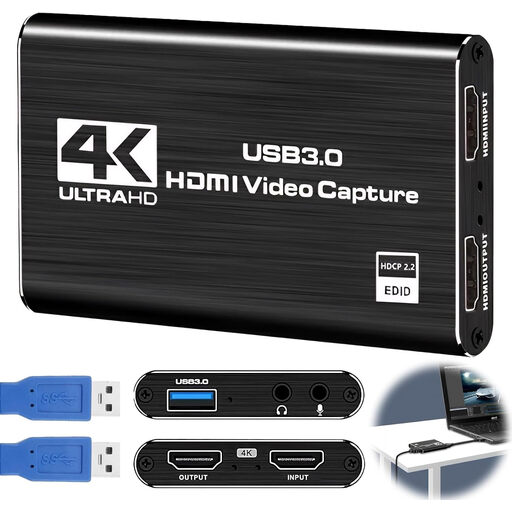 No image available
This is equipment for capturing HDMI video, not a microphone. Compare it only if video recording is also part of your equipment choices.
The product name lists video capture up to 1080p, 4K HDMI pass-through, UVC and UAC, plus a microphone input and headphone output.
 No image available
This cardioid USB condenser microphone is an option to compare for voice recording from a fixed position.
The product description lists gain control, a mute function, a supplied boom arm, pop filter and windscreen, and a 3.5mm headphone socket for monitoring.
 No image available
A desktop USB microphone to compare if you’re looking for a compact setup with a stable base.
The product description lists a cardioid pickup pattern, a USB-C to USB-A cable, a mute button, built-in pop filter and shock mount, and an adjustable stand.
 No image available
A compact USB microphone for desktop use, worth comparing for voice recordings made at a desk.
The product description lists a supercardioid pickup pattern and tap-to-mute controls.
Speak towards the recording side and make a test recording from your usual position. Adjust the distance and position until your voice and the room sound are balanced. RØDE specifically recommends around 5–10 cm for the PodMic USB; this distance doesn’t automatically apply to other microphones.
Not necessarily for the USB features mentioned: RØDE says the NT-USB Mini can connect to a compatible computer without a separate driver, while Sennheiser describes the Profile as a plug-and-play USB microphone. Check that the cable and device are compatible with the exact model, though.
Check whether the exact model has pop protection, then listen to a test passage with quiet and powerful lines through the direct headphone output. RØDE describes the PodMic USB’s pop filter as protection against bursts of air, including those produced by a ‘p’ sound.
Not automatically. Under Dutch copyright law, the creator or rights holder generally has the exclusive right to publish and reproduce the work, subject to legal exceptions. Before publishing, check that you have the necessary rights or that an appropriate exception applies. Buying a microphone doesn’t give you the right to publish.
Consider their privacy before publishing the recording. The Dutch Data Protection Authority says that permission is usually required to publish other people’s personal data online; there is a limited exception for use purely for personal or household purposes.