Who is this guide for?

Solo reviewer in a noisy room

You record spoken reviews where other activity or reflections may be audible, and can speak close to a suitably positioned directional microphone. RØDE and Samson describe the polar patterns of the microphone models mentioned here.

Reviewer who checks recordings straight away

You want to hear through headphones how your voice, plosive sounds and room noise come across in a test recording. Audio-Technica and Samson list direct monitoring for the ATR2100x-USB and Q2U respectively.

Reviewer with a compact desk setup

You’re looking for a simple USB connection and practical controls or mounting options, without having to buy an audio interface straight away. The Samson, Audio-Technica and Razer models mentioned come with different accessories and controls.

What should you look for?

Dynamic USB microphone

A good fit if: you’re mainly recording one voice and can speak close to a fixed microphone.

The trade-off: its polar pattern won’t remove echo or noise coming from in front of the microphone at the same time as your voice.

USB condenser microphone

A good fit if: you’re recording in a relatively quiet place and want gain or monitor-mix controls on the microphone.

The trade-off: check your recording space and what’s included in the box. A polar pattern doesn’t guarantee an echo-free recording.

What to consider What should you check? Who might find this important?
Clarity in a noisy room Check the microphone type, which side to speak into and how it’s mounted. Test both speech and silence in the place where you’ll be recording. When I record in a rehearsal room, I want my voice to remain clear despite echo or activity; around 37% of consumers put this concern first.
Listening as you record Look for a headphone output and check whether you can monitor the microphone directly and adjust the volume. I want to hear during a quick test whether my voice and any unwanted noise are coming through; around 27% of consumers prioritise checking their recording as they go.
A stable desk setup Check what’s in the box and whether it includes a desk stand, clamp, boom arm and the USB cable you need. When I want to set up a fixed speaking position quickly, I look at the mounting options; around 18% of consumers prioritise ease of setup.
Connections and expandability Check the full model number, the USB port on your recording device and whether the model has both USB and XLR. If I want to record via USB now but might use XLR later, I need to choose a model that supports both; around 18% of consumers base their choice mainly on connections and expandability.

Common mistakes

  • Expecting a polar pattern to eliminate all room noise

    A cardioid microphone picks up sound in front of the capsule most strongly, but it can’t guarantee that other audible sources and reflections will disappear.

    Position the microphone carefully, choose a quieter time to record if you can, and listen back to a test recording.

  • Confusing the RØDE PodMic with the PodMic USB

    The names refer to different models, and you can’t assume they have the same USB connection.

    Before buying, check the full model name and the connections on the version being sold.

  • Assuming a standalone microphone comes with everything you need for a desk setup

    Without a suitable mount, it can be difficult to position the microphone securely at a consistent speaking distance.

    Check what’s included with the exact model, including cables, a stand, clamp and windscreen.

  • Assuming the manufacturer’s warranty is the same as your full statutory rights

    ACM ConsuWijzer explains that statutory rights exist alongside any retailer’s or manufacturer’s warranty.

    Keep your proof of purchase and contact the retailer if a product is faulty.

Brands to consider

RØDE

The PodMic USB is a dynamic USB-C/XLR microphone for a fixed, close-up speaking position. It’s a different model from the PodMic without USB.

  • RØDE lists a cardioid pattern, headphone output, internal plosive protection and a USB-C cable in the box with the PodMic USB.
  • RØDE recommends speaking around 5–10 cm from this model. You’ll need a suitable stand or arm to mount it, so check what’s included with your version.

Audio-Technica

The ATR2100x-USB is a dynamic cardioid handheld microphone with USB-C and XLR connections for voice recordings.

  • Audio-Technica lists direct headphone monitoring, a foldable desktop tripod and USB and XLR cables for the ATR2100x-USB.
  • These features apply to the ATR2100x-USB and aren’t automatically included with other ATR models.

Samson

The Q2U is a dynamic USB/XLR microphone supplied with mounting accessories in the set described by Samson.

  • Samson lists a cardioid pattern, direct monitoring, a desktop tripod, windscreen and cables.
  • The manufacturer’s description of the microphone as suitable for untreated rooms doesn’t guarantee that echo or other room noise will disappear.

Sennheiser

The Profile USB is a cardioid USB-C condenser microphone for anyone looking for on-device controls.

  • Sennheiser lists gain, mix and volume controls, as well as a headphone output.
  • Check which Profile version you’re choosing: the standalone microphone and Streaming Set don’t have the same setup.

Shure

The MV7+ is a dynamic USB-C/XLR microphone with a headphone output and settings available through the MOTIV Mix app.

  • Shure lists controls for gain and monitoring.
  • Shure explains that ‘Voice Isolation’ on this model refers to its cardioid pickup pattern. Don’t take this term as a guarantee of a quiet rehearsal room.

Razer

The Seiren V3 Mini is a compact USB condenser microphone for a small desk setup.

  • Razer lists a supercardioid pattern, a tilting stand and tap-to-mute controls for the Seiren V3 Mini.
  • Assess room noise with a test recording and check separately whether the headphone monitoring you want is available.

USB condenser microphones on Joybuy

The products below are USB condenser microphones for a desk setup. Check each model’s controls, mounting options and connections to make sure they suit your recording space.
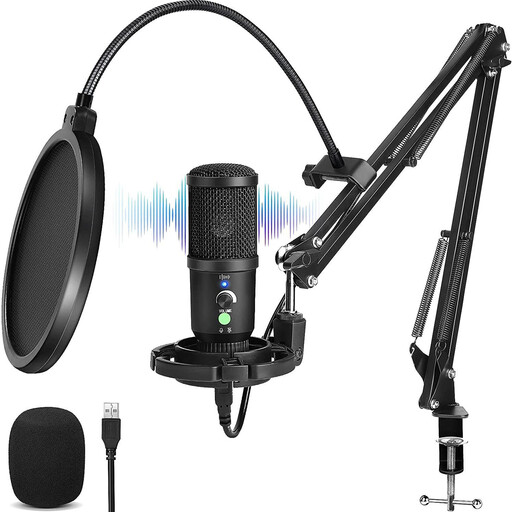
USB condenser microphone with cardioid pattern

USB condenser microphone with cardioid pattern

For a USB desk setup; the product information mentions headphone monitoring.

The product information lists a cardioid pattern, gain control, mute button, boom arm, shock mount, pop filter and USB cable.

A cardioid pattern doesn’t guarantee that echo or noise picked up at the same time as your voice will disappear.

View at Joybuy
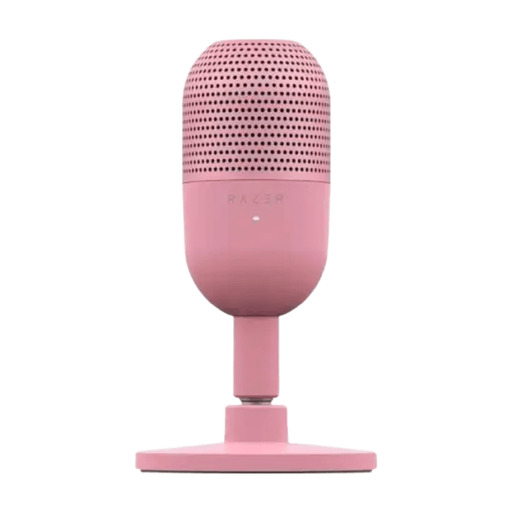
Razer Seiren V3 Mini Quartz USB microphone

Razer Seiren V3 Mini Quartz

A compact USB desktop setup with tap-to-mute functionality.

Razer lists a supercardioid pattern and tilting stand for the Seiren V3 Mini.

A directional pattern doesn’t guarantee that echo or noise picked up at the same time as your voice will disappear.

View at Joybuy

Frequently asked questions

How should you position the microphone before recording a book review?

Point the speaking side towards your mouth and record a short voice and silence test in the place where you’ll actually be recording. For the PodMic USB, RØDE recommends a distance of around 5–10 cm; check the positioning guidance for any other model.

Do you need a stand or audio interface as well as a USB microphone?

For direct USB recording, the PodMic USB described here doesn’t need an external audio interface, but it does need a suitable stand or arm for mounting. Samson and Audio-Technica list a desktop tripod with the Q2U and ATR2100x-USB respectively; check what’s included with the version you choose.

Will a cardioid microphone make a rehearsal room quiet?

No. A cardioid pattern doesn’t guarantee that echo or noise picked up at the same time as your voice will disappear. Point the microphone towards your mouth and use a test recording to assess how the room sounds from your chosen position.

What about cancellation rights and warranties when buying online in the Netherlands?

ACM ConsuWijzer states that online consumer purchases generally come with a statutory cooling-off period of up to 14 days after delivery, subject to legal exceptions. Statutory rights are separate from any manufacturer’s warranty; if a product is faulty, contact the retailer.

Can you read extracts from a book in a published review?

Not automatically. The Dutch government notes that copyright-protected books can’t be freely shared with the public. Auteursrecht.nl explains that a short, relevant quotation may be allowed in a review under certain conditions, including crediting the source and author and using no more than is necessary. Check the specific extract before publishing.
