
Voiceover artist who listens back while recording
You’re practising the transition between two languages using a local clip, and want to review your new voice recording through headphones.


If you want to hear a local audio file and your own voice during a new take, check not only whether the microphone has a headphone output, but also whether computer audio can be included in the monitor mix. For a solo intro in a room where background noise is audible, your speaking distance and a test recording matter too. If there are two speakers, also check how the microphone picks up their different positions.
You’re practising the transition between two languages using a local clip, and want to review your new voice recording through headphones.
You record short takes in a room where traffic, ventilation or housemates may be audible. Keeping a consistent speaking distance and making a test recording are important to you.
You often start sentences again and want a simple desk setup that lets you save recordings on separate tracks.
| What to consider | What to look for | Who is this most relevant to? |
|---|---|---|
| Hearing your voice and the example at the same time | Check whether the monitor mix can combine computer audio and microphone audio; a headphone output alone doesn’t tell you how the mix works. | If I want to follow a local clip while recording my own voice, I pay attention to the mix and software settings. Around 36% of consumers say monitoring both at once is their main concern. |
| Recording clearly in a noisy room | Check the speaking direction and the distance you can maintain with the supplied stand or boom arm. Test it in your usual recording spot. | When background noise or echo may be picked up, I want to hear whether my solo intro remains clear from my usual position. Around 29% of consumers put room noise first. |
| Recording short retakes | Check that the connection and stand suit your setup, and look for an option to record on a new track in your recording software. A mute button doesn’t save takes. | If I often re-record sentences, I want to be able to find earlier versions without having to work out my setup all over again. Around 21% of consumers give short retakes top priority. |
| Two speakers at a table | First, decide whether you really need to record two speakers. Then test the pickup pattern and sound quality from both seating positions. | If two people are recording the languages, I want to know whether one microphone can pick up both voices from their seats. Around 14% of consumers say recording two separate speakers is their main concern. |
A headphone output can let you hear your microphone signal, but it doesn’t tell you whether you can also hear the example file through the same route.
Check the monitor mix for the exact model, and test that your voice and the local file play together through your headphones before a long practice session.
HyperX describes the SoloCast 2 as a refreshed version, and specifically mentions a headphone output for the SoloCast 2 Pro. Don’t assume another model has this feature without checking.
Compare the full model name and connections of the version you’re considering.
A mute button controls the microphone; saving a new take on a separate track depends on how you record and which software you use.
Before you start practising, try playing a local file and recording a new take on a separate track.
FIFINE distinguishes between versions with and without a stand. USB and XLR are also different connection options.
Check the full model code, connections and box contents before deciding whether the set suits your setup.
Depending on the version, you may still need a suitable stand, boom arm or audio interface for your preferred setup.
Compare the dynamic PodMic USB for close-up voice recording with the NT-USB+ condenser microphone if you want an adjustable mix of computer and microphone audio.
The dynamic MV7+ has USB-C and XLR, making it an option if you want to start with USB while also considering an analogue recording route.
The Yeti is worth comparing if you sometimes record solo and sometimes share a table.
The Wave:3 MK.2 is worth a look if you want to monitor microphone and system audio through your headphones on a computer.
Compare the AM8T set with boom arm and the K688 if you want to record at close range and consider a possible XLR setup in future.
The SoloCast series offers compact USB desk options. Compare the full model name if monitoring or included accessories matter to you.
Below are wireless microphone systems with a USB-C connection or receiver. They’re a different setup from a USB desk microphone, so before buying, check that they work with your computer and recording software, and that you can listen to your local file and microphone signal at the same time.
 No image available
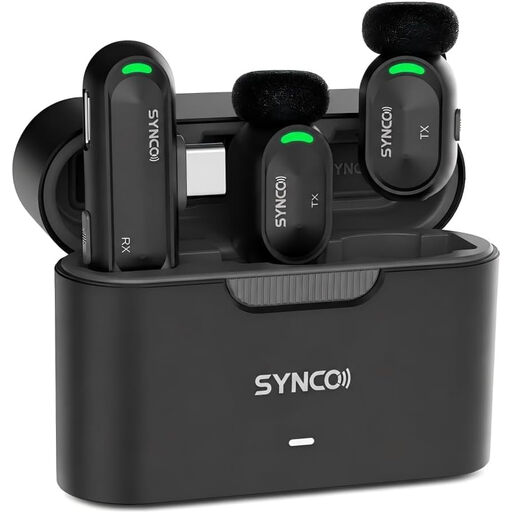
A wireless set worth considering if you want to use two transmitters. Check that the receiver you choose works with your computer and recording software.
The product description lists two microphones, a camera and smartphone receiver, and a charging case.
 No image available
A wireless option with a USB-C receiver. Before use, check that your computer and recording software support the connection.
 No image available
A wireless USB-C option for a compatible Android device. Before choosing it for computer recording, check that it’s suitable for your recording device and software.
 No image available
A set with two transmitters worth considering if two people will be recording. Check that the USB-C receiver works with your recording device and software.
The product name lists 2TX+1RX and a range of 150 m.
 No image available
A set with one transmitter worth considering for solo voice recording. Check that the USB-C receiver works with your recording device and software.
The product name lists 1TX+1RX and a range of 150 m.
Yes, with recording software that plays earlier tracks while you record a new one. The Audacity Manual describes this process for overdubbing. Set up your microphone and headphones correctly, and test separately to check that you can hear your own voice without distracting delay.
Listen through headphones rather than speakers, and check your input and playback settings. The Audacity Manual recommends using headphones when recording with a microphone, so the microphone doesn’t also pick up the clip being played.
Not if you use the USB connection and your computer and software are compatible. The XLR output requires a suitable analogue recording chain; check which cables and components are included with each version.
It depends on the pickup pattern and the distance between the speakers. Logitech lists multiple pickup patterns for the Yeti; make a test recording from both seating positions before relying on this setup.
Having a file stored locally doesn’t in itself give you permission to publish it. According to the Dutch government, you may generally only use someone else’s copyright-protected work with permission; a private copy for personal use must not be distributed or made public.