For recording a spoken travel diary in an untreated room, a directional dynamic USB microphone that you can position close to your mouth is a sensible starting point. However, it won’t remove echo or background noise by itself. If you often record in different places, also check the included stand and compatible cables. In a relatively quiet room, a USB condenser microphone with on-mic controls may be a good fit. Before buying, check the exact version and what’s included in the box.
Who is this guide for?
Solo speaker in an echoey room
You usually record your travel stories on your own and can speak close to a suitably positioned microphone. Placement and audible room noise both matter when choosing. For the PodMic USB, for example, RØDE recommends a speaking distance of around 5–10 cm.
Travel diary maker who records in different places
You set up your recording equipment each time, so you’ll want to consider the stand, cables and connection, as well as how it captures your voice. Samson and Audio-Technica describe models that come with a desk stand and cables.
Creator who wants to monitor recordings as they go
You want to listen through headphones while recording and adjust settings easily. The models mentioned from Samson, Audio-Technica, Shure and Sennheiser offer different connections and controls depending on the version.
What should you look for when choosing?
Start with where you’ll be recording and how close you can comfortably speak to the microphone. Then compare what you need to carry it, connect it and monitor your recording.
| What to consider |
What should you check? |
Who is this important for? |
| Room noise and solo speech |
Check the pickup pattern and whether you can position the microphone close to your mouth. For the PodMic USB, RØDE recommends around 5–10 cm; make a test recording in the place where you’ll be recording. |
If I’m recording on my own in an untreated room, I want to capture my voice close to the microphone and hear how the room affects the sound. Around 36% of consumers prioritise reducing room noise. |
| Portability and set-up |
Check whether the exact version includes a desk stand and cables that work with your device. Samson describes the Q2U as coming with a desk stand and windscreen; Audio-Technica lists USB-C-to-USB-C and USB-C-to-USB-A cables with the ATR2100x-USB. |
If I record in different places, I want to know whether I can easily bring the stand and the right cables. Around 29% of consumers give portability and connectivity top priority. |
| Monitoring and adjusting settings |
Check whether the microphone has a headphone output and what controls are available. Samson, RØDE, Shure and Sennheiser describe these features for specific models; for the MV7+, also check the device requirements for MOTIV Mix. |
If I want to listen while recording or adjust settings, on-mic monitoring and controls are important to me. Around 21% of consumers put monitoring during recording at the top of their list. |
| Upgrading later |
Check whether the exact version has both USB and XLR. Samson, Audio-Technica, RØDE and Shure describe this for the Q2U, ATR2100x-USB, PodMic USB and MV7+; an XLR connection alone does not allow USB recording. |
If I want to record directly via USB now and may use a mixer or audio interface later, I look for both connections. Around 14% of consumers consider expandability their main buying concern. |
Buying pitfalls
-
Assuming noise reduction removes all room noise
A directional microphone still picks up sound within its pickup area. Shure explains that the MV7+’s noise reduction can tackle continuous sounds, but won’t reliably remove voices, dogs barking or keyboard clicks.
Consider the microphone alongside its placement and the room. Make a test recording where you actually plan to speak.
-
Assuming a stand mount means a complete travel set-up
A microphone that can be attached to a stand or boom arm doesn’t necessarily come with a desk stand. The described Samson and Audio-Technica packages do include one.
Check what’s in the exact box, including the stand and cables, before ordering.
-
Confusing an XLR-only model with a USB/XLR microphone
Shure distinguishes between the USB/XLR MV7 and MV7+ models and the MV7X, which has XLR only. The latter is therefore not the same as a microphone that you can connect directly via USB.
Check the full model name and whether that version actually has a USB output. An XLR set-up may require additional recording equipment.
Brands to consider
Samson
The Q2U is a dynamic USB/XLR microphone for speech. Samson describes it as suitable for use in untreated rooms.
- Samson says the Q2U has a cardioid pickup pattern, direct headphone monitoring and comes with a desk stand, windscreen and cables.
- These features apply to the Q2U version described. They don’t prove that room noise will disappear or that all Samson microphones have the same features.
Audio-Technica
The ATR2100x-USB is a handheld dynamic USB-C/XLR microphone that Audio-Technica lists in its EU range for speech and location recording.
- Audio-Technica lists a foldable desk stand and USB-C-to-USB-C and USB-C-to-USB-A cables with the version described.
- Check what’s included with the version you’re considering. The included accessories don’t prove that the microphone will reduce echo in every room.
RØDE
The PodMic USB is a dynamic USB-C/XLR microphone for speech, with focused pickup and an integrated swivel mount.
- For this model, RØDE recommends a distance of around 5–10 cm. The manufacturer also lists headphone monitoring and a pop filter.
- Check that you have a compatible stand or boom arm: the integrated mount isn’t the same as an included desk stand.
Shure
According to Shure’s Dutch product information, the MV7+ is a USB-C/XLR podcast microphone with direct monitoring and adjustable digital features.
- Shure describes features such as automatic level control and noise reduction. MOTIV Mix has device requirements.
- According to Shure Support, noise reduction won’t reliably remove voices, dogs barking or keyboard clicks. These features don’t guarantee an echo-free recording.
Sennheiser
Sennheiser describes the Profile USB as a USB-C condenser microphone with a cardioid capsule and controls for gain and monitor mix.
- Sennheiser lists an included desk stand and on-mic controls for the Profile USB.
- These features don’t show that this model handles echo in an untreated room better than a dynamic alternative.
Joybuy products
This Joybuy selection focuses on compact USB microphones for spoken travel diary recordings in different locations.
 No image available
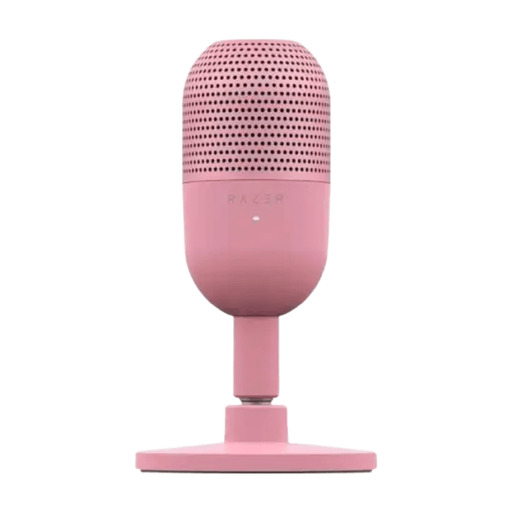
Razer SEIRÉN V3 MINI Quartz, ultra-compact USB microphone with tap-to-mute
This ultra-compact USB version is a good fit if you want to take a small microphone set-up with you for spoken recordings.
The product name specifies USB and tap-to-mute control.
Shop at Joybuy
Frequently asked questions
How should I position the microphone if the room is echoey?
Point the pickup side towards your mouth and make a test recording close to the microphone. For the PodMic USB, RØDE recommends around 5–10 cm; don’t automatically apply this model-specific distance to other microphones. Shure also recommends reducing the distance to unwanted sounds compared with the distance to your voice, and covering reflective surfaces where possible.
Do I also need an audio interface for a USB microphone?
You don’t need an audio interface to record directly via USB with the USB models described. If you later want to use the XLR output of a compatible model, check which mixer or audio interface is suitable for that set-up.
What if my new microphone doesn’t work properly?
For a consumer purchase in the Netherlands, the retailer is your point of contact if a product is faulty. The Dutch government explains that there is no fixed statutory warranty period. For an eligible online purchase from a business, you’ll generally have 14 days to change your mind, subject to the exceptions set out in government guidance.
Can I publish other people’s voices in my travel diary?
If you publish other people’s identifiable personal information publicly online, the Dutch Data Protection Authority says consent is required in most cases. Other legal grounds under the GDPR exist, as does a limited exception for use that is exclusively personal or domestic. Whether you’re allowed to record a particular conversation is a separate question: consider recording and publishing separately, and ask those involved beforehand if in doubt.


