
Student filming on the move
Films and talks at the same time, and wants a microphone that moves with them. RØDE describes clip-on transmitters for the Wireless Micro; BOYA describes the BY-DM2 as a wired USB-C lapel microphone.


If you’re walking around the room while filming, compare a wireless clip-on microphone with a USB receiver with a wired USB-C lapel microphone. Check beforehand that your device and recording app support the microphone. If you’re recording the commentary later in one place, a desktop USB microphone is better suited to that approach, and you can check the positioning and make a test recording first. The product specifications quoted are supplied by the manufacturers; they are not the result of comparative sound tests.
Films and talks at the same time, and wants a microphone that moves with them. RØDE describes clip-on transmitters for the Wireless Micro; BOYA describes the BY-DM2 as a wired USB-C lapel microphone.
Films first, then records the commentary at a desk. RØDE, Shure, Sennheiser and Audio-Technica each offer desktop USB microphones with their own positioning and control features.
Wants to start with a straightforward set-up and mainly checks that the microphone, connection and recording app work together. RØDE says the Wireless Micro app must accept USB audio; BOYA lists Android devices for the BY-DM2.
First decide whether you’ll film and speak at the same time or record the commentary later. That will determine whether freedom of movement or a fixed place to speak matters more.
| What to consider | What should you look for? | Who is this important to? |
|---|---|---|
| Freedom of movement | Choose between a wireless clip-on microphone and a wired lapel microphone; check the receiver, device and cable routing. RØDE lists smartphone and camera receivers for the Wireless Micro Camera Kit. | If I’m walking around the room while talking, I want the microphone to move with me. Consumers who put freedom of movement first account for around 36%. |
| Clear speech in the room | Make a short test recording from the position and distance you’ll be speaking at. Manufacturer claims about directional pickup or noise processing are no substitute for testing it in practice. | If I’m recording in my room, I want to hear in advance how my voice sounds alongside the sounds around me. Around 29% of consumers prioritise speech clarity where they’re recording. |
| Connection and app | Check your device’s connection and whether your recording app accepts USB audio. RØDE mentions app support for the receiver; BOYA describes the BY-DM2 as a USB-C option for Android devices. | If I want to record without a complicated set-up, the microphone needs to work with my device and app. Consumers who make this their main priority account for around 21%. |
| Checking your recording | Check the exact version, the connections included and the headphone controls you need. RØDE and Sennheiser describe headphone features for their desktop USB microphones. | If I want to listen back after recording and keep the controls within easy reach, I also check what comes with the version I’ve chosen. Around 14% of consumers give checking recordings and having the necessary components top priority. |
The receiver on the RØDE Wireless Micro sends audio to a recording device and an app that accepts USB audio; it doesn’t record your tour by itself.
Before buying, check your device, the version of the kit you’ve chosen and your recording app. Then record a short test video and listen back to it.
A microphone on a desk stays put while you walk around the room. That’s a different set-up from a microphone you wear.
First decide whether you’ll speak live or record a voiceover later. For filming on the move, choose a microphone set-up that moves with you, or record the commentary later at a desk.
Shure describes processing features for the MV6, but the manufacturer’s information doesn’t prove how a recording will sound in your room.
Test it at the speaking distance you’ll actually use and listen back to the recording before filming the whole tour.
RØDE offers both a wireless option for filming on the move and desktop USB microphones for recording a voiceover in one place.
BOYA describes the BY-DM2 as a wired USB-C lapel microphone for compatible Android devices.
The MV6 is a desktop USB microphone for recording in one place.
The Profile is designed for recording in one place when you want to control the microphone directly.
The AT2020USB-X is a desktop option for recording a voiceover in one place.
These wireless clip-on microphones with USB-C receivers are options for anyone moving around the room while filming. Check that each model’s connection and recording app are compatible with your device.
 No image available
Suitable for filming on the move with a compatible smartphone or camera; also check that your smartphone app accepts USB audio.
The kit is listed as including two transmitters, a USB-C smartphone receiver and a camera receiver.
 No image available
A wireless USB-C lavalier option to compare if you move while filming; check that the receiver works with your device.
The product information lists clip-on transmitters and a USB-C receiver.
According to the description, the stated range of up to 150 m applies in open areas.
 No image available
The clip-on set-up suits a recording where the microphones move with the speakers; check your device’s USB-C connection.
The product name lists two transmitters and one receiver.
According to the description, the stated range of up to 150 m applies in open areas.
 No image available
A wireless clip-on option for a speaker who moves while recording; check that the USB-C receiver is compatible with your device.
The product name lists one transmitter and one receiver.
According to the description, the stated range of up to 150 m applies in open areas.
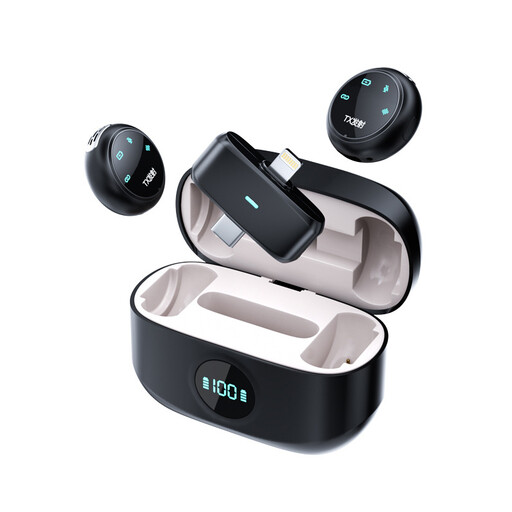 No image available
The wireless clip-on set-up is designed to move with the speaker; check which connection is compatible with your recording device.
The product name lists two microphones and compatibility with iOS and Type-C interfaces.
A desktop USB microphone stays in one place and won’t move with you. If you’re walking and talking at the same time, compare a wearable microphone set-up that works with your recording device. With a desktop microphone, you can record the commentary later in one place.
Check that your recording app accepts USB audio and make a short test video after connecting the microphone. Listen back before recording the whole tour; having a compatible plug alone doesn’t confirm that the app is using the microphone’s signal.
For a wireless set, check that the transmitters and any charging case have enough charge, and make sure your clothing isn’t covering the microphone. With a wired microphone, route the cable safely and make another short test recording.
Not without taking a few steps first. The Dutch Data Protection Authority says that consent is generally required to publish identifiable people on social media. Ask for consent beforehand, or remove or blur identifiable footage before publishing.
For many distance purchases from a business, consumers have a 14-day cooling-off period; this doesn’t apply to purchases from a private seller. You also have rights to a repair or replacement if a product is faulty. The Dutch government outlines these consumer rights. Check the terms of your specific purchase and report any fault to the seller.